
We remember it as the birthplace of the modern medical gaze: the steep wooden funnel where Europe first learned to trust the evidence of its own eyes. Its own age called it something plainer, and felt no shame in the word. It called it a theatre, laid out to the plan of the Roman arena, lit by candles in the dead of winter, and playing in its leading role the body of a hanged man.
Built to the plan of the arena
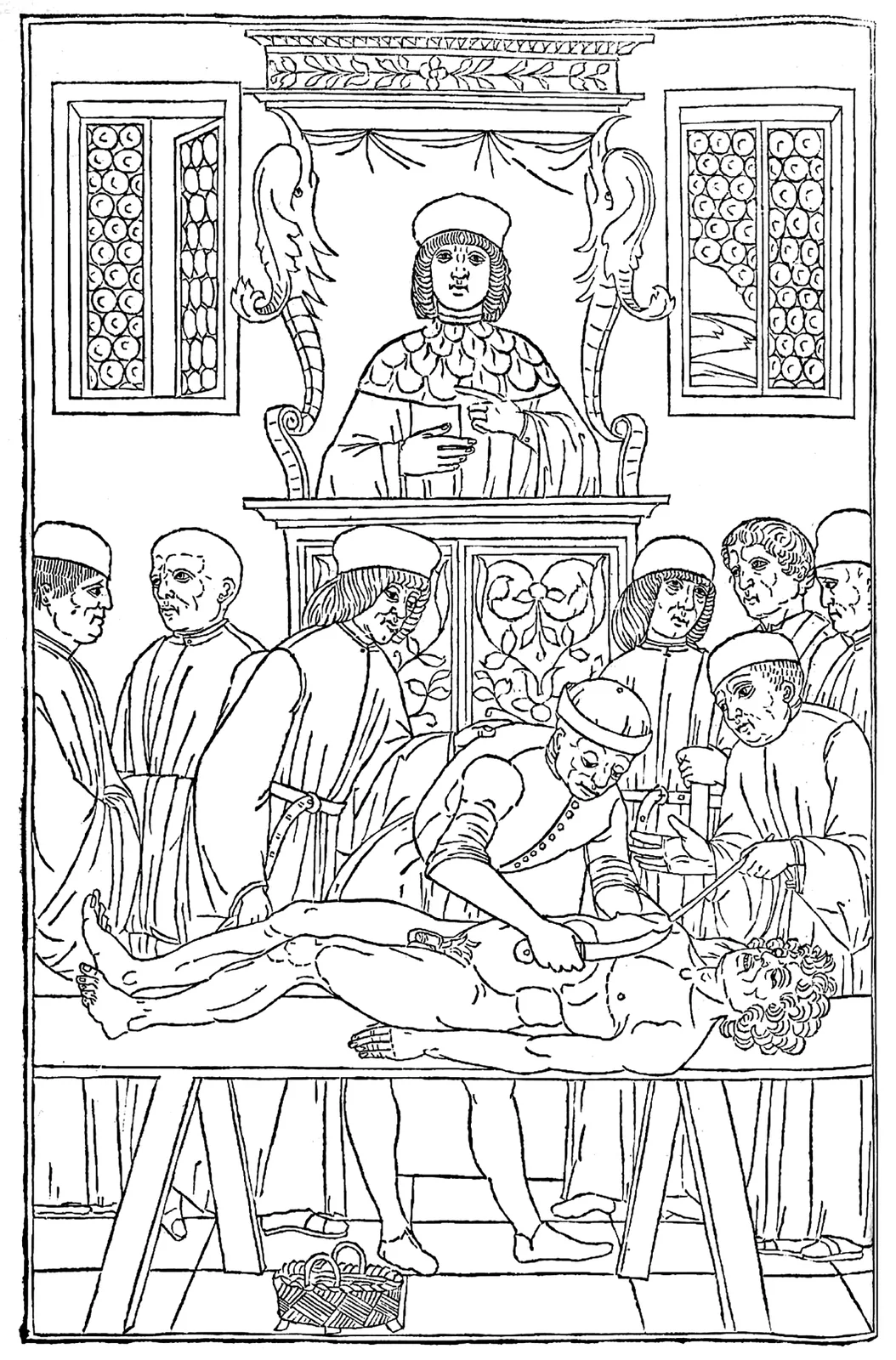
When Andreas Vesalius composed the title page of his Fabrica in 1543, he set the dissection inside a crowded wooden amphitheatre, and the staging was not an ornament.1 The room where the dead were opened was, in the most literal sense, a theatre: a place built so that an audience might watch. Half a century before, the Veronese-born physician Alessandro Benedetti had already described the ideal setting for a public dissection as a temporary structure raised after the manner of the arenas at Rome and Verona, its seats banked in a ring so that every spectator looked down upon the single table at the centre.2 The corpse would lie where the gladiator had once stood.
For most of the sixteenth century these theatres were temporary things, scaffolds knocked together for the dissecting season and taken down when it closed. Then, within a single year, two were made to last. At Leiden in 1594 the anatomist Pieter Pauw fitted one into the shell of a former church; at Padua in the same year Girolamo Fabrici d'Acquapendente, called Fabricius, raised the tall wooden cone that stands to this day, the oldest surviving anatomy theatre in the world.3 It is an extraordinary instrument for looking. Six elliptical galleries climb almost sheer around a small floor; some two hundred and fifty people could crowd the rings, standing, none of them far from the table, every eye running down the funnel to the one lit body at the bottom.4 There were no windows. The work was done by candle and lantern, in the cold months when the flesh would keep.
The crowd it gathered reached well beyond the medical. Public anatomies were ticketed occasions, announced in advance and attended by magistrates, noblemen and the merely curious; at Bologna they were deliberately woven into the revels of Carnival, staged with music and paid admission, so that the opening of a human body took its place among the diversions of the season.5 The historian Giovanna Ferrari has shown that this was policy rather than accident: the spectacle was arranged to fill the seats.
Supplied by the scaffold
There was one thing the theatre could not manufacture, and that was its leading player. A public dissection required a fresh human body, and the law would furnish only one kind: the body of a person the state had put to death. In the Italian cities where the theatres first rose, custom and statute alike restricted the anatomist to the executed criminal, and a stranger was preferred, someone with no kin in the city to lodge a complaint.6 The dissecting table sat at the end of a road that began beneath the gallows.
This coupling was not incidental. Across much of Europe dissection was written into the sentence itself, a punishment inflicted after death and meant to be dreaded. When the English Parliament passed the Murder Act of 1752, it directed that the corpse of a hanged murderer should never be buried whole, but either hung in chains or given over to the surgeons, so that "some further Terror and peculiar Mark of Infamy" might be added to the penalty of death.7 In London the bodies were carried to Surgeons' Hall beside the Old Bailey and opened there, in the lecture theatre, before whatever crowd could press inside.8 To be anatomised was to be punished a second time, once in the flesh and once in the memory. The theatre of anatomy and the theatre of the scaffold were a single civic performance, drawing on one supply and teaching two lessons together: how the body is built, and what the sovereign may do to it.
The hunger of the theatres always outran the gallows. Where the law came up short, others made up the difference. The resurrection-men robbed fresh graves for the private schools, and at length the Anatomy Act of 1832 quietly turned the trade from the criminal to the pauper, handing the surgeons the unclaimed bodies of the workhouse dead.9 The table was seldom without the poor for long.
Know thyself
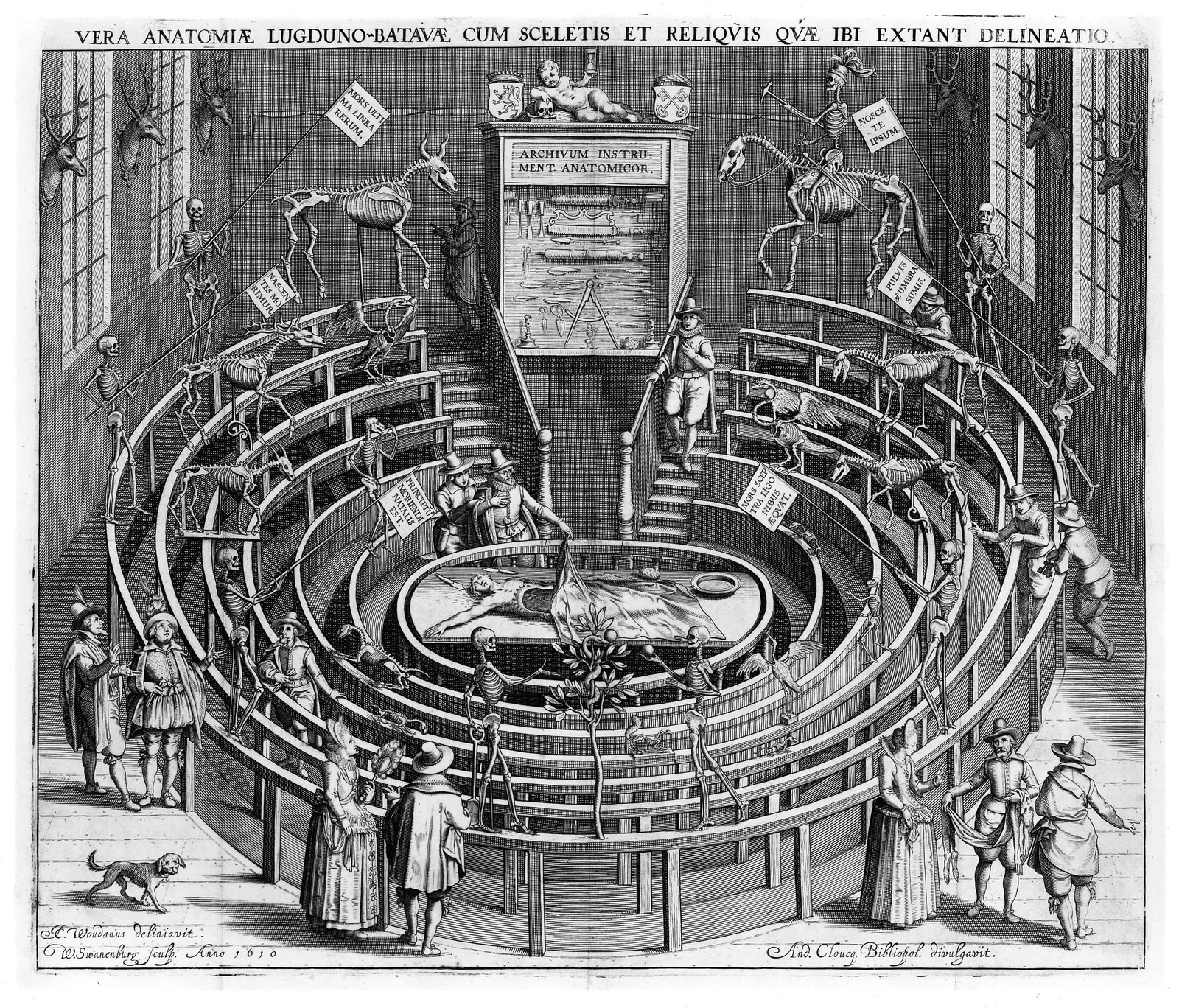
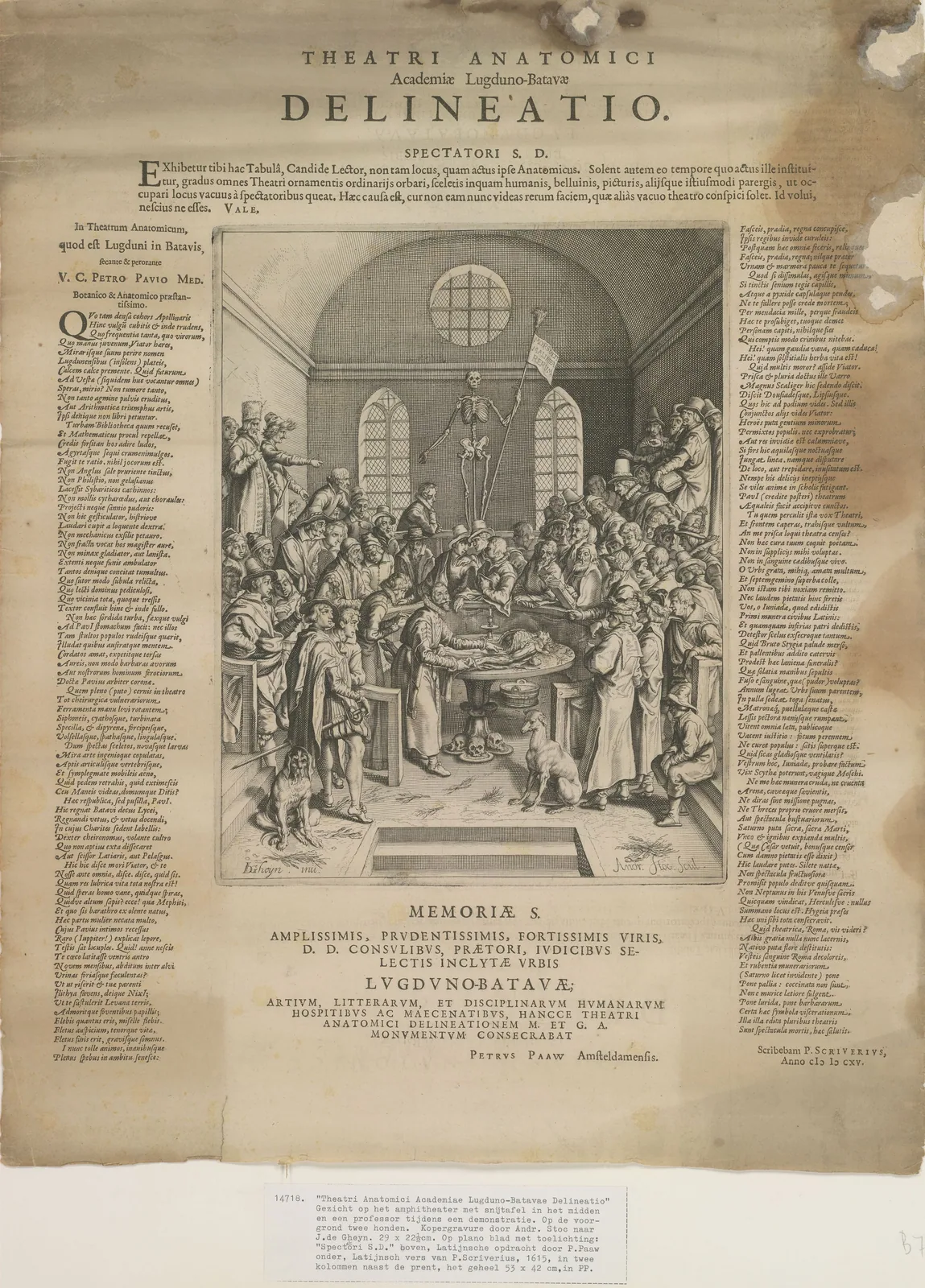
Had the lesson been anatomical alone, the theatres would have resembled laboratories. They resembled something else. Out of season, Pauw's theatre at Leiden became a museum of the dead. Articulated skeletons were stood about the galleries holding little banners: one lettered Mors ultima linea rerum, death the last boundary of things; another Pulvis et umbra sumus, we are dust and shadow; a third Nosce te ipsum, know thyself.10 Among them the university laid out its wonders: Egyptian mummies, Roman coins, the skins of far-off animals, a whole cabinet of the world's strangeness, and travellers paid their fee to walk through it as through any marvel of the town.11 The body on the table was an object of knowledge and, in the same breath, a homily. You came to learn where the liver lay; a skeleton with a flag reminded you that you would shortly be one yourself.
Dr Tulp's audience
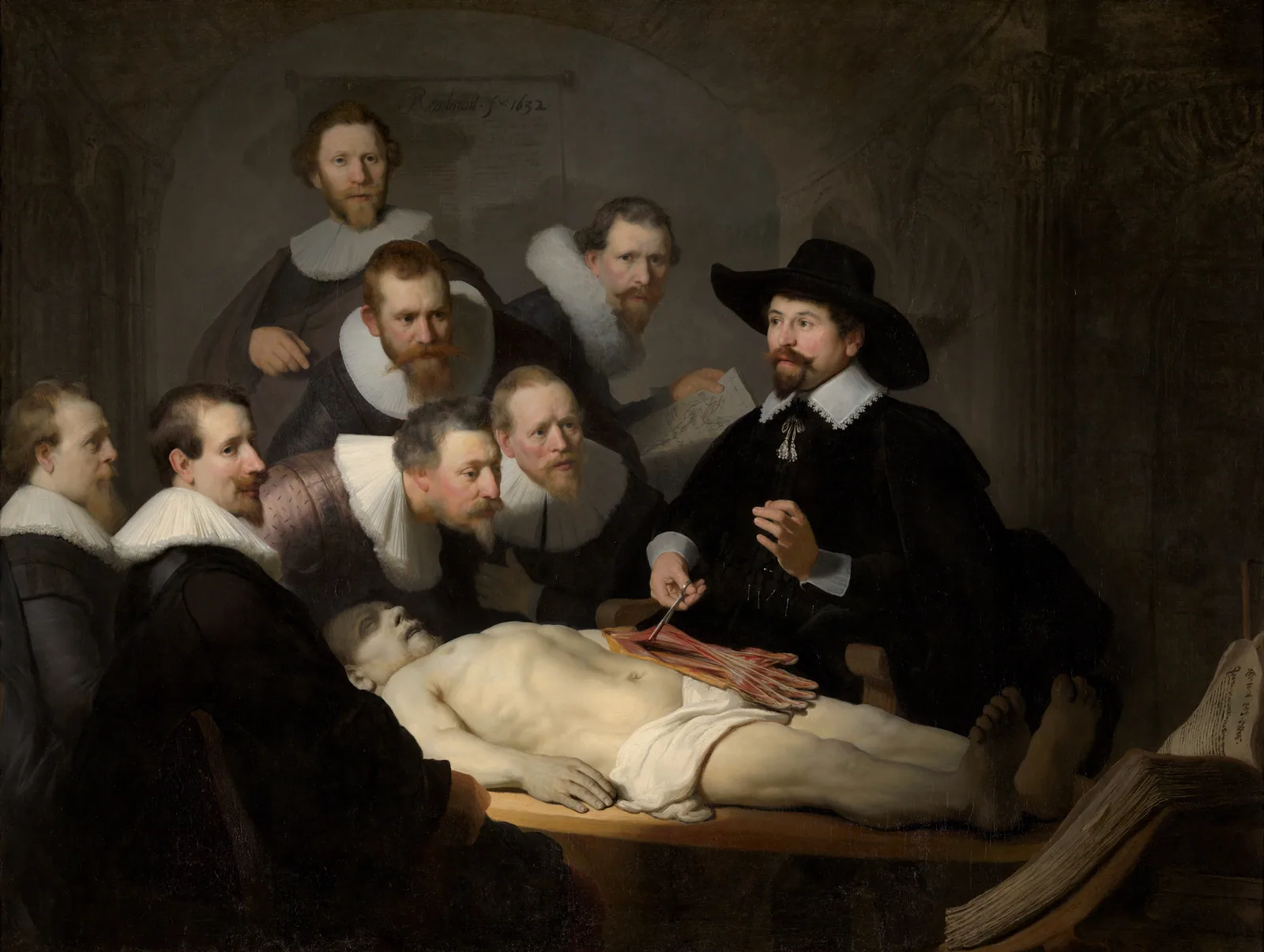
The most famous image of the theatre holds exactly this doubleness, though we seldom read it so. In January 1632 the Amsterdam guild of surgeons held its yearly public anatomy, and the young Rembrandt was engaged to paint it.12 The picture we call The Anatomy Lesson of Dr Nicolaes Tulp is admired as a marvel of light and gathered attention: seven surgeons leaning in as the praelector raises the tendons of a forearm on his forceps. What is said less often is how it came to be made. Each of the seven living men paid for his place in the canvas, the more prominent positions costing more; the painting is, among its other virtues, a receipt.13 Only one figure did not choose to be there. He had a name, Adriaen Adriaenszoon, known as Aris Kindt, and a history: a hardened thief, hanged that very day for a violent robbery, he and an accomplice having set upon a man to take his cloak and sword. His body was made over to the guild because the law permitted it.14 The living men gaze at the book, or out at us, composed for posterity. The dead man, grey-green in Rembrandt's light, is the occasion of their portrait and the only person in the room whose leave was never asked.
Read from the Ward
In the hospital where I trained, the room where surgeons work is called the theatre. We say that a patient has gone to theatre, that a colleague is in theatre, and no one hears anything strange in it. The word is a fossil, carried down five centuries from the wooden funnels of Padua and Leiden, and it keeps a memory most of us would rather mislay: that medicine learned its craft as a performance, watched from banked seats, and in some form still does.
We no longer sell tickets, and the bodies are given now rather than taken. Yet the shape of the old theatre survives wherever we gather to learn from a single body before an audience. It survives in the morning teaching round, the consultant at the centre and the students ranked behind. It survives most exactly in the two rituals my working week is still built upon: the mortality meeting, where a death is laid open in a lecture room and turned over by the whole department in turn; and the older clinicopathological conference, where a physician reasons aloud through a case in public, and only then is the pathologist's verdict, the true condition of the organs, disclosed. These are anatomy theatres with the knives put away. The lesson is still drawn from one body, in the open, in a room shaped so that everyone can see.
What has changed beyond recognition is whose body it is. Padua and Bologna ran on the condemned; the dissecting room where I first met the human interior ran on the gift of a stranger who had willed us the use of their body, and whom we were taught to treat, in death as in life, as a teacher. That passage from the criminal to the donor, from the body seized as punishment to the body offered as a gift, is to my mind the quiet moral centre of modern medicine, more than any drug or machine it owns. It is also a fragile thing. The gaze the theatre was built to concentrate is a genuine power, and it has never been neutral. To be the body on the table is to be looked at by people whose names will be remembered when yours is not.
Fabricius's theatre at Padua is still there, and you can climb into it. The galleries are dark and impossibly steep, the floor at the bottom no wider than a dinner table, and the guides will tell you that William Harvey once stood in those rings as a student, watching, before he carried home to England the question of where the blood goes.15 What they do not tell you, because the theatre never recorded it, is who lay on the table while he watched: some hanged man out of the Paduan winter, nameless now, whose opened body was the first lesson of the century that would, in the end, learn to keep men like him alive. The seats are empty. The word we took from that room is not.
- On the Fabrica title page as a staged public dissection in a crowded amphitheatre, and on the frontispiece as an argument in itself, see J. B. deC. M. Saunders and Charles D. O'Malley, The Illustrations from the Works of Andreas Vesalius of Brussels (Cleveland: World Publishing, 1950), commentary on the title page; and, in this series, "De Humani Corporis Fabrica."↩
- On Alessandro Benedetti's description of a temporary anatomical theatre built after the model of the Roman arenas at Rome and Verona, see Benedetti, Historia corporis humani sive Anatomice (Venice, 1502), bk. 1; and the discussion in Andrea Carlino, Books of the Body: Anatomical Ritual and Renaissance Learning, trans. John Tedeschi and Anne C. Tedeschi (Chicago: University of Chicago Press, 1999); and Andrew Cunningham, The Anatomical Renaissance (Aldershot: Scolar Press, 1997).↩
- On the permanent theatres at Leiden (Pieter Pauw, 1594) and Padua (Fabricius, 1594), the latter the oldest to survive, see Cynthia Klestinec, Theaters of Anatomy: Students, Teachers, and Traditions of Dissection in Renaissance Venice (Baltimore: Johns Hopkins University Press, 2011); and Andrea Porzionato et al., "The Anatomical School of Padua," The Anatomical Record 295, no. 6 (2012): 902–916.↩
- On the form of the Padua theatre — six elliptical galleries, standing room for roughly two hundred and fifty, all close to the central table, worked by candlelight — see Klestinec, Theaters of Anatomy; and Porzionato et al., "The Anatomical School of Padua."↩
- On the deliberate scheduling of Bologna's public anatomies within Carnival, and the fusion of festivity and dissection as a means of drawing audiences, see Giovanna Ferrari, "Public Anatomy Lessons and the Carnival: The Anatomy Theatre of Bologna," Past & Present 117 (1987): 50–106.↩
- On the legal and customary restriction of dissection to the bodies of executed criminals in Renaissance Italy, with a preference for those without local kin, see Carlino, Books of the Body, chaps. 2–3.↩
- The Murder Act of 1752 (25 Geo. II c. 37) required that the body of an executed murderer be either hung in chains or delivered to the surgeons for dissection, so that "some further Terror and peculiar Mark of Infamy" be added to the sentence. On the Act and the wider link between capital punishment and dissection, see Ruth Richardson, Death, Dissection and the Destitute (London: Routledge & Kegan Paul, 1987), chap. 1.↩
- On the public anatomisation of hanged murderers at Surgeons' Hall by the Old Bailey, see Richardson, Death, Dissection and the Destitute, chap. 1; and Peter Linebaugh, "The Tyburn Riot against the Surgeons," in Douglas Hay et al., Albion's Fatal Tree (London: Allen Lane, 1975).↩
- On the shortfall of legal cadavers, the resurrection-men, and the Anatomy Act of 1832 that redirected supply to the unclaimed bodies of the poor, see Richardson, Death, Dissection and the Destitute, chaps. 3–8.↩
- On the skeletons and their memento mori banners in the Leiden theatre out of season — among them Mors ultima linea rerum and Nosce te ipsum, legible in the engraving by Willem Swanenburg after Jan van 't Woudt (1610) and the design by Jacques de Gheyn II — see Cynthia Klestinec, Theaters of Anatomy; and Jonathan Sawday, The Body Emblazoned: Dissection and the Human Body in Renaissance Culture (London: Routledge, 1995).↩
- On the Leiden theatre as a cabinet of curiosities and a paying tourist attraction, see Sawday, The Body Emblazoned; and Klestinec, Theaters of Anatomy.↩
- On the commission of Rembrandt's Anatomy Lesson of Dr Nicolaes Tulp for the Amsterdam guild of surgeons' anatomy of January 1632, see William Schupbach, The Paradox of Rembrandt's "Anatomy of Dr Tulp," Medical History Supplement 2 (London: Wellcome Institute for the History of Medicine, 1982).↩
- On the surgeons' payment for inclusion in the group portrait, see Schupbach, Paradox.↩
- On the identity of the cadaver — Adriaen Adriaenszoon, called Aris Kindt, hanged for theft on the day of the dissection and given to the guild — see Schupbach, Paradox.↩
- On William Harvey's attendance at dissections in the Padua theatre as a student (c. 1600–1602) under Fabricius, see Porzionato et al., "The Anatomical School of Padua"; and Klestinec, Theaters of Anatomy.↩
- Chicago
Kim, D. Y. “The Theatre of Anatomy.” Codex Chronica, July 2, 2026. https://codexchronica.com/the-theatre-of-anatomy/.
- APA
Kim, D. Y. (2026, July 2). The Theatre of Anatomy. Codex Chronica. https://codexchronica.com/the-theatre-of-anatomy/
- Benedetti, Alessandro. Historia corporis humani sive Anatomice. Venice, 1502.
- Carlino, Andrea. Books of the Body: Anatomical Ritual and Renaissance Learning. Translated by John Tedeschi and Anne C. Tedeschi. Chicago: University of Chicago Press, 1999.
- Cunningham, Andrew. The Anatomical Renaissance: The Resurrection of the Anatomical Projects of the Ancients. Aldershot: Scolar Press, 1997.
- Ferrari, Giovanna. "Public Anatomy Lessons and the Carnival: The Anatomy Theatre of Bologna." Past & Present 117 (1987): 50–106.
- Klestinec, Cynthia. Theaters of Anatomy: Students, Teachers, and Traditions of Dissection in Renaissance Venice. Baltimore: Johns Hopkins University Press, 2011.
- Linebaugh, Peter. "The Tyburn Riot against the Surgeons." In Douglas Hay, Peter Linebaugh, John G. Rule, E. P. Thompson, and Cal Winslow, Albion's Fatal Tree: Crime and Society in Eighteenth-Century England. London: Allen Lane, 1975.
- Porzionato, Andrea, Veronica Macchi, Carla Stecco, et al. "The Anatomical School of Padua." The Anatomical Record 295, no. 6 (2012): 902–916.
- Richardson, Ruth. Death, Dissection and the Destitute. London: Routledge & Kegan Paul, 1987.
- Saunders, J. B. deC. M., and Charles D. O'Malley. The Illustrations from the Works of Andreas Vesalius of Brussels. Cleveland: World Publishing, 1950.
- Sawday, Jonathan. The Body Emblazoned: Dissection and the Human Body in Renaissance Culture. London: Routledge, 1995.
- Schupbach, William. The Paradox of Rembrandt's "Anatomy of Dr Tulp." Medical History Supplement 2. London: Wellcome Institute for the History of Medicine, 1982.