
In the summer of 1543 a Flemish anatomist of twenty-eight, lecturing at Padua, finished a book that broke with thirteen centuries of medicine on a single, deceptively simple instruction: do not take the body on another man's word — see it for yourself. The book was exact, magnificent, and revolutionary. It could not quite bring its own author to disbelieve the master it had been written to overthrow.
The chair and the knife
For more than a thousand years, a dissection was a kind of reading. The professor sat enthroned above the room, the lector, and read aloud from Galen in Latin; below him a demonstrator, the ostensor, pointed with a wand to the part under discussion; and lower still a barber-surgeon, the sector, did the actual cutting, his hands in the body while the learned men kept theirs clean.1 Knowledge descended from the text. The corpse on the table was not the source of the lesson but its illustration, opened to confirm what the book had already settled.
The book was always Galen's. Galen of Pergamon, physician in the second century to gladiators and to emperors, had written the human interior into a system so complete that to know anatomy was simply to know Galen. But Galen had laboured under a Roman proscription against opening the human dead, and had built his account from the bodies he could open (Barbary apes, pigs, dogs, oxen), reasoning from the animal to the man.2 Almost never, and perhaps never, did he dissect a human being. For thirteen hundred years the error was invisible, because no one was looking; they were reading.
Autopsia
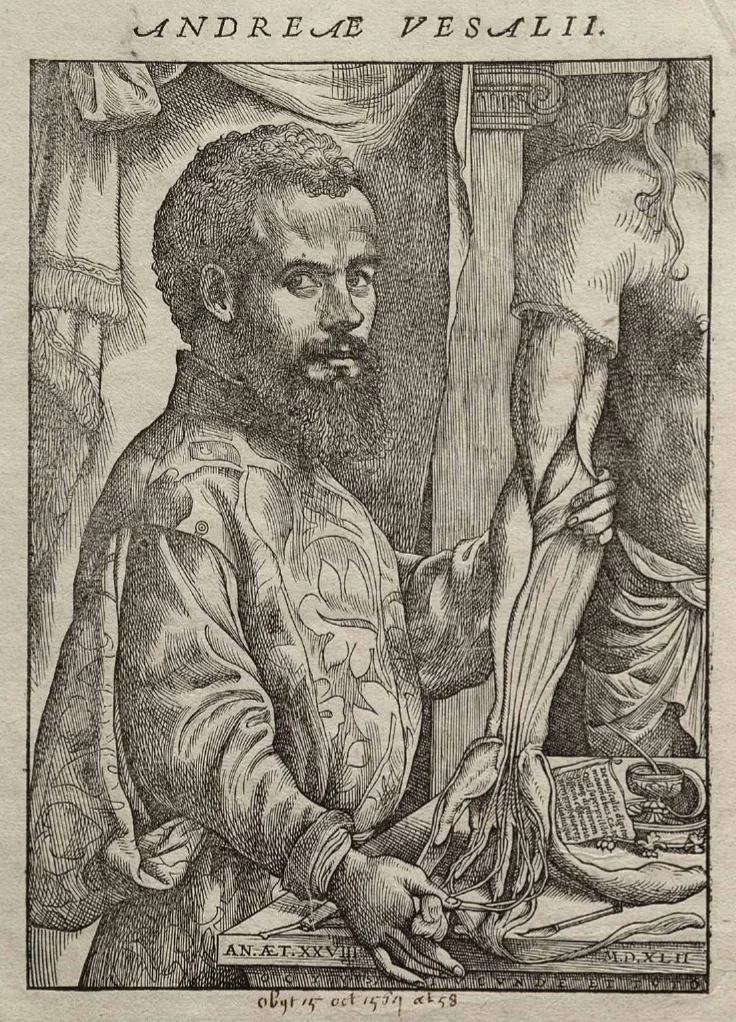
Andreas Vesalius was born in Brussels in 1514 into a line of physicians and apothecaries to the Habsburg court; his father served Charles V. He trained in Paris under Jacobus Sylvius, a Galenist of ferocious loyalty, and took his doctorate at Padua in 1537, where on the same day, at twenty-three, he was made lecturer in surgery.3 His revolution, when it came, was almost rude in its simplicity. He came down from the chair and took the knife himself.
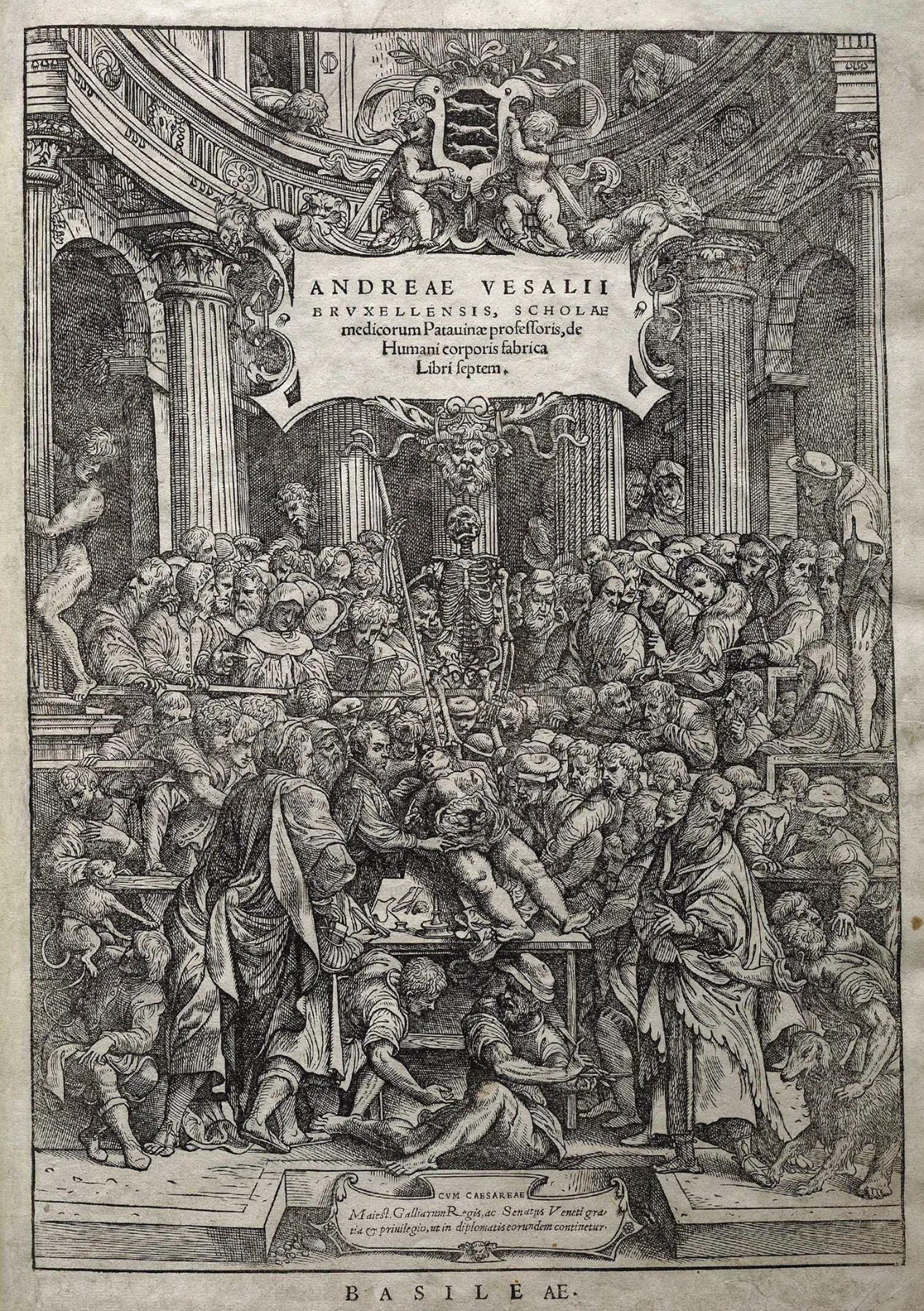
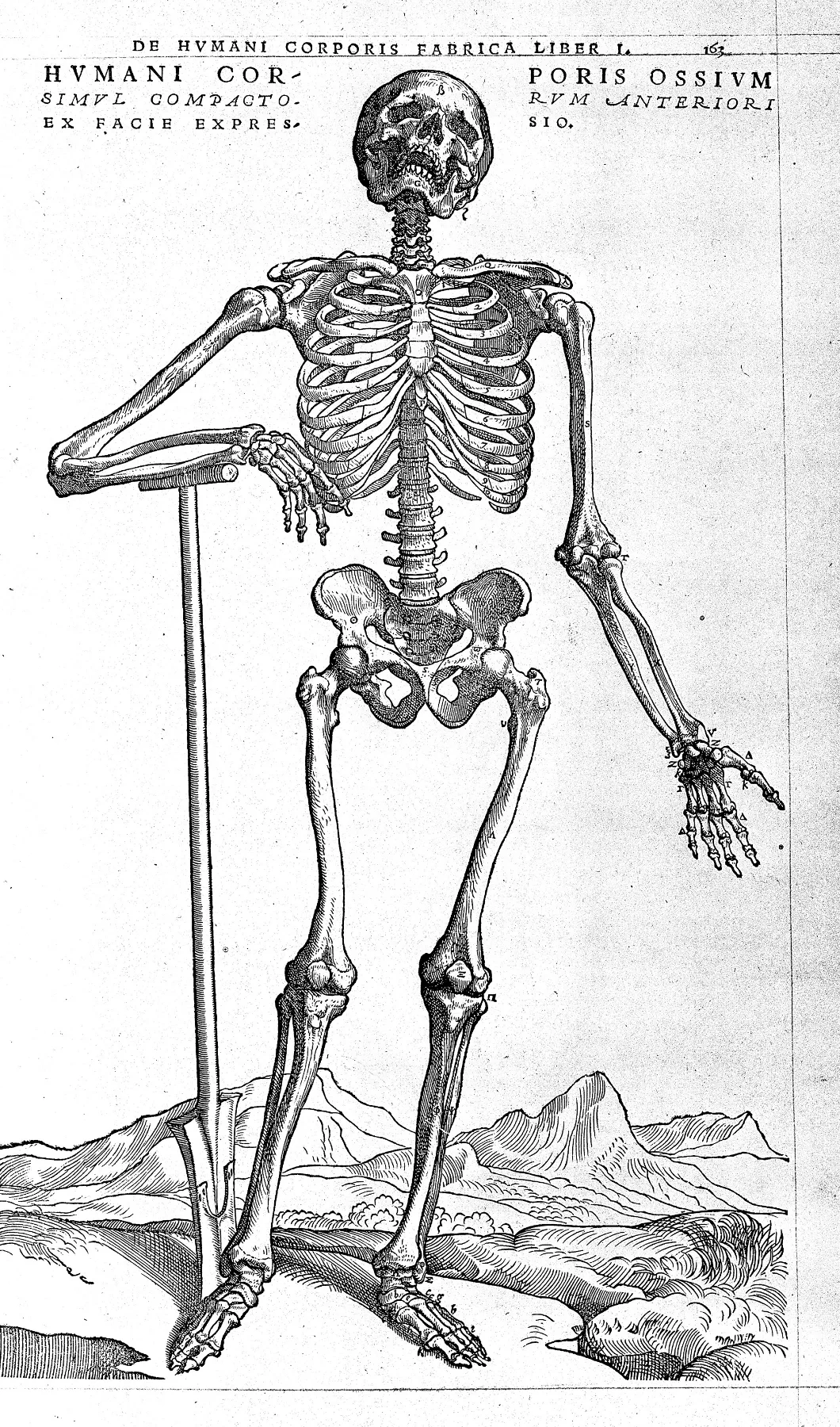
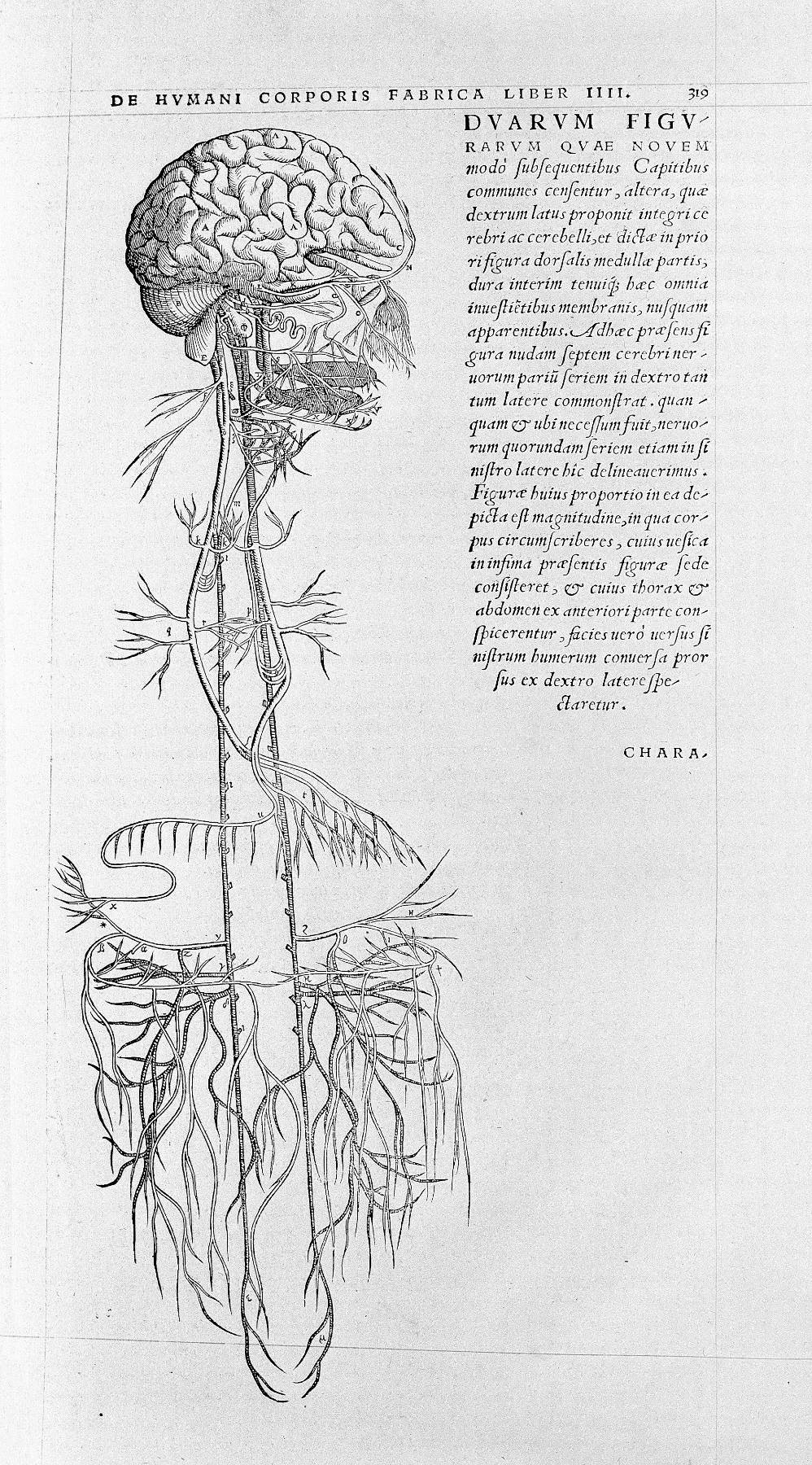
The Greek word for the principle is autopsia, the act of seeing with one's own eyes. The Fabrica, printed in 1543, is that principle built out into seven books: the body raised up from its most durable parts to its most secret, the bones first, then the muscles, the veins and arteries, the nerves, the organs of the belly, the heart and lungs, and last the brain.4 Its title page is the whole argument in one image. There is no professor aloft with a text. There is Vesalius at the centre of a crowded wooden amphitheatre, his own hands inside the opened abdomen of a woman, some seventy spectators banked around him, a skeleton presiding above the scene like a new kind of authority.5 And at the edges, half lost in the press of bodies, a dog and an ape — the animals from whom Galen had taken the human form, brought along as witnesses to the correction about to be made.
Where the body disagreed with the book
The corrections came in their hundreds. The human lower jaw is a single bone, not the two that Galen had described from the mouth of a dog. The breastbone has three segments in a grown man, not the seven of the ape.6 The rete mirabile, the “marvellous net” of vessels that Galen had set at the base of the brain and made the very organ of the soul (the place where the vital spirit was distilled into the animal spirit that ran the nerves), is real in the ox and the sheep, and is simply not there in us.7 By one modern reckoning the Fabrica parts company with Galen on more than two hundred points of fact.8
Vesalius did not begin as an iconoclast. He revered Galen, said so in print, and held that the ancient had been the greatest of anatomists. But he had seen the one thing that undid the whole edifice: that wherever Galen's anatomy and the human cadaver disagreed, it was because Galen had been faithfully describing an animal. The authority of thirteen centuries turned out to rest on a category error, and all it had ever taken to see it was to look.
The pores that were not there
And yet the man who taught Europe to trust the body over the book could not always do it himself. Consider the heart. Galen's physiology required blood to cross from the right chamber to the left; but the wall between them, the septum, is thick and solid muscle, and to get the blood through it Galen had posited pores — passages too fine for the eye. Vesalius opened heart after heart and could not find them. Here was the perfect occasion for see for yourself to do its work.
Instead, in 1543, he wrote one of the most revealing sentences in the history of his science. He did not say Galen was wrong. He wrote that we are driven to wonder at “the handiwork of the Almighty, by means of which the blood sweats from the right into the left ventricle through passages which escape the human vision.” He had the evidence of his own eyes, and he dressed his doubt in a compliment to God. Only in the second edition, in 1555, after twelve more years at the table, did he set it down plainly, that “none, so far as can be perceived by the senses, passes through the septum of the heart from the right ventricle into the left.” The founder of the new anatomy needed a decade of nerve to believe what he had already seen. It is the most human thing about him, and the most instructive — that the hardest authority to cut away is not the one in the book but the one already lodged behind your own eyes. Following the blood the whole way round would take another lifetime, and another man, in another century.
A revolution printed and painted
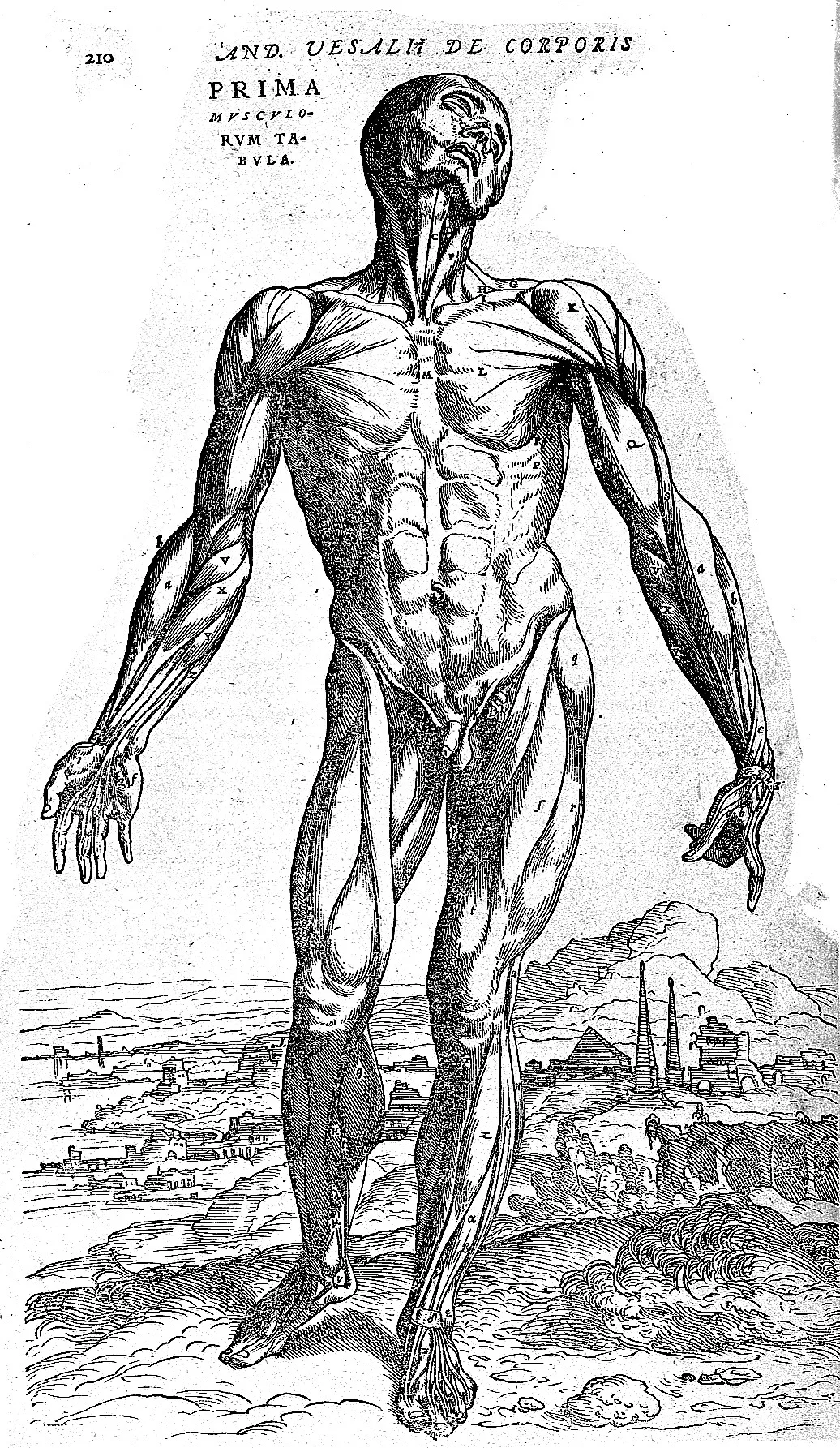
There is a second thing the legend omits, which is that the scalpel did not win this alone. The Fabrica overthrew Galen because it was, before it was anything else, the most beautiful scientific book yet made. Its figures, above all the “muscle-men,” flayed bodies that stand and stride across the pages and are peeled one layer deeper on each successive leaf, came out of the Venetian workshop of Titian, and have been credited for centuries to his pupil Jan Stephan van Calcar; though modern scholars are no longer sure, and may never be, whose hands actually drew them.11 Stand the muscle-men in a row and their backgrounds join into a single continuous landscape of hills and ruins — long taken for the country around Padua, although the aqueducts and pyramids scattered through it answer to no real place.12
None of this was decoration. The blocks were cut, the type was set in Basel by Johannes Oporinus, and more than two hundred and fifty images were carried over the Alps to be printed.13 Vesalius chose a woman's body for his title page, harder to procure and freighted with the old promise of the “secrets of women,” and staged the frontispiece as a piece of theatre. What persuaded Europe to look again was not the dissection only, but the dissection made gorgeous, multiplied by the press, and sold. The new authority of the eye was established, in no small part, by a brilliant act of art direction.
Read from the Ward
The first anatomy I trust each morning is not a body but a picture of one. A study comes up on the workstation: a slice through a skull, a window cut through a chest. I read the living interior off a screen in shades of grey, the same structures Vesalius cut by hand to find. We still learn the body from the dead in order to act on the living: every physician I know first met the human interior in a dissection room, on a donor who had willed us the use of their last privacy. The Fabrica is five hundred years old, and I work inside its argument every day. When the chart and the patient disagree, I am to believe the patient. That is autopsia, brought to the bedside and made routine.
But the part I find I cannot put down is the septum, and the pores that were not there. Because the failure was not a failure of looking: Vesalius looked, and looked well. It was a failure of believing what he saw against what he had been taught, and that failure has not gone anywhere. It has clinical names now: anchoring, premature closure, the diagnosis you settle on early and then defend against the evidence. The mistake Vesalius made with the heart in 1543 is the one I am warned against on every shift, because it is the easiest one in medicine to make — to trust the remembered authority over the body in front of you. He is not a cautionary figure in this. He is the ordinary case, drawn large.
And there is the atlas itself, the thing he gave us. An atlas shows a body: single, canonical, beautifully labelled, the artery exactly where the artery belongs. The patient on the table is this body — a variant, with the vessel running where the book swears it does not, the nerve a finger's breadth from where I reached for it. Vesalius handed medicine its first true map of itself and, in the same motion, the discipline that keeps the map honest: the standing knowledge that the map is not the patient, and that the moment you forget the difference is the moment you stop seeing.
The original blocks from which those figures were printed survived for four hundred years. They were kept, near the end, in a library in Munich, and one night in 1944 they burned with the city. What the fire could not reach was the smaller and stranger thing the book had set loose — the instruction a young man cut into the imagination of medicine, and that I carry, without thinking, to the next bed in the row. Do not take it on my word. Put your hand in. See for yourself.
- On the late-medieval and early-Renaissance dissection as a textual ritual divided among lecturer (lector), demonstrator (ostensor) and barber-surgeon (sector), and Vesalius's collapse of the three roles into one, see Andrew Cunningham, The Anatomical Renaissance (Aldershot: Scolar Press, 1997); and C. D. O'Malley, Andreas Vesalius of Brussels, 1514–1564 (Berkeley: University of California Press, 1964), chaps. 3–4.↩
- On Galen's reliance on animal dissection — Barbary apes, pigs, dogs, oxen — under the Roman proscription of human dissection, and the consequent transfer of animal structures to the human body, see Vivian Nutton, Ancient Medicine, 2nd ed. (London: Routledge, 2013), chaps. 15–17.↩
- On Vesalius's birth (Brussels, 1514) into a family of court physicians, his training in Paris under Jacobus Sylvius, and his doctorate and appointment as lecturer in surgery at Padua in 1537, see O'Malley, Andreas Vesalius, chaps. 1–3.↩
- On the programme of the Fabrica — the anatomist must use his own hands and eyes rather than defer to the text — set out in the preface dedicated to Charles V, and on the order of its seven books, see Andreas Vesalius, De humani corporis fabrica libri septem (Basel: Oporinus, 1543), preface; and Daniel H. Garrison and Malcolm H. Hast, trans., The Fabric of the Human Body: An Annotated Translation of the 1543 and 1555 Editions (Basel: Karger, 2014).↩
- On the frontispiece — Vesalius central with a female cadaver, the crowded amphitheatre, the presiding skeleton, and the dog and ape that allude to Galen's animal sources — see J. B. deC. M. Saunders and Charles D. O'Malley, The Illustrations from the Works of Andreas Vesalius of Brussels (Cleveland: World Publishing, 1950), commentary on the title page.↩
- On the single human mandible (against Galen's two, from the dog) and the three-part adult sternum (against Galen's seven, from the ape), see O'Malley, Andreas Vesalius, chap. 6; and Garrison and Hast, Fabric of the Human Body.↩
- On the rete mirabile — present in ungulates such as the ox and sheep, absent in the human, yet central to Galen's physiology of the spirits — and Vesalius's report that he could not find it in man, see O'Malley, Andreas Vesalius, chap. 6; and Nutton, Ancient Medicine, chap. 17.↩
- The figure of “more than two hundred” corrections is a modern summary count and varies with how one tallies; on the scope of Vesalius's departures from Galen, especially in the musculoskeletal anatomy, see O'Malley, Andreas Vesalius, chap. 6, and the secondary literature surveyed there.↩
- Vesalius, Fabrica (1543), Book VI, on the interventricular septum: the reader is urged to wonder at the handiwork of the Almighty, by means of which the blood is made to “sweat” from the right ventricle into the left through passages “which escape the human vision.” The English follows the standard translation widely reproduced in the cardiological and history-of-medicine literature; for the 1543 and 1555 texts in parallel see Garrison and Hast, Fabric of the Human Body (Basel: Karger, 2014), and the discussion in O'Malley, Andreas Vesalius, chap. 6.↩
- Vesalius, Fabrica, 2nd ed. (1555), Book VI, now stating plainly that “none, so far as can be perceived by the senses, passes through the septum of the heart from the right ventricle into the left.” On the strengthening of Vesalius's denial between the two editions, see Vivian Nutton, “Vesalius Revised. His Annotations to the 1555 Fabrica,” Medical History 56, no. 4 (2012): 415–443; and Garrison and Hast, Fabric of the Human Body (1555 text).↩
- On the illustrations' origin in Titian's Venetian workshop, the traditional and now-doubted attribution to Jan Stephan van Calcar, and the involvement of several hands, see Sachiko Kusukawa, Picturing the Book of Nature (Chicago: University of Chicago Press, 2012), chaps. 6–7; and Saunders and O'Malley, Illustrations.↩
- On the continuous landscape formed by the muscle-men plates — its resemblance to the Euganean hills near Padua and the classicising, partly imaginary elements (aqueducts, obelisks, pyramids) that argue against a literal topography — see Kusukawa, Picturing the Book of Nature; and Saunders and O'Malley, Illustrations.↩
- On the printing of the Fabrica by Johannes Oporinus at Basel, the transport of the woodblocks over the Alps, and the more than two hundred and fifty figures, see O'Malley, Andreas Vesalius, chaps. 5 and 7. The original blocks survived until destroyed in the bombing of Munich in 1944, their last impressions taken for the Icones Anatomicae (Munich and New York, 1934).↩
- Chicago
Kim, D. Y. “De Humani Corporis Fabrica.” Codex Chronica, June 29, 2026. https://codexchronica.com/de-humani-corporis-fabrica/.
- APA
Kim, D. Y. (2026, June 29). De Humani Corporis Fabrica. Codex Chronica. https://codexchronica.com/de-humani-corporis-fabrica/
- Cunningham, Andrew. The Anatomical Renaissance: The Resurrection of the Anatomical Projects of the Ancients. Aldershot: Scolar Press, 1997.
- Garrison, Daniel H., and Malcolm H. Hast, trans. The Fabric of the Human Body: An Annotated Translation of the 1543 and 1555 Editions of Andreas Vesalius's De Humani Corporis Fabrica. Basel: Karger, 2014.
- Kusukawa, Sachiko. Picturing the Book of Nature: Image, Text, and Argument in Sixteenth-Century Human Anatomy and Medical Botany. Chicago: University of Chicago Press, 2012.
- Nutton, Vivian. Ancient Medicine. 2nd ed. London: Routledge, 2013.
- Nutton, Vivian. “Vesalius Revised. His Annotations to the 1555 Fabrica.” Medical History 56, no. 4 (2012): 415–443.
- O'Malley, C. D. Andreas Vesalius of Brussels, 1514–1564. Berkeley: University of California Press, 1964.
- Saunders, J. B. deC. M., and Charles D. O'Malley. The Illustrations from the Works of Andreas Vesalius of Brussels. Cleveland: World Publishing, 1950.
- Vesalius, Andreas. De humani corporis fabrica libri septem. Basel: Johannes Oporinus, 1543.