
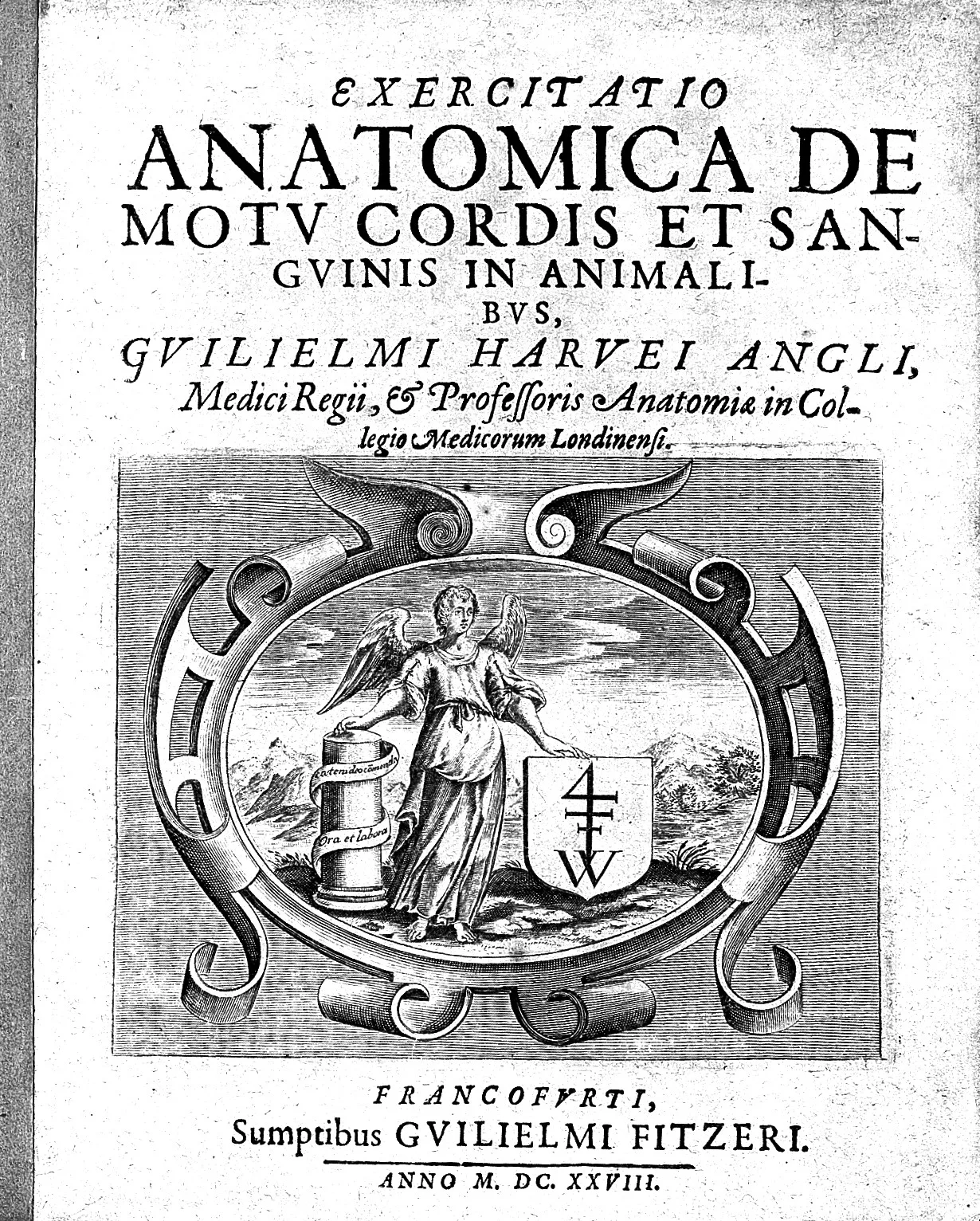
In 1628 a royal physician of fifty, who had carried his secret for a dozen years, sent seventy-two pages of cheap Frankfurt print into the world and proved, by arithmetic, a thing no eye could yet see: that the blood is not made and spent like fuel but driven round the body in a closed circle, and that the heart which drives it is a muscle and a pump. He demonstrated the circle without ever finding the place where it closed.
Another man, in another century
When Andreas Vesalius opened the heart in 1543 he found the wall between its chambers to be solid muscle, searched it for the pores that Galen's physiology required, and could not find them — and then, unable to believe his own eyes against thirteen centuries of authority, wrote that the blood must somehow sweat through passages “which escape the human vision.”1 Following the blood the whole way round, and saying so plainly, would take another lifetime and another man.
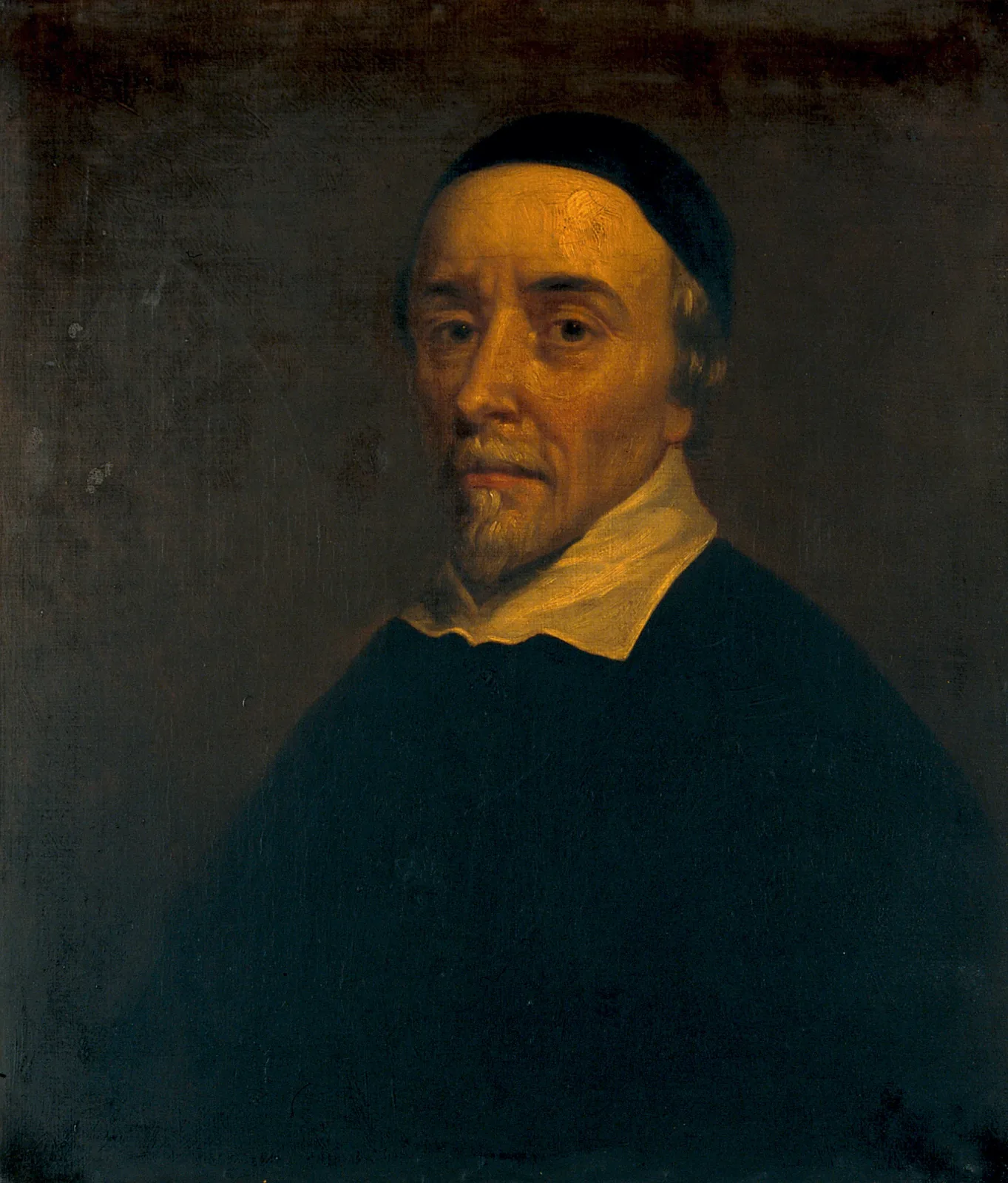
The man was William Harvey, born at Folkestone in Kent in 1578, fourteen years after Vesalius died.2 He read medicine at Cambridge and then at Padua, in the same school where Vesalius had made his name, under Hieronymus Fabricius — the anatomist who had lately described the little valves inside the veins.3 From his teacher Harvey took an observation Fabricius himself had misread. From Vesalius's revolution he took the licence to trust the body over the book. And then he did the thing his masters never quite dared, and the reverse of what Vesalius had done with the septum: he trusted a number over his eye, and proved a thing he could not see.
The inheritance
The system Harvey was born into was Galen's, and it was not a circle but a tide. Food was carried to the liver, this account ran, and there turned into blood; the liver sent that blood outward through the veins like a slow, spending sea, to be soaked up and consumed by the flesh it fed, and replenished from the next meal. A little of it crossed from the right side of the heart to the left through invisible pores in the septum, mixed there with air drawn down from the lungs, took on “vital spirit,” and ebbed out through a second and separate system, the arteries.4 Two tides, two kinds of blood, made and burnt and never returning. The heart in this picture was less a pump than a hearth, and its important motion was held to be its expansion, the moment it drew blood in.
The account had been straining at one seam for some time. That the blood might cross from the right heart to the left the long way round, out to the lungs and back, rather than through the septum, had been written down in the thirteenth century by the Damascus-trained Ibn al-Nafis, whose pages lay unread in Europe until 1924; printed in 1553 by the heretic Michael Servetus, in a work of theology burnt, with most of its copies and its author, at Geneva that same year; and described from the dissecting table in 1559 by Realdo Colombo.5 The passage through the lungs was, by Harvey's day, there for anyone who cared to look. The whole circle, and a proof of it, was not.
The sum
Harvey's lecture notes for the College of Physicians show him teaching the circulation as early as 1616. He held it back from print for twelve years.6 When the argument came, what carried it was not a finer dissection but a piece of arithmetic.
First he settled what the heart actually does. Watching it in cold-blooded animals, and in warm-blooded ones as they died, where the motion slows enough to follow, he saw that the heart's working stroke is its contraction: it tightens, pales, and throws its blood out, the way a fist closes. The heart is a muscle, and the pulse at the wrist is only the arteries taking that thrown blood under pressure.7 Then he counted. The left ventricle holds upward of two ounces: he measured it in the dead.8 It cannot empty wholly, but it expels at the least an eighth of its content at every beat, and the heart beats more than a thousand times in half an hour. Set the smallest plausible figure against the beats and the total turns absurd. Even at a single drachm a stroke, better than ten pounds of blood pass through the heart in half an hour; at an ounce a stroke, above eighty — many times over the weight of all the blood a body holds, and in a single hour.9 He opened a sheep and found it carried about four pounds of blood in all; his sums sent three and a half pounds of it past the animal's heart in thirty minutes.10
No body makes and destroys blood at that rate. There is not food enough in the world to supply it, nor room in the veins to hold it. The only ledger that balances is one in which the same blood comes back and is spent again and again — in which it circulates. The decisive instrument of the new physiology was neither a knife nor a lens. It was a column of figures, and the nerve to follow them past what anyone had seen.11
The body made to confess
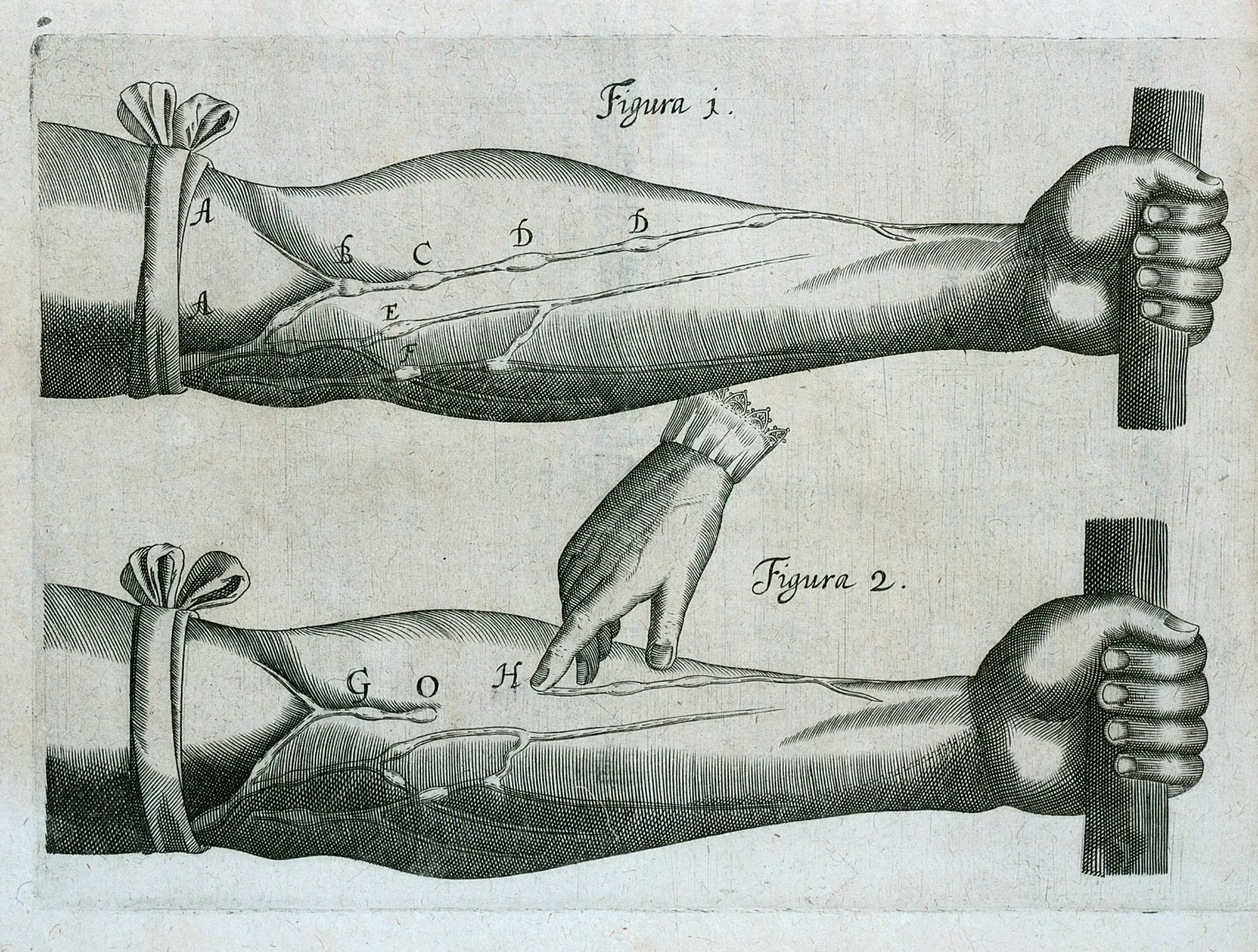
Arithmetic gave the quantity; it did not give the direction. For that Harvey turned to his teacher's neglected valves. Fabricius had found the little folds inside the veins and taken them for baffles, structures to slow the blood's fall into the legs.12 Harvey bound a cord about a bared arm and read them the other way. The veins below the ligature swell; press the blood along one of them with a fingertip and it runs freely toward the heart, and will not be driven back; lift the finger above a valve and the vein fills again only from below. The valves are not brakes. They are gates, and every one opens inward, toward the heart. The arteries carry the blood out under the force of the pump; the veins, gated, bring it home. It is an experiment a man may do on his own forearm in an afternoon, and Harvey set a picture of that bound arm — adapted from Fabricius's own engraving — into the book, so the reader might do it too.13
The thing he could not see
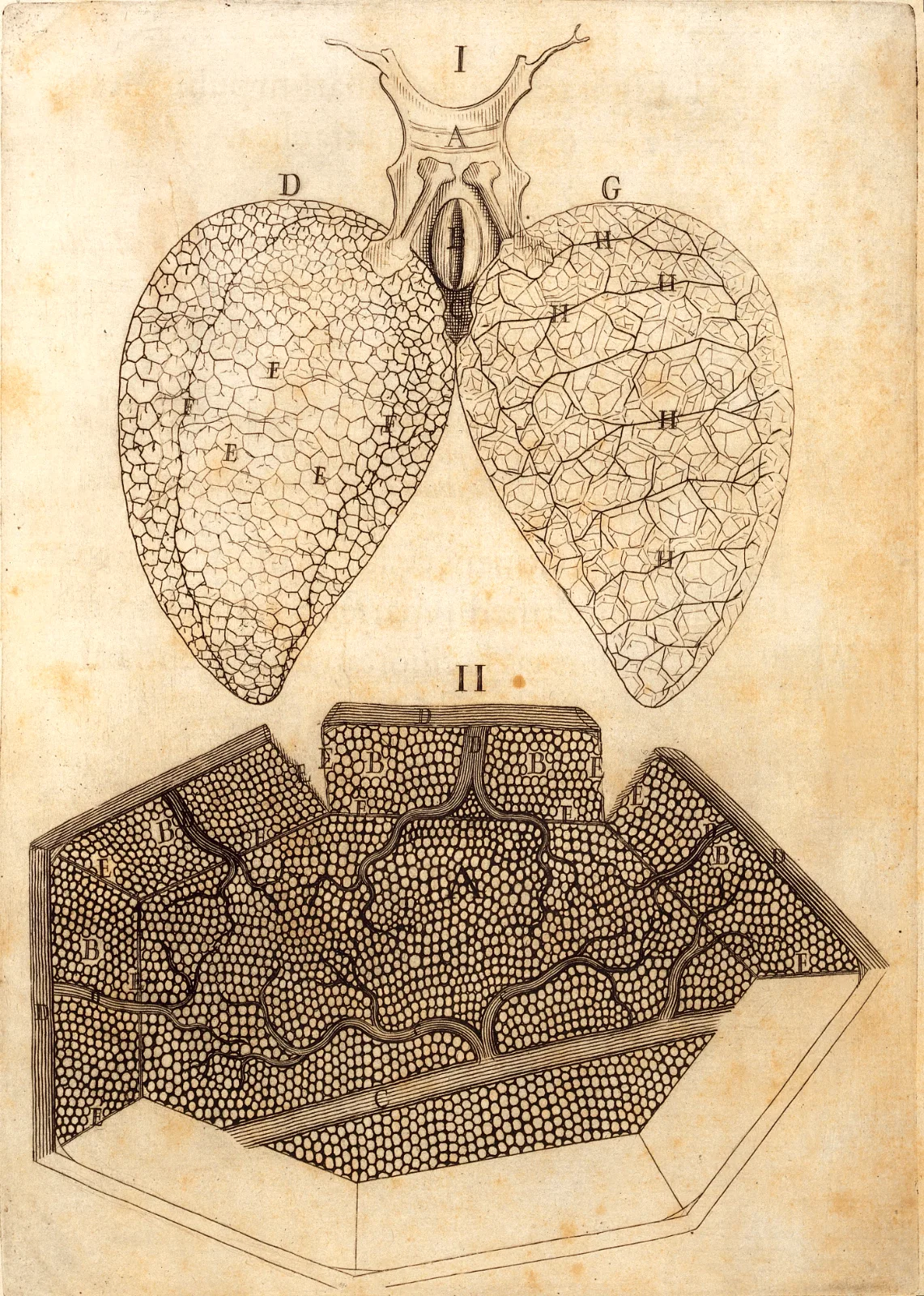
For all the force of the sum, the circle Harvey drew had a gap in it he could not close. Somewhere between the smallest artery and the smallest vein the blood must cross from the outbound stream to the homeward one, and there, at the very joint of his system, he could see nothing whatever. He supposed “porosities,” anastomoses, channels finer than sight. And here, unlike Galen with his convenient septal pores, he did the rare and honest thing: he confessed that he did not know. On how the arteries join the veins, he wrote, no one hitherto has said anything rightly; “I am now engaged in that investigation.”14
He never found them. The crossing was first seen by Marcello Malpighi, who in 1661 laid a frog's lung beneath a microscope and watched the blood run from artery to vein through a mesh of vessels too fine to have had a name — four years after Harvey was dead.15
This is the quiet reversal at the centre of the story, and the part I cannot put down. A century earlier Vesalius had looked straight at the septum, seen no pores, and declined to believe his own eyes. Harvey looked at the junction of the vessels, saw nothing at all, and believed in the circle regardless, because the numbers admitted no other answer. The founder of the new anatomy had distrusted what he plainly saw; the founder of physiology trusted what he could not see. Both were right, and the medicine I practise is the child of both habits at once.
The cost of a circle
Print brought him more grief than honour, at first. The book was dedicated to Charles I in language that made the heart a king and the king a heart: the heart “the sun of its microcosm,” the sovereign in turn “the sun of the world around him, the heart of the republic.”16 It was a cheap, error-strewn quarto, seventy-two pages on poor Frankfurt paper, trailing a leaf of a hundred and twenty-six corrections its author had been too far away to make.17 And it cost him. He “fell mightily in his practice,” John Aubrey recorded, and “’twas believed by the vulgar that he was crack-brained.”18 Jean Riolan of Paris fought him for years, and even Descartes, who granted the circulation gladly, denied the pump, holding that a native heat in the heart boiled the blood outward rather than a muscle squeezing it.19 Yet, almost alone among men who overthrow a science, Harvey lived to see himself believed; within his lifetime the circle was taught in the schools. The king he had made into a heart was beheaded in 1649; the physician outlived the sovereign of his microcosm by eight years and died, in 1657, of a haemorrhage in the brain — a vessel giving way at last in the organ his circuit serves first.20
Read from the Ward
At two in the morning the most honest thing in the room is a number. A man's heart is failing in front of me, and the monitor renders it as a single figure that redraws itself every few seconds: the litres it moves each minute, spread across his body. I treat the number. I lift it with one drug and unburden the heart with another and watch it climb, and the whole while I am doing Harvey's half-hour sum, made continuous and lit on a screen. Cardiac output is stroke volume times rate — his two ounces, his thousand beats — and nearly four centuries of physics and engineering have gone only into measuring faster the thing he reasoned his way to with a quill.
What I inherit from him, though, is stranger than a formula. It is the permission to act on what I cannot see. I cannot watch the blood failing to reach the gut; I read it off a rising lactate and believe it. I cannot see the output; I infer it and treat the inference. A great deal of what I do on a bad night turns, like Harvey's capillaries, on something the arithmetic demands and the eye never delivers. We are trained, after Vesalius, to trust the patient over the textbook; we are trained, after Harvey, to trust the sum over the absence of a sign, to move on a circuit we credit without once watching it complete. The two teachings pull against each other, and the whole art lies in holding both — knowing, on this patient, at this hour, when to believe the eye and when to believe the number.
Harvey proved that the blood comes home. It came home for him, as well. The circle he could describe down to its last unseen vessel closed, one morning in 1657, on a broken artery in his own brain. I think of him on the worst nights, when the figure on the monitor is the only thing the body will tell me, and I do the sum that he did, and I trust the circuit I have never once watched close.
- Vesalius on the interventricular septum — that the blood is somehow made to pass from the right ventricle to the left “through passages which escape the human vision” — in Andreas Vesalius, De humani corporis fabrica (Basel: Oporinus, 1543), Book VI; see the parallel 1543/1555 text in Daniel H. Garrison and Malcolm H. Hast, trans., The Fabric of the Human Body (Basel: Karger, 2014), and the discussion in C. D. O'Malley, Andreas Vesalius of Brussels (Berkeley: University of California Press, 1964), chap. 6.↩
- On Harvey's birth at Folkestone in 1578 and his studies at Gonville and Caius College, Cambridge, and at Padua (M.D. 1602), see Geoffrey Keynes, The Life of William Harvey (Oxford: Clarendon Press, 1966), chaps. 1–3.↩
- On Harvey at Padua under Hieronymus Fabricius ab Aquapendente, and on Fabricius's De venarum ostiolis (1603), the first clear account of the venous valves, see Keynes, Life, chap. 3; and Roger French, William Harvey's Natural Philosophy (Cambridge: Cambridge University Press, 1994), chaps. 1–2.↩
- On the Galenic scheme — blood made in the liver, drawn outward through the veins and consumed as nourishment; a portion crossing the septum to be charged with “vital spirit” and distributed through the arteries; the heart's active phase taken to be dilation — see Vivian Nutton, Ancient Medicine, 2nd ed. (London: Routledge, 2013), chaps. 15–17.↩
- On the pulmonary (lesser) circulation before Harvey: Ibn al-Nafis in the thirteenth century, his account long unread in Europe and his manuscript rediscovered only in 1924; Michael Servetus in the Christianismi Restitutio (1553); and Realdo Colombo in De re anatomica (1559). See John B. West, “Ibn al-Nafis, the pulmonary circulation, and the Islamic Golden Age,” Journal of Applied Physiology 105, no. 6 (2008): 1877–1880; and French, Harvey's Natural Philosophy, chap. 3. These describe the lung transit, not the whole systemic circuit Harvey would prove.↩
- Harvey's Prelectiones anatomiae universalis (the notes for his Lumleian lectures at the College of Physicians, begun 1616) already set out the circulation, more than a decade before De motu cordis appeared in 1628; see Keynes, Life, chaps. 8–10.↩
- On Harvey's demonstration, from vivisection of cold-blooded and dying animals, that the heart's active motion is its contraction (systole) and that the heart is a muscle whose stroke produces the arterial pulse, see William Harvey, Exercitatio anatomica de motu cordis et sanguinis in animalibus (Frankfurt: Fitzer, 1628), caps. 2–5; trans. Robert Willis, The Works of William Harvey (London: Sydenham Society, 1847).↩
- Harvey, De motu cordis, cap. 9: the left ventricle in the dead found to hold “upward of two ounces.”↩
- Harvey, De motu cordis, cap. 9: at least an eighth of the ventricle's content expelled per beat, more than a thousand beats in a half-hour, and the resulting reckoning — by his own conservative table, from above ten pounds (at a drachm a beat) to above eighty pounds (at an ounce a beat) passing in half an hour, more than the whole mass of blood in the body. See also Frederick G. Kilgour, “William Harvey's Use of the Quantitative Method,” Yale Journal of Biology and Medicine 26, no. 5 (1954): 410–421.↩
- Harvey, De motu cordis, cap. 9: a sheep found to contain no more than about four pounds of blood, against the three and a half pounds his calculation drove past its heart in half an hour (“quod in ove expertus sum”).↩
- On the quantitative argument as the decisive and novel feature of Harvey's proof, see Kilgour, “Harvey's Use of the Quantitative Method”; and French, Harvey's Natural Philosophy, chap. 4.↩
- On Fabricius's discovery of the venous valves and his mistaken reading of them as retarders of the blood's flow into the limbs, see French, Harvey's Natural Philosophy, chaps. 2–3; and Keynes, Life, chap. 3.↩
- Harvey, De motu cordis, cap. 13, on the ligature-and-valve demonstration in the arm, with the figures adapted from Fabricius's plates; trans. Willis, Works. See also Keynes, Life, chap. 11.↩
- Harvey, De motu cordis, cap. 9: that on the manner in which the arteries join the veins “no one hitherto has said anything rightly,” and “I am now engaged in that investigation” (Ego in illa disquisitione jam sum); trans. Willis, Works.↩
- On Marcello Malpighi's microscopic observation of the pulmonary capillaries in the frog's lung in De pulmonibus (1661), four years after Harvey's death, supplying the connexion Harvey had only postulated, see John B. West, “Marcello Malpighi and the discovery of the pulmonary capillaries and alveoli,” American Journal of Physiology — Lung Cellular and Molecular Physiology 304, no. 6 (2013): L383–L390.↩
- Harvey, De motu cordis, dedicatory epistle to Charles I — the heart “the foundation of life… the sun of its microcosm,” and the king in turn “the foundation of his kingdoms, the sun of the world around him, the heart of the republic”; trans. Robert Willis, Works.↩
- On the publication of De motu cordis at Frankfurt by Wilhelm Fitzer in 1628 — seventy-two pages, thin and poor paper, an errata leaf of one hundred and twenty-six corrections occasioned by Harvey's distance from the press — see Geoffrey Keynes, A Bibliography of the Writings of Dr William Harvey, 2nd ed. (Cambridge: Cambridge University Press, 1953); and Keynes, Life, chap. 13.↩
- John Aubrey, Brief Lives, ed. Andrew Clark (Oxford: Clarendon Press, 1898), s.v. “William Harvey”: after the book “he fell mightily in his Practize, and… ’twas believed by the vulgar that he was crack-brained.” On the hostile early reception of the circulation more broadly, see Thomas Wright, Circulation: William Harvey's Revolutionary Idea (London: Chatto & Windus, 2012); and French, Harvey's Natural Philosophy, chaps. 9–10.↩
- On Jean Riolan the younger as Harvey's chief antagonist (answered in Harvey's Exercitationes duae anatomicae de circulatione sanguinis, 1649), and on Descartes' acceptance of the circulation but rejection of the muscular pump in favour of a heart that heats and rarefies the blood (Discours de la méthode, 1637, part 5), see Thomas Fuchs, The Mechanization of the Heart: Harvey and Descartes, trans. Marjorie Grene (Rochester: University of Rochester Press, 2001); and French, Harvey's Natural Philosophy, chaps. 9–10.↩
- On the acceptance of the circulation within Harvey's lifetime, and on his death at Roehampton on 3 June 1657 of a cerebral haemorrhage, see Keynes, Life, chaps. 28–34. Charles I was executed on 30 January 1649.↩
- Chicago
Kim, D. Y. “De Motu Cordis.” Codex Chronica, June 30, 2026. https://codexchronica.com/de-motu-cordis/.
- APA
Kim, D. Y. (2026, June 30). De Motu Cordis. Codex Chronica. https://codexchronica.com/de-motu-cordis/
- Aubrey, John. Brief Lives. Edited by Andrew Clark. 2 vols. Oxford: Clarendon Press, 1898.
- Fabricius ab Aquapendente, Hieronymus. De venarum ostiolis. Padua, 1603.
- French, Roger. William Harvey's Natural Philosophy. Cambridge: Cambridge University Press, 1994.
- Fuchs, Thomas. The Mechanization of the Heart: Harvey and Descartes. Translated by Marjorie Grene. Rochester: University of Rochester Press, 2001.
- Harvey, William. Exercitatio Anatomica de Motu Cordis et Sanguinis in Animalibus. Frankfurt: Wilhelm Fitzer, 1628.
- Harvey, William. The Works of William Harvey. Translated by Robert Willis. London: Sydenham Society, 1847.
- Keynes, Geoffrey. A Bibliography of the Writings of Dr William Harvey. 2nd ed. Cambridge: Cambridge University Press, 1953.
- Keynes, Geoffrey. The Life of William Harvey. Oxford: Clarendon Press, 1966.
- Kilgour, Frederick G. “William Harvey's Use of the Quantitative Method.” Yale Journal of Biology and Medicine 26, no. 5 (1954): 410–421.
- Nutton, Vivian. Ancient Medicine. 2nd ed. London: Routledge, 2013.
- West, John B. “Ibn al-Nafis, the pulmonary circulation, and the Islamic Golden Age.” Journal of Applied Physiology 105, no. 6 (2008): 1877–1880.
- West, John B. “Marcello Malpighi and the discovery of the pulmonary capillaries and alveoli.” American Journal of Physiology — Lung Cellular and Molecular Physiology 304, no. 6 (2013): L383–L390.
- Wright, Thomas. Circulation: William Harvey's Revolutionary Idea. London: Chatto & Windus, 2012.