
For the better part of a century the anatomists of Europe kept finding small folds of membrane inside the veins, and kept taking them for the wrong thing. They had the structure entire — dissected, shown in the public theatres, at last engraved to the life — long before any of them grasped what it was for. What turned that old anatomy into the proof of the circulation was not a finer blade but a single question, put by a pupil at Padua to his teacher's most beautiful mistake: not what the little doors were, but which way they opened.
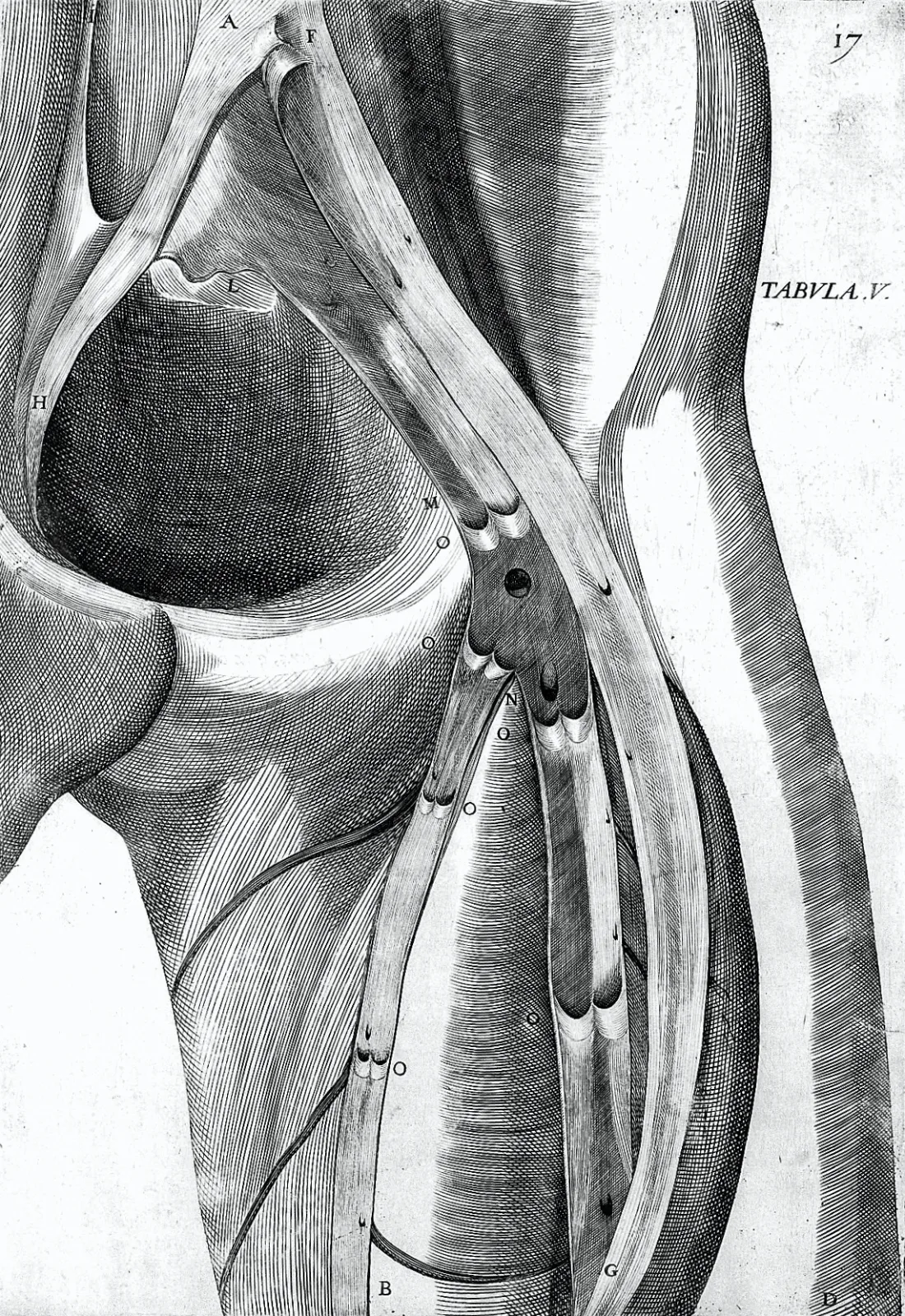
A discovery that was not one
The circulation of the blood belongs, in every schoolroom, to one man and one book: William Harvey, and the seventy-two cheap pages he printed at Frankfurt in 1628. The companion to this plate follows that book — the arithmetic that forced a closed circle, and the one crossing Harvey reasoned his way to but did not live to see.1 Yet the hinge on which his whole proof swung was not a thing he found. It was a structure he had watched his teacher display to a theatre of students, copied afterwards from that same teacher's engravings, and read against the grain: the little one-way valves set inside the veins. Their story runs back three generations before his book, and it is the plainer parable. The valves were seen, and drawn, and dissected by careful men for eighty years before Harvey — and the meaning of them kept slipping through their hands.
The long looking
That able men kept meeting the valves and failing to hold them is not a charge of dullness. It is a lesson in how much the eye owes to the idea behind it. As early as 1545 Charles Estienne, dissecting at Paris, noted membranous outgrowths — apophyses — in the veins, though he looked for them in the liver, which is nearly the last place to find them.2 In Ferrara, in the same years, Giambattista Canano showed a valve at the mouth of the azygos vein to the Portuguese physician Amatus Lusitanus, who set it down in print in 1551 and gave Canano the credit.3 Others at Paris, Jacobus Sylvius among them, reported folds in the veins of the limbs.4 The valves were surfacing, in three cities, in the hands of careful anatomists.
Then the greatest anatomist of the age looked, and would not have them. Andreas Vesalius — the man whose whole revolution had been the command to trust the body over the book — did not admit the venous valves into the Fabrica of 1543, and his authority was heavy enough that the question fell quiet for a generation.5 Here is the first of the story's discomforts, and it rhymes with its end: the great champion of the eye could not credit what his doctrine had no place for, and the men who had seen truly were overruled by the one who had seen most.
The little doors
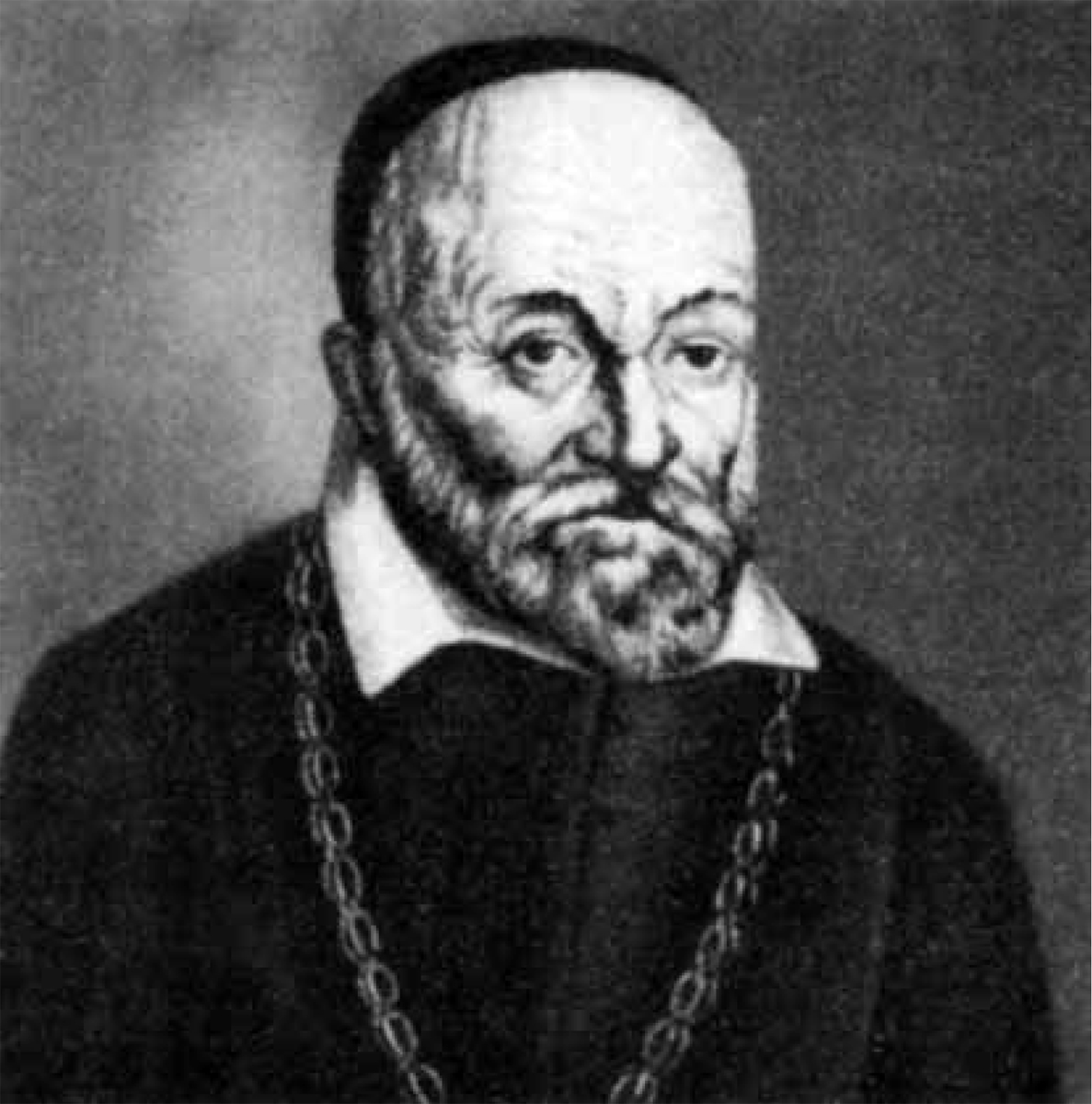
The question woke again at Padua, in the theatre of Vesalius's distant successor in the same chair, Girolamo Fabrici — Hieronymus Fabricius ab Aquapendente. From about 1579 he displayed the valves in his dissections; in 1603, an old man, he gave them their first full treatise, De venarum ostiolis, On the Little Doors of the Veins.6 The book is a small marvel of looking. He traced the valves through the whole venous tree, marked where they cluster and where they are wanting, and had them engraved (pouched, half-moon folds springing from the vessel wall) with a fidelity no one had troubled to reach. An earlier figure, drawn by Salomon Alberti in 1585, had shown a single valve; Fabricius mapped the country.7
And having seen them more clearly than any man alive, he read their office exactly backwards. The valves, he wrote, are there to retard the blood — to slow its outward flow from the liver into the limbs, so that it should not all rush down and gather in the hands and feet but feed the flesh evenly along the way; the Supreme Artificer had set them, he judged, to keep the veins from over-distending.8 This was not folly. It was the correct deduction from a false premise. Everyone knew, as Galen had settled it fourteen centuries before, that the veins carry blood outward, from the liver to the body, to be soaked up and spent.9 Grant that current, and valves that brake and baffle it make excellent sense. Fabricius had the anatomy nearly whole and the direction of the river wrong, and so the little doors, which open only one way, became in his hands a set of gentle dams.
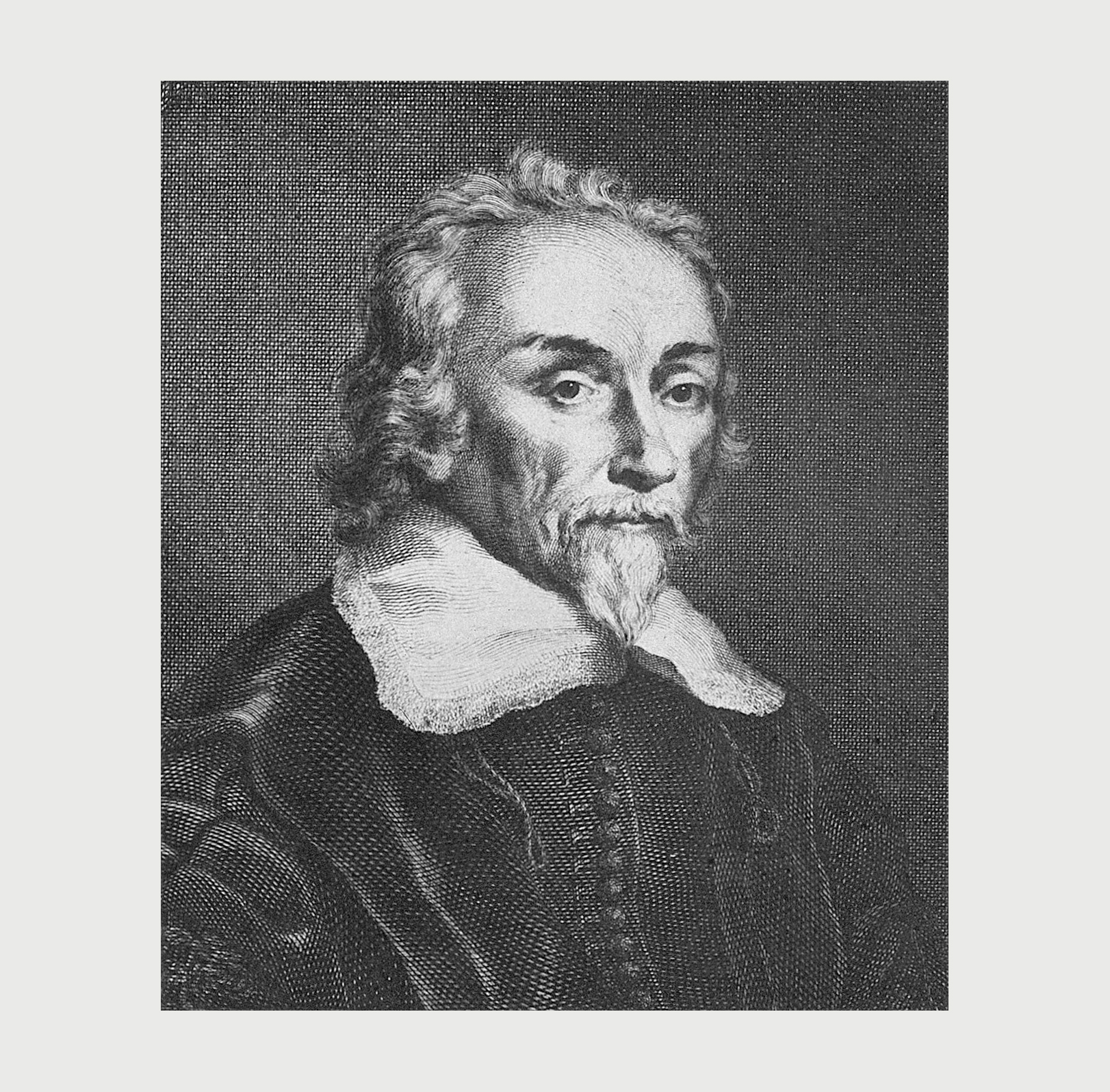
Which way they open
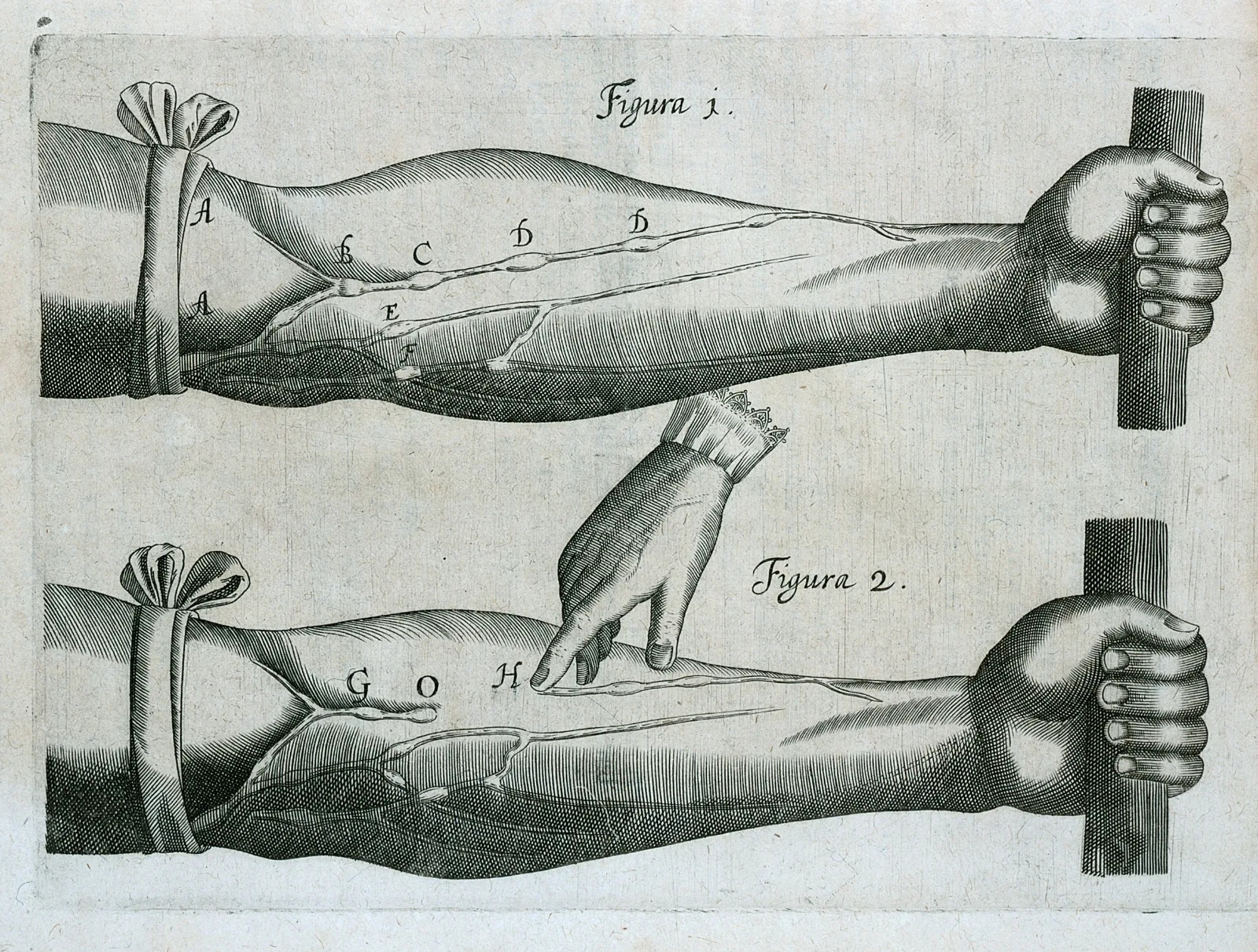
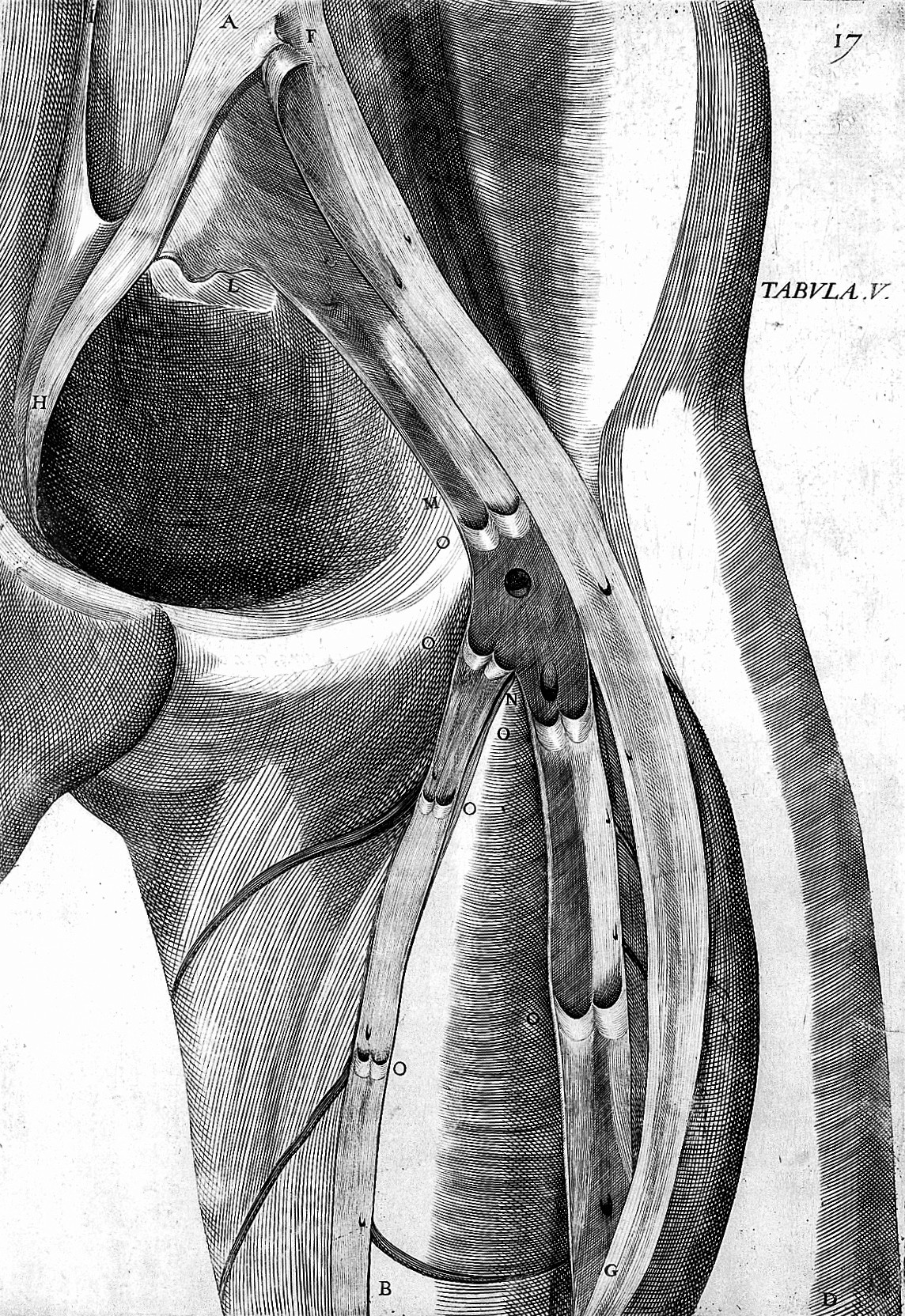
William Harvey came to Padua in 1600, an Englishman of two-and-twenty, and sat in Fabricius's theatre while the old man showed the valves.10 He added nothing to the anatomy — nothing at all; the plate of the bared, bound arm that he later set in his own book he adapted from Fabricius's engravings. What he brought was a question so simple no one had thought to ask it: which way did the valves let the blood run? He bound a cord about the arm until the veins stood up in knots, pressed a fingertip to a swollen vessel, and tried to drive the blood along it. Toward the hand it would not go; the valve held. Toward the heart it ran freely, and the emptied length would not refill from above.11 The little doors were not brakes on an outbound tide. They were gates on a homeward one, and every one of them opened inward, toward the heart.
He clinched it with a detail that undid his teacher's whole reading. If the office of the valves were to stay the blood from falling by its own weight into the extremities, the valves in the veins of the neck should face upward, to catch it as it fell. They do the reverse: the valves of the jugular veins open downward, toward the heart, against the pull of gravity.12 So too the great pattern of the valves that Fabricius had mapped and misjudged: they crowd the veins of the limbs and are wholly wanting in the broad central veins near the heart, where the blood already runs the right way and no gate is needed.13 Harvey gave his master his due, and said plainly that the discoverers of the valves had not rightly understood their use.14 He had found none of the structure. He had asked it the one question that turned an anatomy of dams into the proof of a circle.
Read from the Ward
At the bedside I do Harvey's experiment most nights, and I do it without a cord. I lay an ultrasound probe over the vein behind a patient's knee and, with my free hand, squeeze the calf. On the screen the blood lights and surges toward the heart — a bright, brief flood — and then, as I let go, it stops, held from running back by the same little doors Fabricius drew four hundred years ago. We call it augmentation, and we use it to hunt for clots: a vein that will not augment, or that leaks colour backward through a broken valve, has something wrong in it. It is the ligature and the thumb, rendered in sound. And each time I watch that flood go home and refuse to return, I think how wholly a man may see a thing and still not know what he is looking at.
For Fabricius's error is not a museum piece. It is the standing temptation of the work I do. His plates are finer than my grey, grainy Doppler; his eye was not the weaker of the two. What he lacked was the model — the frame in the head that tells a current which way to run — and lacking it he read a true image into a false physiology and was elegantly, completely wrong. In the unit we are half-drowned now in pictures and numbers, more of them every year, and the failure that harms my patients is almost never that we did not see. It is that we saw clearly and construed it through the wrong idea: the falling pressure taken for one thing when it was another, the good-looking figure trusted because it looked good. The trainee who has the scan and the wrong story to hang on it stands nearer to Fabricius than either of us would wish.
The valves keep one last lesson, and it is one their describer could not have reached. In the growing child they do not appear until the heart has begun to beat and the small muscles of the limbs begin to move; the flow lays down the very gates that will come to govern it, and where the blood already runs surely toward the heart, no valve forms at all.15 The structure is the child of the current. I cannot look at a failed valve on the screen — an old vein giving way, the blood pooling backward into a swollen ankle, Fabricius's dreaded distension come round at last — without feeling the length of the thing: that these doors are shaped by the circuit whose proof once hung on the way they opened, and that they wear out, in the end, doing the work he never knew they did.
The patient on the bed knows none of this, and needs none of it. I press the calf once more and watch the bright tide climb toward the heart and hold, stopped at the door. Fabricius drew this valve, and named it, and went to his grave in 1619 with the blood inside it still running, in his mind, the wrong way — nine years before a pupil's book set it right. The seeing was never what was hard. I lift the probe, wipe the gel from a stranger's knee, and write my note.
- The quantitative proof of the closed circuit, and the crossing between the smallest arteries and veins that Harvey postulated but never saw, are treated in the companion plate (De Motu Cordis). See William Harvey, Exercitatio anatomica de motu cordis et sanguinis in animalibus (Frankfurt: Fitzer, 1628), caps. 9, 13; trans. Robert Willis, The Works of William Harvey (London: Sydenham Society, 1847).↩
- On Charles Estienne's notice of membranous apophyses in the veins in De dissectione partium corporis humani (Paris, 1545), and on the false starts of the mid-sixteenth century, see Anke H. Scultetus, J. Leonel Villavicencio, and Norman M. Rich, "Facts and Fiction Surrounding the Discovery of the Venous Valves," Journal of Vascular Surgery 33, no. 2 (2001): 435–441; and Alberto Caggiati et al., "1603–2003: Four Centuries of Valves," European Journal of Vascular and Endovascular Surgery 28 (2004): 439–441.↩
- On Giambattista Canano's demonstration of the valve at the mouth of the vena azygos and Amatus Lusitanus's published record of it, see Amatus Lusitanus, Curationum medicinalium centuria prima (Florence, 1551); and Scultetus et al., "Facts and Fiction," 435–441.↩
- On the reports of valves in the veins of the limbs by Jacobus Sylvius (Jacques Dubois) and others in these same years, see Scultetus et al., "Facts and Fiction"; and Caggiati, "Four Centuries of Valves."↩
- On Vesalius's failure to admit the venous valves in the Fabrica (1543) and the suppressive weight of his authority upon the question until 1579, see Scultetus et al., "Facts and Fiction," 435–441; and, on Vesalius more broadly, C. D. O'Malley, Andreas Vesalius of Brussels, 1514–1564 (Berkeley: University of California Press, 1964).↩
- On Fabricius ab Aquapendente's public demonstrations of the valves at Padua from about 1579 and his De venarum ostiolis (Padua, 1603), the first treatise on the subject, see K. J. Franklin, trans., De venarum ostiolis 1603 of Hieronymus Fabricius of Aquapendente (Springfield, IL: Charles C. Thomas, 1933); and Roger French, William Harvey's Natural Philosophy (Cambridge: Cambridge University Press, 1994), chaps. 1–3.↩
- On Salomon Alberti's earlier printed figure of a venous valve (1585), see Caggiati, "Four Centuries of Valves," 439–441.↩
- On Fabricius's teleological reading of the valves — as retarders of the outward blood, distributing it evenly and preventing the veins' over-distension — see Fabricius, De venarum ostiolis (1603), trans. Franklin; and French, Harvey's Natural Philosophy, chaps. 2–3.↩
- On the Galenic doctrine of centrifugal venous flow — blood made in the liver and carried outward through the veins to be consumed as nourishment — see Vivian Nutton, Ancient Medicine, 2nd ed. (London: Routledge, 2013), chaps. 15–17.↩
- On Harvey's years at Padua (1600–1602) under Fabricius, see Geoffrey Keynes, The Life of William Harvey (Oxford: Clarendon Press, 1966), chap. 3.↩
- Harvey, De motu cordis, cap. 13, on the ligature-and-valve demonstration in the arm, with figures adapted from Fabricius's plates; trans. Willis, Works.↩
- Harvey, De motu cordis, cap. 13: that the valves of the jugular veins open downward, toward the heart and against gravity, disproving the notion that their office is to stay the blood's descent into the limbs; trans. Willis, Works; and French, Harvey's Natural Philosophy, chap. 8.↩
- On the distribution of the valves — numerous in the veins of the limbs, absent in the venae cavae and the great central veins — see Alberto Caggiati, "The Venous Valves of the Lower Limbs," Phlebolymphology 20, no. 2 (2013); and K. J. Franklin, A Monograph on Veins (Springfield, IL: Charles C. Thomas, 1937).↩
- Harvey, De motu cordis, cap. 13: that the discoverers of the valves, and those who wrote of them after, had not rightly understood their use; trans. Willis, Works.↩
- On the development of the venous valves only after the onset of the heartbeat and limb movement, and their absence where the flow is already heartward, see Otto F. Kampmeier and C. L. Birch, "The Origin and Development of the Venous Valves," American Journal of Anatomy 38 (1927): 451–499; and Caggiati, "The Venous Valves of the Lower Limbs."↩
- Chicago
Kim, D. Y. “Of Valves and Vessels.” Codex Chronica, July 1, 2026. https://codexchronica.com/of-valves-and-vessels/.
- APA
Kim, D. Y. (2026, July 1). Of Valves and Vessels. Codex Chronica. https://codexchronica.com/of-valves-and-vessels/
- Caggiati, Alberto. "The Venous Valves of the Lower Limbs." Phlebolymphology 20, no. 2 (2013).
- Caggiati, Alberto, Maurizio Rippa Bonati, et al. "1603–2003: Four Centuries of Valves." European Journal of Vascular and Endovascular Surgery 28 (2004): 439–441.
- Estienne, Charles. De dissectione partium corporis humani libri tres. Paris: Simon de Colines, 1545.
- Fabricius ab Aquapendente, Hieronymus. De venarum ostiolis. Padua, 1603. Translated by K. J. Franklin as De venarum ostiolis 1603 of Hieronymus Fabricius of Aquapendente. Springfield, IL: Charles C. Thomas, 1933.
- Franklin, Kenneth J. A Monograph on Veins. Springfield, IL: Charles C. Thomas, 1937.
- French, Roger. William Harvey's Natural Philosophy. Cambridge: Cambridge University Press, 1994.
- Harvey, William. Exercitatio Anatomica de Motu Cordis et Sanguinis in Animalibus. Frankfurt: Wilhelm Fitzer, 1628.
- Harvey, William. The Works of William Harvey. Translated by Robert Willis. London: Sydenham Society, 1847.
- Kampmeier, Otto F., and C. L. Birch. "The Origin and Development of the Venous Valves, with Particular Reference to the Saphenous District." American Journal of Anatomy 38 (1927): 451–499.
- Keynes, Geoffrey. The Life of William Harvey. Oxford: Clarendon Press, 1966.
- Lusitanus, Amatus. Curationum medicinalium centuria prima. Florence, 1551.
- Nutton, Vivian. Ancient Medicine. 2nd ed. London: Routledge, 2013.
- O'Malley, C. D. Andreas Vesalius of Brussels, 1514–1564. Berkeley: University of California Press, 1964.
- Scultetus, Anke H., J. Leonel Villavicencio, and Norman M. Rich. "Facts and Fiction Surrounding the Discovery of the Venous Valves." Journal of Vascular Surgery 33, no. 2 (2001): 435–441.