
Smallpox killed perhaps a third of those it marked and blinded or scarred most of the rest, and in the eighteenth century it did so by the hundreds of thousands every year. That such a monster could be undone by the pus of a dairymaid's blistered hand was a piece of country lore long before it was a piece of science. A Gloucestershire doctor did not invent it, and could not have told you why it worked, and yet by a single experiment on a boy of eight he began the work that has left the disease existing nowhere on earth but in two locked freezers. He was not the first to try it, and the animal we named it after may have been the wrong one.
The speckled monster
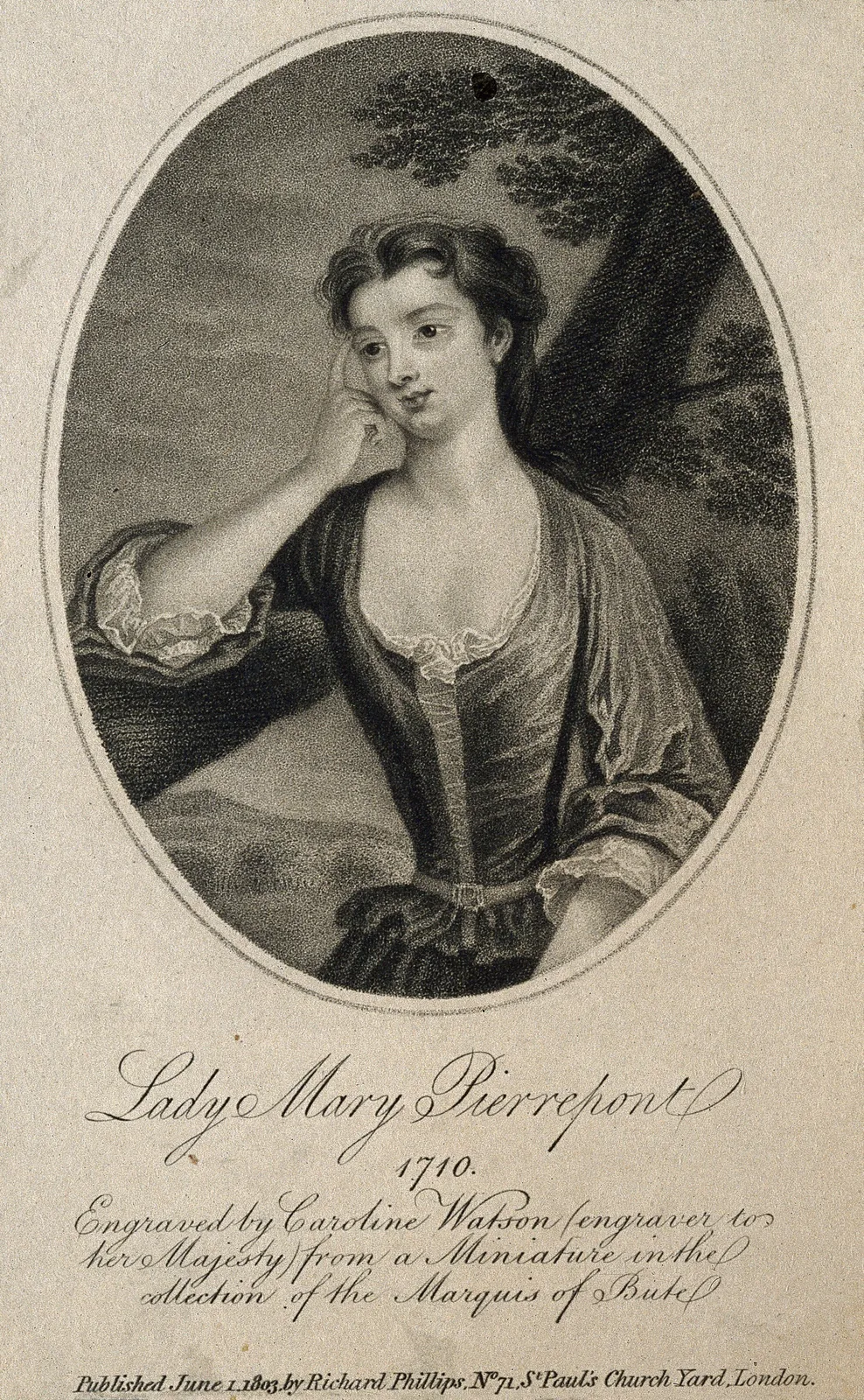
For most of recorded history smallpox was simply a condition of being alive. It came in waves that emptied nurseries and disfigured the survivors, pitting their faces and clouding their eyes, and it is thought to have killed some three hundred million people in the twentieth century alone, having done such work since at least the age of the pharaohs, whose mummies carry its scars.1 Against a foe so total, humanity had found one crude defence long before it understood the enemy. Take a little matter from the pocks of a mild case, work it into a scratch on a healthy person, and that person usually suffered only a limited illness and was then safe for life. The practice was called variolation, and it was old and widespread, done in China and in India, across the Ottoman lands, and among the peoples of West Africa centuries before Europe paid it any attention.2 Europe learned it, in the end, from those it was least willing to credit. When smallpox struck Boston in 1721, the minister Cotton Mather pressed the city's doctors to try it, having learned of it years before from Onesimus, a West African he had enslaved, who had described the deliberate scarring he once underwent and carried its mark on his arm.3 In London it arrived through Lady Mary Wortley Montagu, who had watched the women of Constantinople perform it and had her own children done. The gamble was real, for variolation killed perhaps one or two in a hundred. Natural smallpox killed thirty, and against those odds people took the smaller risk.4
The dairymaids
In the dairy counties of the west there was another piece of knowledge, humbler still and passed from mouth to mouth. Milkmaids were famous for their unspoilt complexions, and the country reason given was that they did not take the smallpox because they had already had the cow-pox, a mild eruption caught on the hands from the udders of infected cattle.5 It was not a secret, and it was not merely talked about. In 1774, more than twenty years before Jenner, a Dorset farmer named Benjamin Jesty acted on the lore during a smallpox scare: he walked his wife and two sons to a neighbour's cow and, with a darning needle, worked cow-pox matter into their arms. His wife's arm inflamed alarmingly and then healed, the boys shrugged it off, and all three proved sound against smallpox for the rest of their lives.6 Jesty was not even the only one; at least half a dozen people in England, Germany and Denmark are known to have tried the same thing in those decades. The idea was in the very air of the byres. What it lacked was not a first practitioner but a patient investigator willing to test it, record it, and tell the world.
The boy
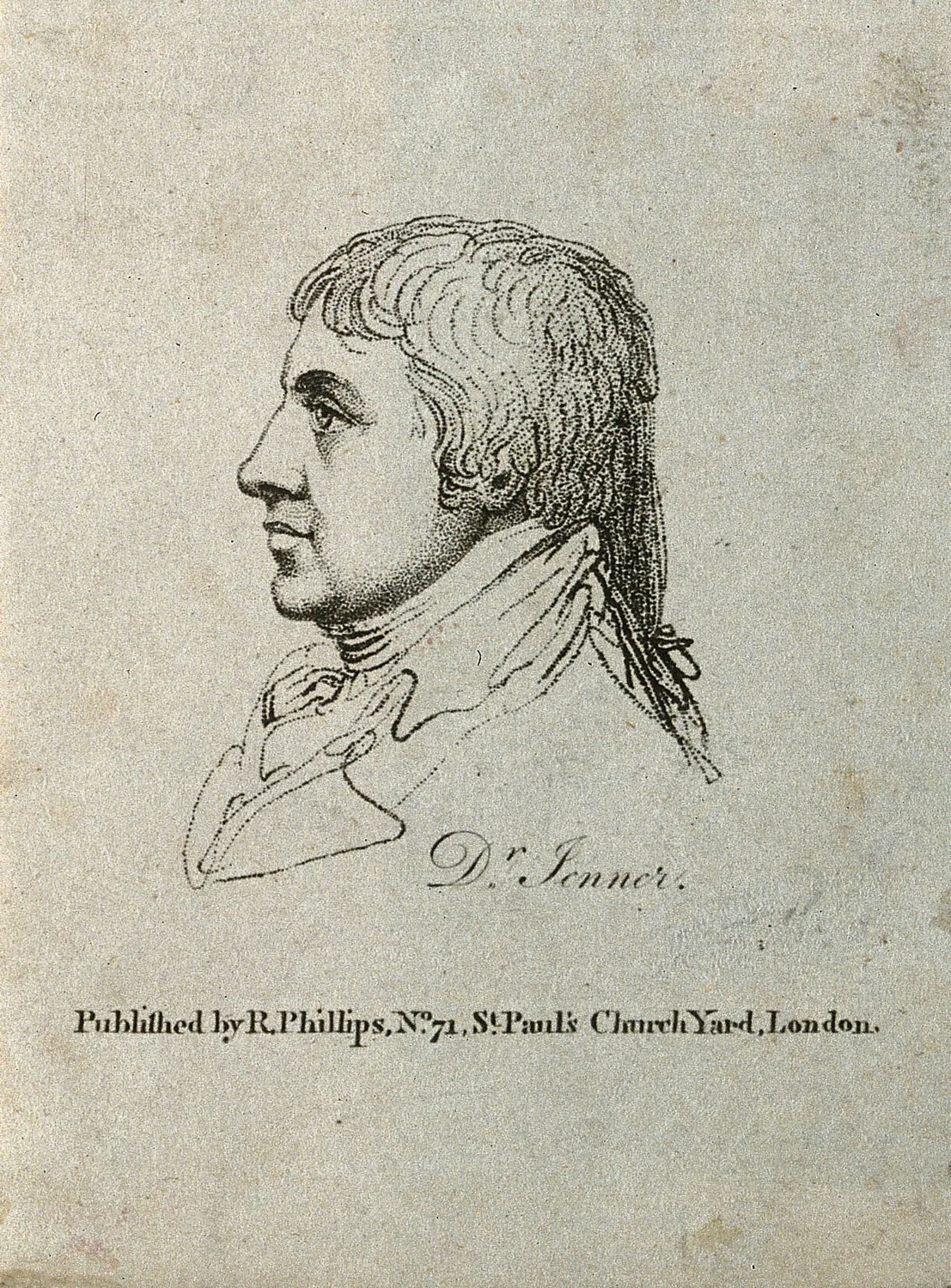
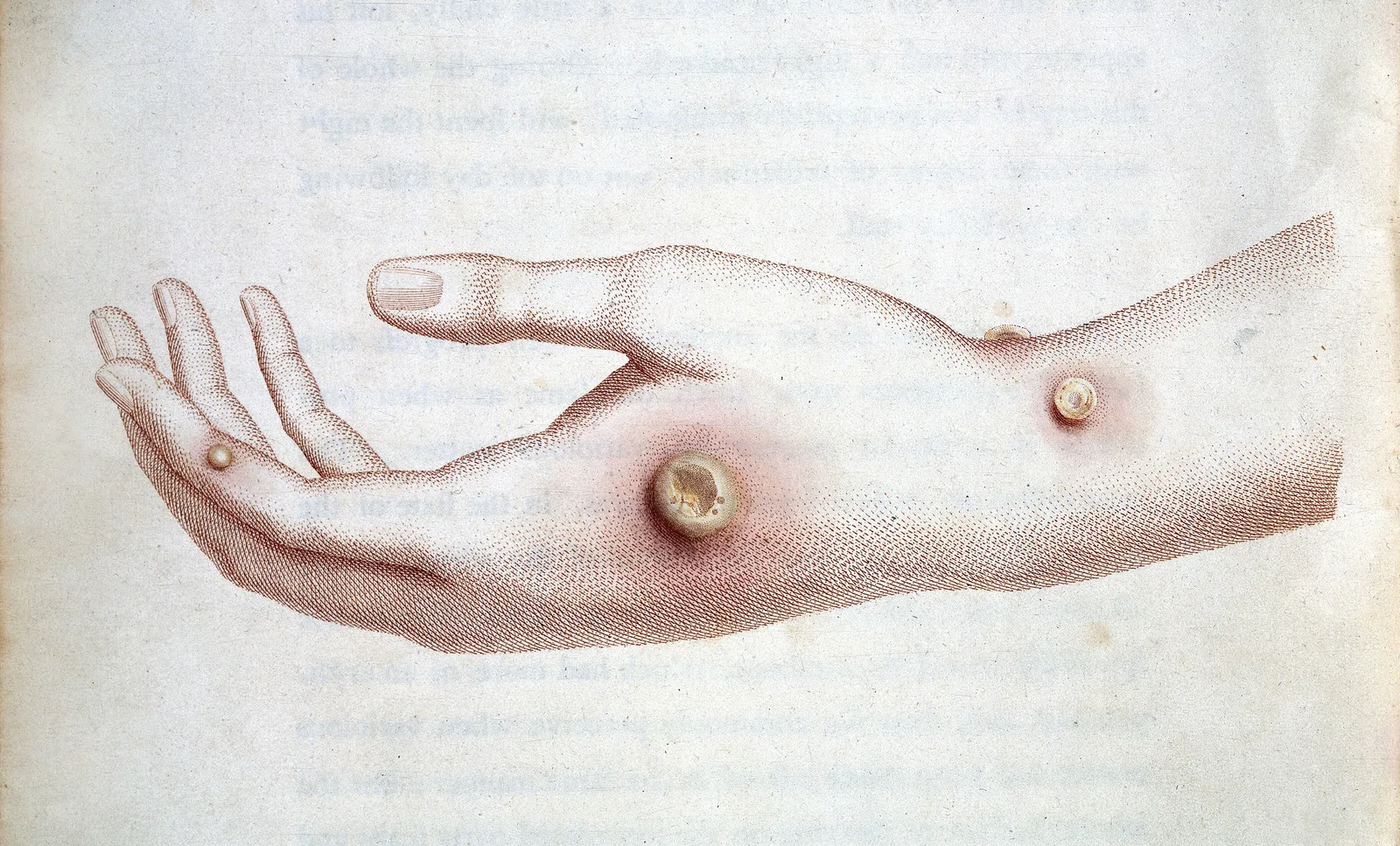
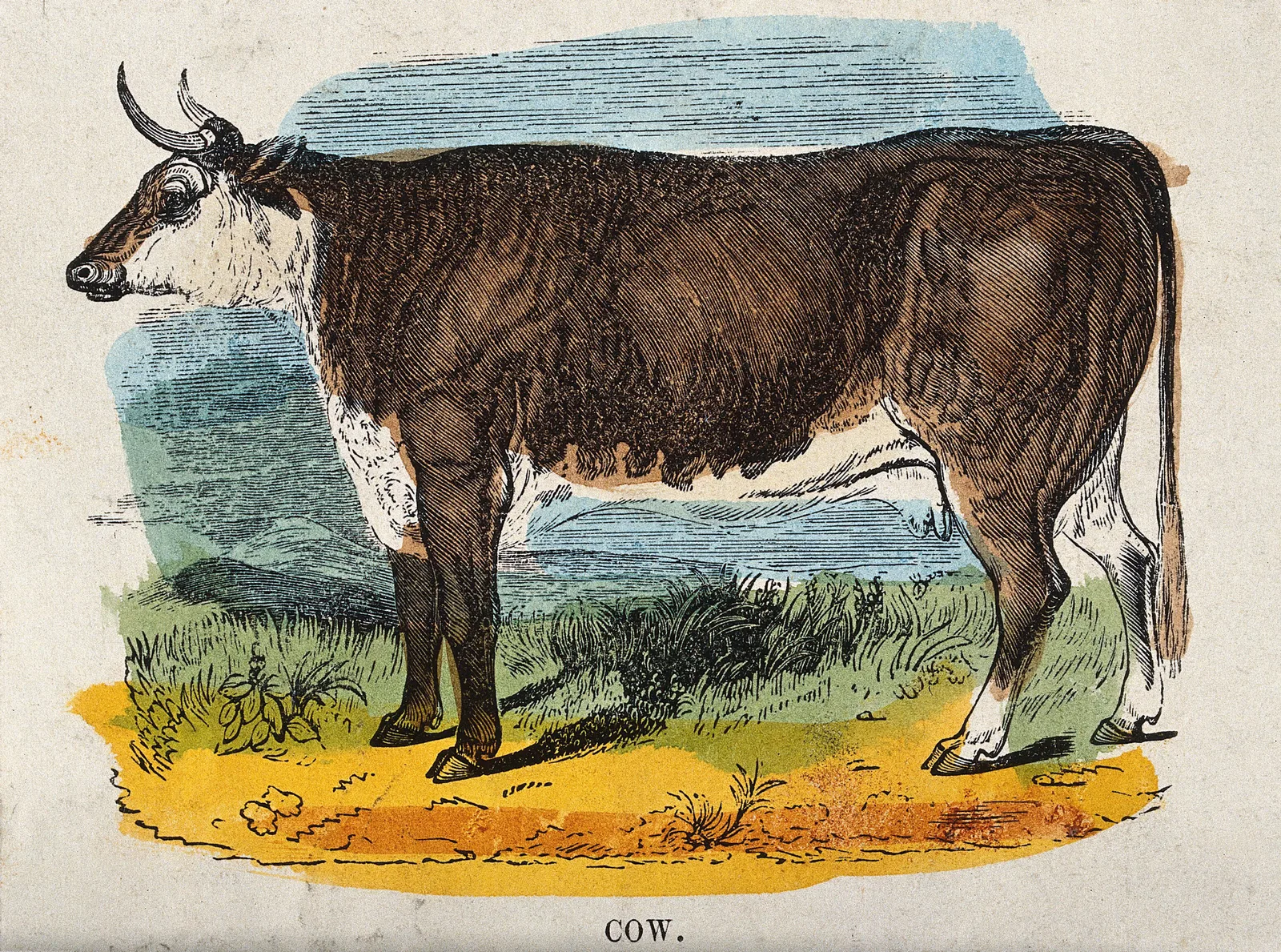
Edward Jenner was a country surgeon at Berkeley in Gloucestershire, a former pupil of the great John Hunter, a man of wide and unhurried curiosity who had spent years turning the dairymaids' saying over in his mind. On the fourteenth of May, 1796, he put it to the test. A young dairymaid named Sarah Nelmes had fresh cow-pox on her hand, caught from a cow that local record insists was called Blossom, and Jenner took matter from her sores and worked it into two small cuts on the arm of James Phipps, the eight-year-old son of his gardener.7 The boy sickened lightly, as the milkmaids did, and was well within days. Then came the part that no ethics committee on earth would now permit. On the first of July, Jenner deliberately inoculated the child with live smallpox, the true variolation, the real poison, to see whether the cow-pox had armed him. Phipps felt almost nothing; the smallpox would not take. Jenner challenged him again some weeks later, and by later accounts tested him repeatedly over the years, and the boy stayed immune.8 In 1798 he set out his results in a slim book, An Inquiry into the Causes and Effects of the Variolæ Vaccinæ, and gave the procedure the name it still carries, from the Latin vacca, a cow: vaccination.9 What he had truly added to Jesty and the folk practice was method. He passed the cow-pox from arm to arm, one person to the next, so that it could travel without a cow, and he wrote it down so carefully that the world could not ignore it.10
What he did not know
For all his care, Jenner was working a full lifetime before anyone knew what a virus was, or a germ, or an antibody, and his account of why cow-pox should guard against smallpox was frankly wrong. He believed the cow-pox was not really a disease of cattle at all: it sprang, he said, from "the grease," an infection of horses' heels, carried to the cows on the hands of farm men.11 His contemporaries thought this a distraction, and it was quietly dropped. Here the story takes a turn Jenner could not have savoured, for he did not live to see it. The virus the world's smallpox vaccine actually became, vaccinia, the strain grown and passed from arm to arm for two centuries, is not cow-pox. When it was at last sequenced it proved to be its own creature, and its nearest known relative is horse-pox, not the cow-pox of the dairies.12 The likeliest reading now is that much of the early vaccine really did come from horses, precisely as Jenner's discarded hunch had it, and that the name we still use, drawn from the Latin for cow, may honour the wrong animal. The man had seen something true in the byres and reached for the nearest explanation to hand; it took the gene sequencers of our own century to notice that his throwaway guess about the horse lay closer to the mark than the doctrine that replaced it.
The world it made
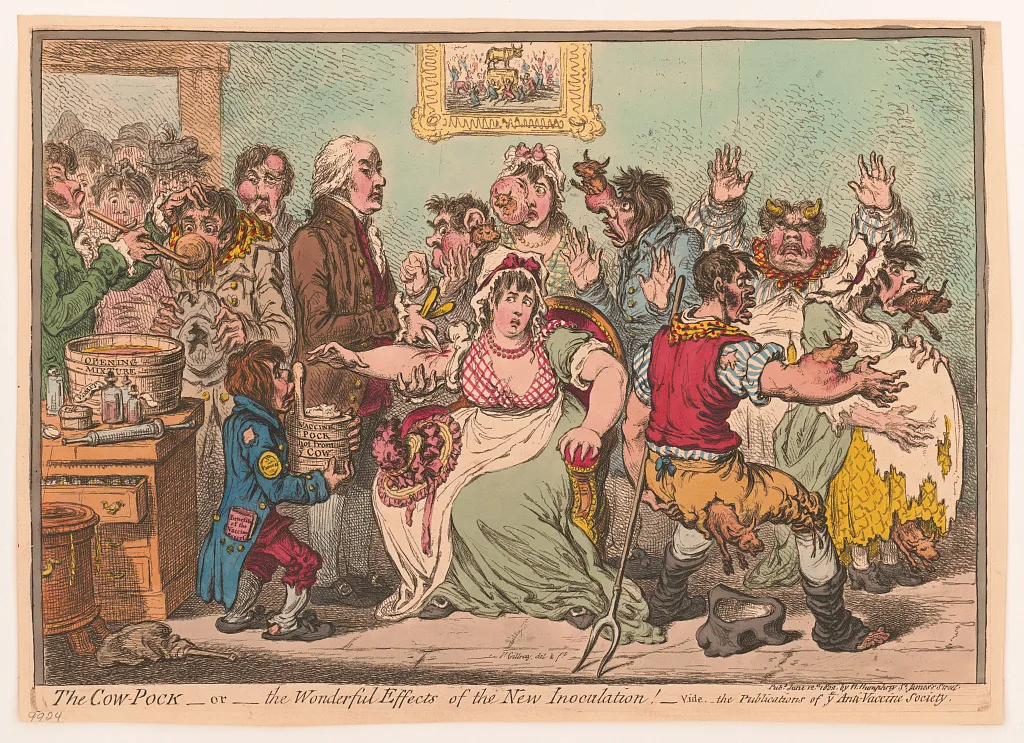
Vaccination spread with a speed nothing in medicine had matched. Within a few years it had crossed Europe and the Atlantic and reached India and beyond, carried on the arms of children in long human chains when no cow was to be had, and it was plainly safer than variolation, since it did not give the recipient smallpox and could not touch off an epidemic.13 Resistance came just as fast. Cartoonists drew the vaccinated sprouting horns and calves from their bodies, clergymen called it unchristian to put the humours of a beast into a child, and when governments later made it compulsory a movement of objectors rose against them, the direct ancestors of every vaccine argument we are still having.14 None of it altered the result. Country by country the pocked faces grew rarer, and in the twentieth century the World Health Organization set out to finish the task on purpose, hunting the virus into its last refuges. The final person to catch smallpox in the wild was a Somali hospital cook named Ali Maow Maalin, in 1977; he recovered. The last to catch it at all was a medical photographer in Birmingham who took it from a laboratory in her own building the next year and died, the disease claiming its final victim through human carelessness rather than the wild. In 1980 it was declared eradicated, the only human disease ever driven from the earth.15
Read from the Ward
I have never seen a case of smallpox, and I never will. Neither had most of my teachers; the disease was gone from the world before I entered medicine, and the nearest I have come to it is the faint round scar on the upper arms of people born early enough to have been vaccinated while it still walked among us. A great deal of what I do not see is like this. The measles brain-swelling that once filled neurology wards, the lockjaw of tetanus, the meningitis a single childhood jab now turns aside: I have met these mostly in textbooks and in the memory of older colleagues, as absences, as diseases shaped like the space where they used to be.16 It is the strangest kind of monument, a prevention, because its triumph is invisible. No one can point to the child who did not die.
What unsettles me, reading Jenner back, is how little of what I am trained to demand he actually possessed. I want a mechanism before I trust a treatment, and he had none; the immunity he was rousing would not be described for a hundred years. I want a controlled trial, and he had a boy and a hunch. Above all I want consent, and James Phipps, eight years old, the son of a servant, given first a live animal disease and then the deadliest infection known, could give none that would mean anything to me now. The single greatest stroke in the history of medicine would fail every standard I have been taught to bring to the smallest.
And yet I do not read it as licence for pride in our present carefulness so much as a reminder of what the carefulness is for. Jenner's century accepted a plain arithmetic that ours has the luxury of forgetting: that the child inoculated ran a small risk so that he, and those around him, might escape a large one. That is still the whole bargain of a vaccine, the individual's small hazard set against the community's large deliverance, and it is the point on which all our arguments still turn. We have built elaborate machinery around that bargain: trials, ethics boards, consent, the mechanism worked out to the last molecule. But the trade it guards has not changed since a Dorset farmer set a darning needle to his wife's arm. The machinery is a good thing, and I would not give back an ounce of it. It is scaffolding around Jenner's bare fact, and not a replacement for it.
The thing itself is not quite gone. By international agreement the last stocks of the live virus were not destroyed but kept, and they sit today in two high-security freezers, one at the CDC in Atlanta and one at a laboratory in Russia, the entire surviving reservoir of a killer that once carried off a third of a continent's children.17 I cannot quite decide what to feel about those two freezers; they are a trophy and a hazard and a strange memorial at once. But when I set them beside the arm of that Gloucestershire boy in the summer of 1796, and the whole vast weight of dying that has simply not happened since, the freezers seem the smaller fact. Somewhere a monster is asleep in a locked box, and the reason it is in a box at all is that a child once bared his arm to a country doctor who could not have told him why it would work.
- On smallpox's case-fatality (roughly 30 per cent), its estimated three hundred million deaths in the twentieth century, and its antiquity (the pustular rash on the mummy of Ramesses V), see Donald R. Hopkins, The Greatest Killer: Smallpox in History (Chicago: University of Chicago Press, 2002); Frank Fenner et al., Smallpox and Its Eradication (Geneva: WHO, 1988).↩
- On variolation in China (insufflation of powdered scabs), India, the Ottoman lands and West Africa long before its European adoption, and the ~1–2 per cent mortality of variolation against ~30 per cent for natural smallpox, see Stefan Riedel, "Edward Jenner and the History of Smallpox and Vaccination," Proceedings (Baylor University Medical Center) 18 (2005): 21–25.↩
- On Onesimus, the enslaved West African who described variolation to Cotton Mather, and the 1721 Boston inoculations by Zabdiel Boylston, see Riedel, "Edward Jenner"; "The History of Variolation," History of Vaccines (College of Physicians of Philadelphia).↩
- On Lady Mary Wortley Montagu learning variolation at Constantinople (1717) and its introduction to England from 1721, see Riedel, "Edward Jenner"; Hopkins, The Greatest Killer.↩
- On the folk knowledge that cow-pox protected dairy workers against smallpox, see Derrick Baxby, Jenner's Smallpox Vaccine: The Riddle of Vaccinia Virus and Its Origin (London: Heinemann, 1981).↩
- On Benjamin Jesty's 1774 cow-pox inoculation of his wife Elizabeth and two sons, and the several other cow-pox inoculators (e.g., Jobst Böse, 1769; Peter Plett, 1791) who preceded Jenner, see Patrick J. Pead, "Benjamin Jesty: New Light in the Dawn of Vaccination," The Lancet 362 (2003): 2104–09.↩
- On the 14 May 1796 inoculation of James Phipps (aged eight) with cow-pox from the hand of the dairymaid Sarah Nelmes (from the cow Blossom), see Riedel, "Edward Jenner"; Edward Jenner, An Inquiry into the Causes and Effects of the Variolæ Vaccinæ (London, 1798).↩
- On the 1 July 1796 variolation challenge that failed to take, the repeated later challenges, and Jenner's later provision of a cottage to Phipps, see Riedel, "Edward Jenner"; Hopkins, The Greatest Killer.↩
- Edward Jenner, An Inquiry into the Causes and Effects of the Variolæ Vaccinæ (London: printed for the author by Sampson Low, 1798); on the coining of "vaccine/vaccination" from vacca, and Pasteur's later (1881) generalisation of the term in Jenner's honour, see Riedel, "Edward Jenner."↩
- On Jenner's distinctive contribution — arm-to-arm serial vaccination that freed the practice from the cow, and systematic publication — as against Jesty's private act, see Baxby, Jenner's Smallpox Vaccine; Pead, "Benjamin Jesty."↩
- On Jenner's belief that cow-pox derived from "the grease," a disease of horses' heels, see Baxby, Jenner's Smallpox Vaccine; José Esparza et al., "Equination (inoculation of horsepox): An early alternative to vaccination," Vaccine 35 (2017): 7222–30.↩
- On vaccinia being serologically distinct from cow-pox (shown in 1939 by A. W. Downie) and genomically closest to horse-pox, see Esparza et al., "Equination" (2017); Baxby, Jenner's Smallpox Vaccine. The 2017 sequencing of a 1902 Mulford vaccine, whose core genome proved ~99.7 per cent identical to horsepox virus, is reported in Livia Schrick et al., "An Early American Smallpox Vaccine Based on Horsepox," New England Journal of Medicine 377 (2017): 1491–92.↩
- On the rapid global diffusion of vaccination, the arm-to-arm human chains (e.g., the Balmis expedition), and its greater safety than variolation, see Hervé Bazin, The Eradication of Smallpox (San Diego: Academic Press, 2000).↩
- On early anti-vaccination sentiment, Gillray's 1802 caricature The Cow-Pock, and the objector movement against the compulsory Vaccination Acts, see Nadja Durbach, Bodily Matters: The Anti-Vaccination Movement in England, 1853–1907 (Durham: Duke University Press, 2005).↩
- On Ali Maow Maalin as the last endemic smallpox case (1977) and the World Health Assembly's declaration of eradication on 8 May 1980 — the only human disease so eliminated — see Fenner et al., Smallpox and Its Eradication (1988).↩
- On the near-disappearance in vaccinated populations of measles (and its late complication, subacute sclerosing panencephalitis), tetanus, and Haemophilus influenzae type b meningitis, see Centers for Disease Control and Prevention, Epidemiology and Prevention of Vaccine-Preventable Diseases (the "Pink Book"), 14th ed. (2021).↩
- On the retention of the last authorised variola virus stocks at the CDC (Atlanta) and the VECTOR laboratory (Koltsovo, Russia), see WHO, "Smallpox" fact sheets and the reports of the WHO Advisory Committee on Variola Virus Research.↩
- Chicago
Kim, D. Y. “An Inquiry into the Cow-Pox.” Codex Chronica, July 3, 2026. https://codexchronica.com/an-inquiry-into-the-cow-pox/.
- APA
Kim, D. Y. (2026, July 3). An Inquiry into the Cow-Pox. Codex Chronica. https://codexchronica.com/an-inquiry-into-the-cow-pox/
- Baxby, Derrick. Jenner's Smallpox Vaccine: The Riddle of Vaccinia Virus and Its Origin. London: Heinemann Educational, 1981.
- Bazin, Hervé. The Eradication of Smallpox: Edward Jenner and the First and Only Eradication of a Human Infectious Disease. San Diego: Academic Press, 2000.
- Durbach, Nadja. Bodily Matters: The Anti-Vaccination Movement in England, 1853–1907. Durham: Duke University Press, 2005.
- Esparza, José, Livia Schrick, Clarissa R. Damaso, and Andreas Nitsche. "Equination (inoculation of horsepox): An early alternative to vaccination (inoculation of cowpox) and the potential role of horsepox virus in the origin of the smallpox vaccine." Vaccine 35 (2017): 7222–30.
- Fenner, Frank, Donald A. Henderson, Isao Arita, Zdeněk Ježek, and Ivan D. Ladnyi. Smallpox and Its Eradication. Geneva: World Health Organization, 1988.
- Hopkins, Donald R. The Greatest Killer: Smallpox in History. Chicago: University of Chicago Press, 2002.
- Jenner, Edward. An Inquiry into the Causes and Effects of the Variolæ Vaccinæ. London: printed for the author by Sampson Low, 1798.
- Pead, Patrick J. "Benjamin Jesty: New Light in the Dawn of Vaccination." The Lancet 362 (2003): 2104–09.
- Riedel, Stefan. "Edward Jenner and the History of Smallpox and Vaccination." Proceedings (Baylor University Medical Center) 18 (2005): 21–25.