
On the fourteenth of May, 1796, a Gloucestershire doctor scratched the arm of his gardener's eight-year-old son with matter from a milkmaid's sore, and seven weeks later put live smallpox into the same child to see whether the first had saved him. It had. From that summer descends the whole edifice of vaccination, and with it the only human disease ever driven from the earth. The boy is remembered, when he is remembered at all, as a happy footnote to a great man's triumph. He is worth a longer look, because almost everything that still troubles us about how such knowledge is won is already present in his small bared arm.
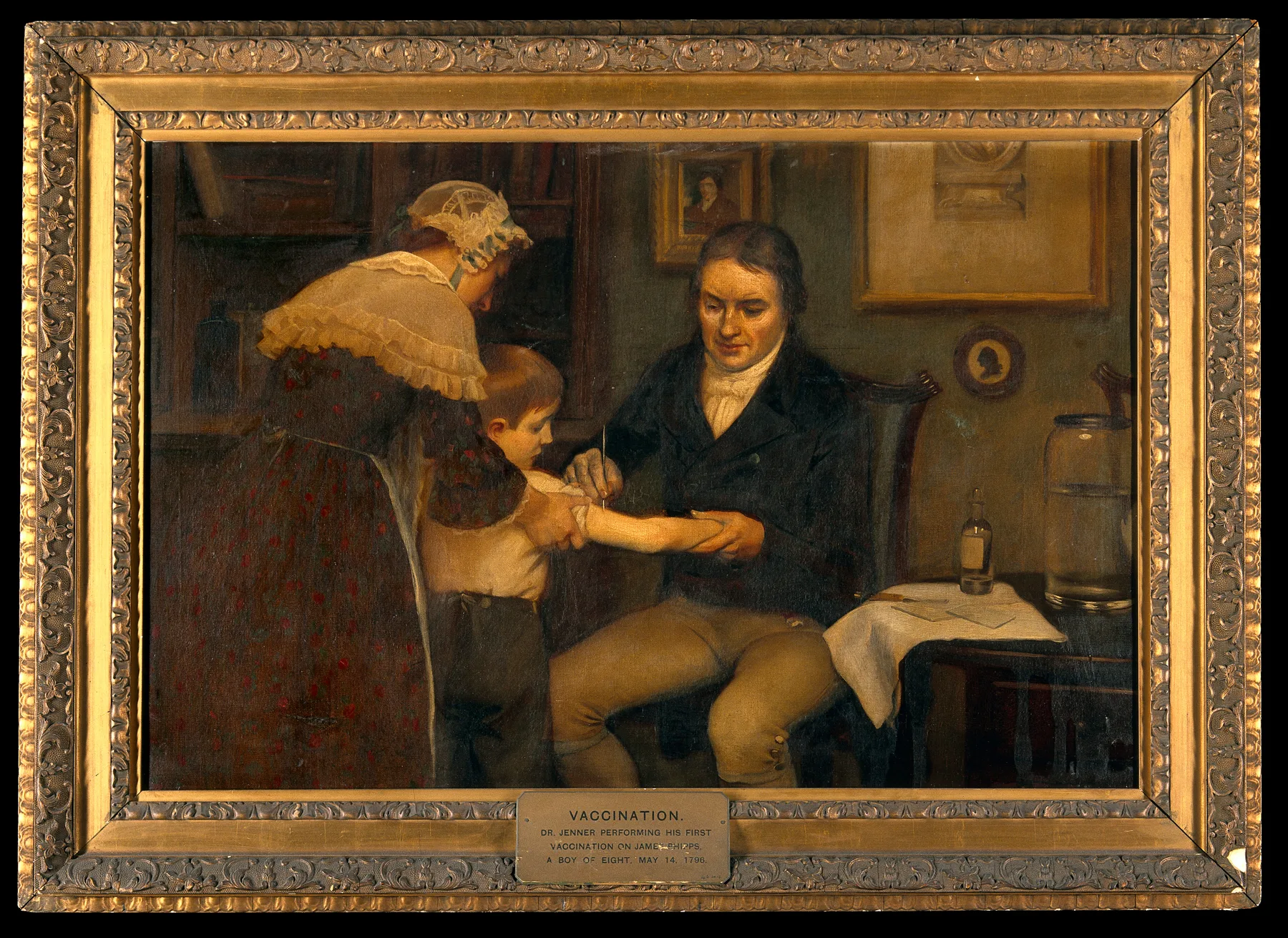
The story as it is usually told is charming, and that is the first thing wrong with it. A wise country doctor, a folk belief about milkmaids, a brave little boy, a needle, and a monster undone: it has the shape of a fairy tale, and fairy tales are built to reassure. James Phipps, eight years old, is the child actor in this one, and the telling grants him a kind of cheerful complicity, as though he had stepped forward for glory. He did not. He was chosen, and the grounds on which he was chosen are the grounds on which the powerless have been enrolled in the work of medicine ever since.
The gardener's son
Edward Jenner was a surgeon at Berkeley in Gloucestershire, a former pupil of the great anatomist John Hunter, and a man who had turned the dairies' old saying over in his mind for the better part of twenty years before he moved. When at last he did, the child he reached for was near to hand. James Phipps was the son of Jenner's own gardener, a landless labourer's boy from among the parish poor, christened in the same church where he would one day be buried.1 He was available, he was healthy, and his family was in no position to refuse the doctor who kept them. None of this was thought worth remarking at the time, because none of it needed to be. The eighteenth century did not experiment on the powerful. It experimented on servants, on children, on the inmates of workhouses and foundling homes, on the people whose bodies were already, in a hundred quiet ways, at the disposal of their betters.
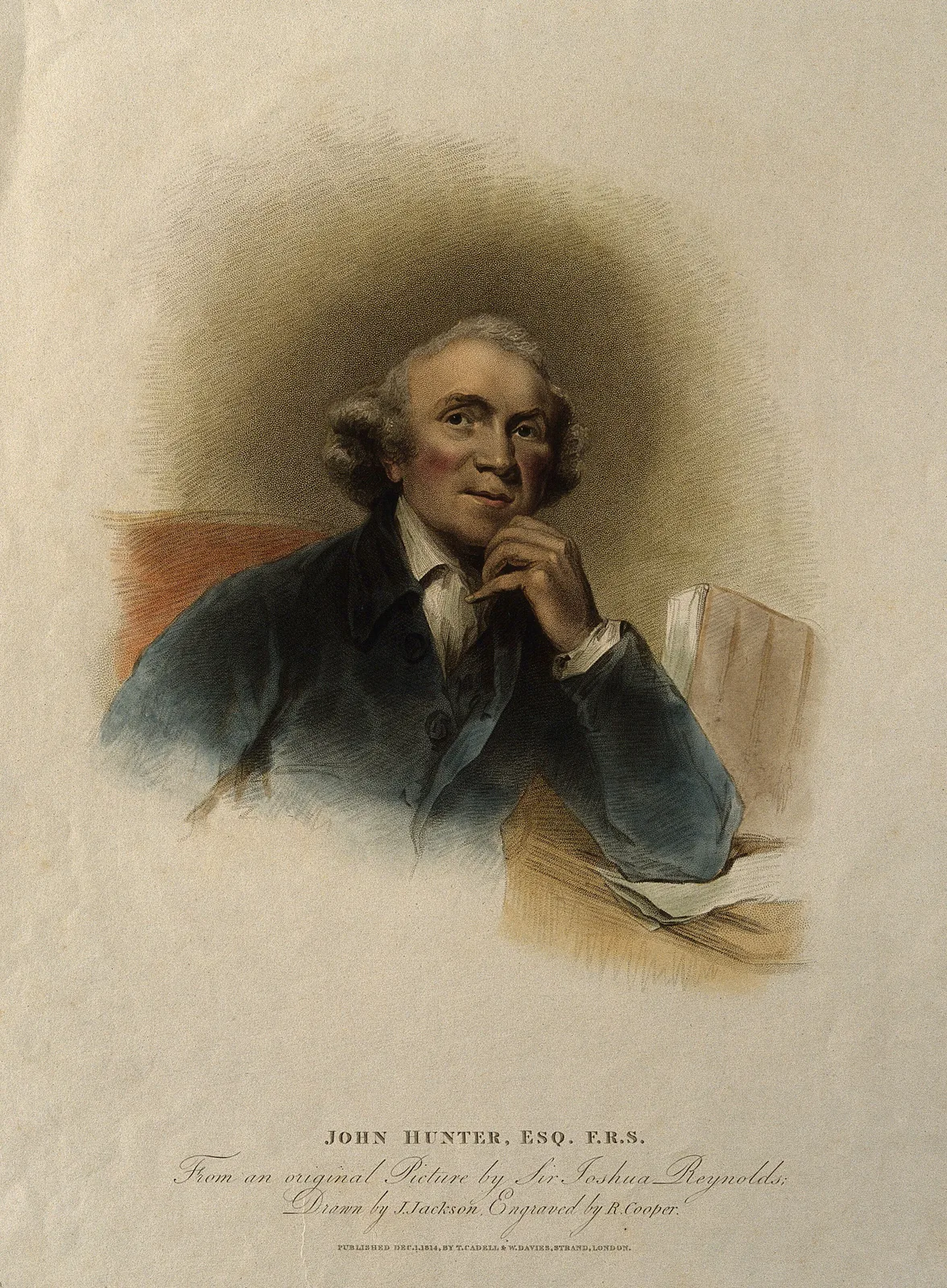
Jenner had learned his method from a man who prized it above all theory. In the words his biographer preserved, John Hunter had once written to him, on a different question: "I think your solution is just; but why think? Why not try the experiment?"2 It is one of the founding sentences of experimental medicine. Notice what it measures and what it leaves out. It weighs hard evidence above speculation, and on that count Hunter was right and the whole of modern practice has agreed with him. It says nothing whatever about who is to provide the arm. That silence was not cruelty; it was simply the shape of the world, and the boy in Jenner's garden fell into it without anyone thinking to ask.
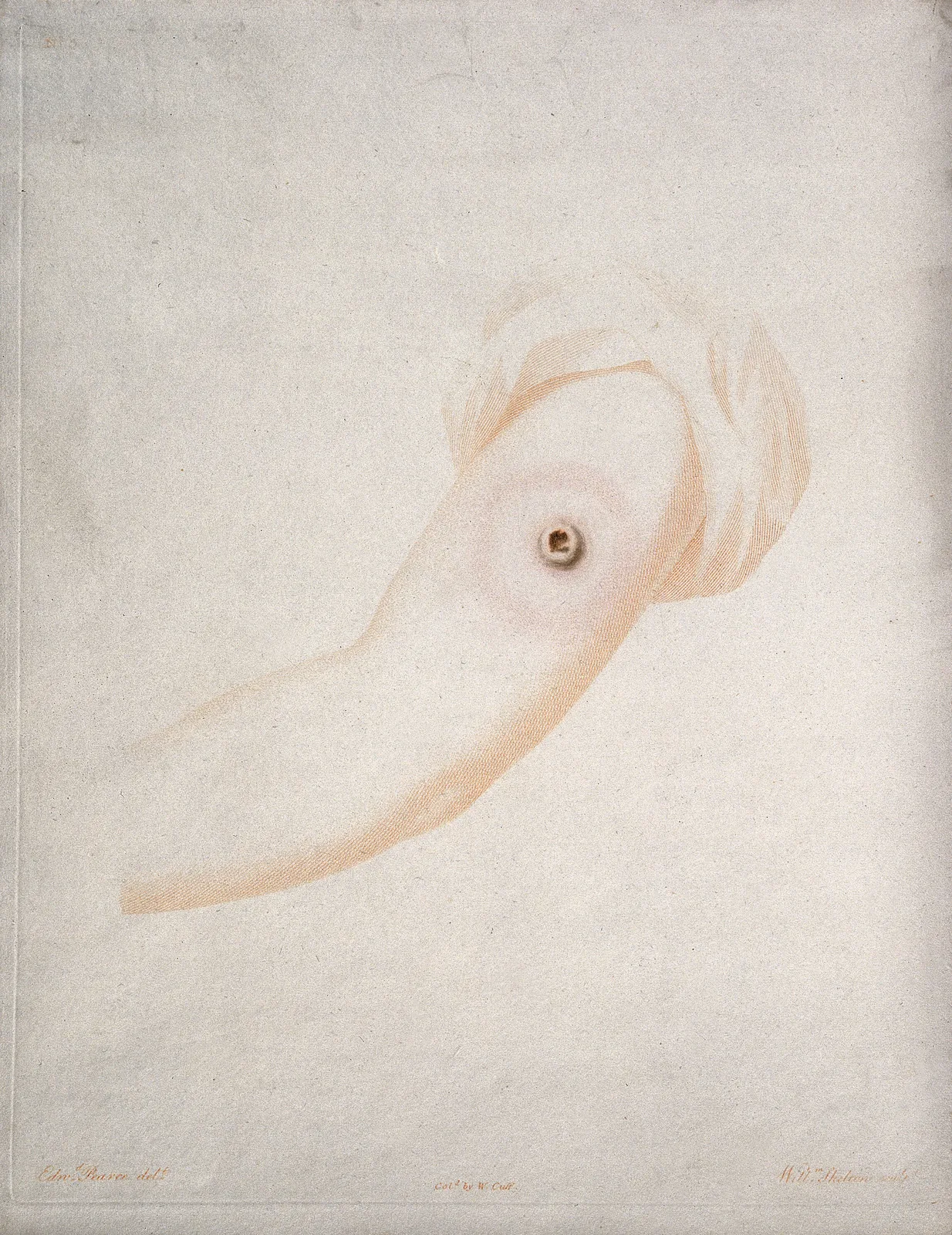
On the fourteenth of May, 1796, Jenner took matter from the cow-pox sores on the hand of a dairymaid, Sarah Nelmes, and worked it into two shallow cuts on the boy's arm.3 Phipps sickened lightly, as the milkmaids always had, and within days was well. Then came the act that no one may now repeat. On the first of July, Jenner inoculated the child with live smallpox, the true variola, the killer itself, to see whether the cow-pox had built a wall around him.4 Had he been wrong, he would have given an eight-year-old the very disease he claimed to abolish. He was not wrong. The smallpox would not take. He challenged the boy again some weeks later, and by the account of his own biographer went on testing him with smallpox some twenty times across the years that followed, each trial mounted to convince a doubting world that the protection held.5
The children in the small print
Phipps was not the first child Jenner had used, and here the record is more honest than the legend. Seven years earlier, in late 1789, Jenner had inoculated his own eldest son, Edward, then about ten months old, with swine-pox, and afterwards challenged the child with smallpox to see whether it had taken.6 It ought to count for something that the doctor tried his hunches on his own infant before he tried them on the gardener's son; it is the nearest thing to a defence the story offers, and I would not wave it away. But it did not stop with his own child.
When Jenner assembled the twenty-three cases of his 1798 Inquiry, they included others less fortunate than Phipps.7 One was a boy of five named John Baker, inoculated in March 1798 with matter that traced back not to a cow but to the greasy heels of a horse. The child took a mild illness and seemed to mend. Then he drops out of the argument, and the reason is a single cold clause in Jenner's own text: Baker "was rendered unfit for inoculation from having felt the effects of a contagious fever in a work-house, soon after this experiment was made."8 The proof that would have given his ordeal a meaning was never completed, because the boy fell ill of something else in the poorhouse where he lived, and there his trace in the record grows faint. He is a footnote to a footnote, a child used and then lost, and the triumphal version of events has no room for him at all.
The vaccine that lived in children
The deepest dependence on children was not in the proving of the vaccine. It lay in the spreading of it. Cow-pox matter dried on a lancet and died; to carry the protection any distance you needed the living infection itself, passed from a ripe blister on one arm into the fresh cut of the next. Vaccination therefore travelled as a human chain, and the links, over and over, were children: the young, the orphaned, the institutionalised, whose arms could be commanded and whose cow-pox was reliably fresh.9
The most extraordinary of these chains put to sea from the Spanish port of A Coruña on the thirtieth of November, 1803. The corvette María Pita carried a royal expedition charged with bringing vaccination to Spain's empire beyond the Atlantic, and it carried its vaccine alive in the bodies of twenty-two orphan boys, aged three to nine, drawn from the foundling home of the city.10 Two were vaccinated as the ship cleared harbour; when their blisters ripened, the matter was carried to two more, and so onward, arm to arm, an infection kept deliberately burning across the ocean in a relay of small children. In charge of them sailed Isabel Zendal Gómez, the rectoress of the orphanage, since widely honoured as the first nurse to take part in an international health mission, a recognition attributed to the World Health Organization in 1950.11 The scheme was ingenious, humane in its intention, and built entirely upon the bodies of children who belonged to no one able to object.
The chain had a hidden price. Matter drawn from a child's arm carried whatever else ran in that child's blood, and arm-to-arm vaccination sometimes passed on a good deal more than cow-pox. The most notorious instance fell at Rivalta, in Italy, in 1861, where vaccine taken from one infant gave syphilis to dozens of other children along with their protection.12 Disasters of that kind eventually drove the practice away from human chains and towards vaccine raised on the flanks of calves — which is to say that the children were used until an animal could be found to take their place.
What became of the boy
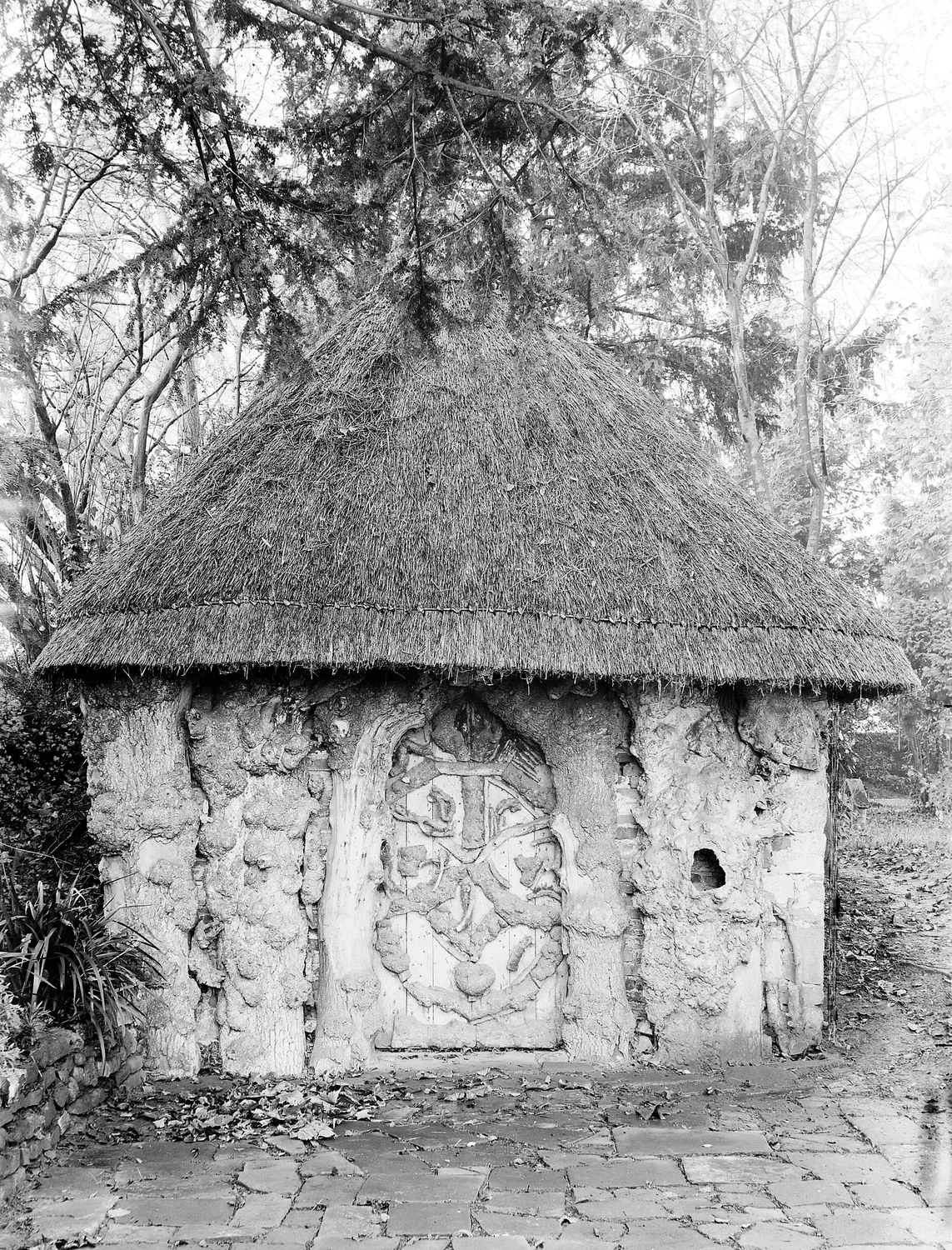
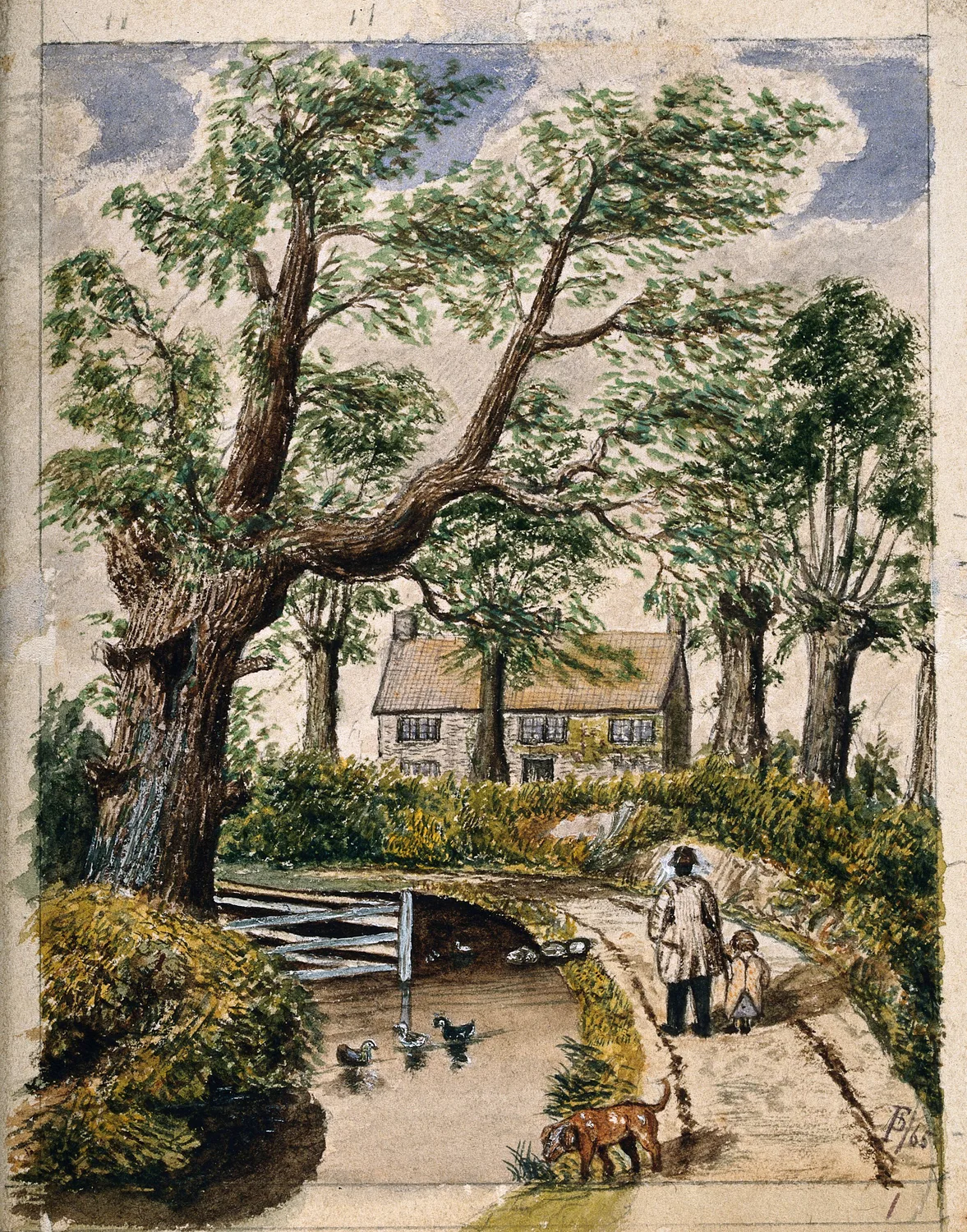
Jenner did not discard James Phipps. Whatever else is true of that strange bond, the doctor seems to have felt its weight. In later years he granted Phipps, by then a married man with children of his own, the rent-free lease of a cottage in Berkeley, and he laid out its small garden and stocked it with roses under his own eye.13 When Jenner died in 1823, Phipps, the gardener's son, the first vaccinated arm in the history of the world, walked among the mourners at his funeral.14 He outlived his benefactor by thirty years, dying in 1853, and was buried in the churchyard of St Mary's at Berkeley, where he had been christened as a small boy. The parish register keeps him in four words: "James Phipps, aged 66."15
Read from the Ward
The signatures I gather most often are not the patient's own. In the intensive-care unit the person whose body is at issue is frequently unconscious, or sedated past reach, or so scattered by illness that nothing they signed would carry the meaning a signature is supposed to carry. So I turn to a husband in a corridor, to a daughter on a telephone at two in the morning, and I ask them to decide on behalf of someone who cannot. Around that act we have raised a whole cathedral of protection: surrogates ranked by statute, ethics boards, the special rules that fence off children and prisoners and the incapacitated as populations who must be shielded precisely because they cannot shield themselves.16 Every stone of it is an answer to a question James Phipps was never in a position to be asked.
Reading his case from the far side of all that apparatus, what strikes me is less that Jenner lacked my scruples than that he had nowhere to put them. His world held no category for what James Phipps was. The research subject, the protected class, the person owed a special duty precisely because he cannot guard his own interest: these are inventions, and late ones, assembled brick by brick and mostly in the aftermath of harm. They were built out of exactly his kind of case, out of the Bakers who were used and then lost from the record, out of the orphans on the María Pita, out of a long line of the poor and the parentless upon whom medicine first tried itself. It would be easy, and cheap, to sit in judgement from here. The harder thing is to admit that the cathedral of consent I work inside was raised over precisely this ground, and that I could not do a day of my work without it. One does not build such elaborate walls around a danger that was never real.
And beneath all of it lies a fact the walls cannot abolish: someone must still be first. Every drug I prescribe without a second thought was, at some early hour, given to a human being on evidence that did not yet amount to proof. We have laboured to make that person a volunteer, informed and willing, free to walk away, and that is a genuine moral achievement. But the shape of the thing has not altered since a doctor bent over a boy in a Gloucestershire garden. A small, particular body takes a present risk so that a great and faceless multitude may be spared a larger one. Phipps was that body, chosen for his smallness in every sense, and the world of unpitted faces we now walk through was bought, in some part, with an arm he did not know how to withhold.
He seems to have borne it lightly. He took his cottage and his roses, followed his doctor to the grave, and lived out an ordinary span in the village where he was born, guarded by that first strange summer from the disease that had marked the faces of nearly everyone around him. Nothing in the record says he ever thought himself ill-used, and perhaps he was not. But when I stand at a bedside asking a stranger's family to weigh a hazard for someone who cannot answer, it is not Jenner I think of, nor his monster laid low. It is the boy: eight years old, his sleeve rolled up by a hand he trusted, giving his consent to nothing and his arm to everything.
- On James Phipps as the son of Jenner's gardener, a labourer among the Berkeley parish poor, christened and later buried at St Mary's, Berkeley, see John Baron, The Life of Edward Jenner (London: Henry Colburn, 1838); Stefan Riedel, "Edward Jenner and the History of Smallpox and Vaccination," Proceedings (Baylor University Medical Center) 18 (2005): 21–25.↩
- John Hunter to Edward Jenner (letter of 2 August 1775, on a query about hedgehog hibernation). The wording given here — "I think your solution is just; but why think? Why not try the experiment?" — is the rendering popularised by John Baron, The Life of Edward Jenner (1838); the surviving autograph in the Royal College of Surgeons reads more tersely, "why think, why not trie the experiment." The dictum is routinely cited as the emblem of Hunter's experimental creed.↩
- On the inoculation of James Phipps (aged eight) on 14 May 1796 with cow-pox matter from the hand of the dairymaid Sarah Nelmes (from a cow traditionally named Blossom), see Riedel, "Edward Jenner"; Edward Jenner, An Inquiry into the Causes and Effects of the Variolæ Vaccinæ (London, 1798).↩
- On the deliberate variolation challenge of 1 July 1796, which failed to take, see Riedel, "Edward Jenner"; Jenner, Inquiry (1798).↩
- On Jenner's repeated later re-challenge of Phipps with smallpox to demonstrate durable immunity, see Baron, The Life of Edward Jenner, who records Phipps being inoculated with variolous matter as many as a twentieth time without effect.↩
- Edward Jenner junior was born in January 1789; his father inoculated him with swine-pox in November 1789, when the child was about ten months old, and challenged him with smallpox in 1791. The material's identity (variously called swine-pox, pig-pox, or cow-pox) was itself uncertain. See Derrick Baxby, Jenner's Smallpox Vaccine: The Riddle of Vaccinia Virus and Its Origin (London: Heinemann, 1981).↩
- On the twenty-three case histories of the 1798 Inquiry, most of them natural cow-pox and a minority deliberate inoculations, see Jenner, Inquiry (1798); Baxby, Jenner's Smallpox Vaccine.↩
- Jenner, Inquiry (1798), Case XVIII: John Baker, a child of five, inoculated 16 March 1798 with matter from a pustule of equine ("grease") origin, who "was rendered unfit for inoculation from having felt the effects of a contagious fever in a work-house, soon after this experiment was made." See also Baxby, Jenner's Smallpox Vaccine.↩
- On the necessity of arm-to-arm serial transfer to keep the vaccine alive and its reliance on children as the successive links, see Hervé Bazin, The Eradication of Smallpox (San Diego: Academic Press, 2000); Baxby, Jenner's Smallpox Vaccine.↩
- On the Real Expedición Filantrópica de la Vacuna (Balmis Expedition), which sailed from A Coruña aboard the corvette María Pita on 30 November 1803 carrying twenty-two orphan boys (aged three to nine) from the city's foundling home as living vaccine carriers, see Catherine Mark and José G. Rigau-Pérez, "The World's First Immunization Campaign: The Spanish Smallpox Vaccine Expedition, 1803–1813," Bulletin of the History of Medicine 83 (2009): 63–94.↩
- On Isabel Zendal (Zendala) Gómez, rectoress of the A Coruña foundling home, who accompanied the boys as their carer, see Mark and Rigau-Pérez, "The World's First Immunization Campaign," which describes her as the only woman on the expedition. The often-repeated claim that the World Health Organization in 1950 named her the first nurse in an international health mission is widely reported in the Spanish literature but not well documented in primary WHO sources.↩
- On the transmission of syphilis by arm-to-arm vaccination and the Rivalta outbreak of 1861 (dozens of children infected), which helped drive the shift to animal (calf) lymph, see Baxby, Jenner's Smallpox Vaccine.↩
- On Jenner's grant to Phipps of a rent-free cottage at Berkeley and his laying out of its rose garden, see Baron, The Life of Edward Jenner.↩
- On Phipps's presence among the mourners at Jenner's funeral in February 1823, see Baron, The Life of Edward Jenner.↩
- On Phipps's death (25 April 1853) and burial at St Mary's, Berkeley, the parish register recording "James Phipps, 25th April 1853, aged 66," see the St Mary's, Berkeley, burial register as transcribed by the Edward Jenner Museum.↩
- On the modern framework of research protections — informed consent, institutional review boards, and the designation of children, prisoners, and the decisionally impaired as "vulnerable populations" owed additional safeguards — see The National Commission for the Protection of Human Subjects of Biomedical and Behavioral Research, The Belmont Report (Washington, DC: 1979); 45 C.F.R. § 46 (Common Rule), Subpart C (prisoners) and Subpart D (children).↩
- Chicago
Kim, D. Y. “The Boy James Phipps.” Codex Chronica, July 3, 2026. https://codexchronica.com/the-boy-james-phipps/.
- APA
Kim, D. Y. (2026, July 3). The Boy James Phipps. Codex Chronica. https://codexchronica.com/the-boy-james-phipps/
- Baron, John. The Life of Edward Jenner, M.D. London: Henry Colburn, 1838.
- Baxby, Derrick. Jenner's Smallpox Vaccine: The Riddle of Vaccinia Virus and Its Origin. London: Heinemann Educational, 1981.
- Bazin, Hervé. The Eradication of Smallpox: Edward Jenner and the First and Only Eradication of a Human Infectious Disease. San Diego: Academic Press, 2000.
- Fenner, Frank, Donald A. Henderson, Isao Arita, Zdeněk Ježek, and Ivan D. Ladnyi. Smallpox and Its Eradication. Geneva: World Health Organization, 1988.
- Hopkins, Donald R. The Greatest Killer: Smallpox in History. Chicago: University of Chicago Press, 2002.
- Jenner, Edward. An Inquiry into the Causes and Effects of the Variolæ Vaccinæ. London: printed for the author by Sampson Low, 1798.
- Mark, Catherine, and José G. Rigau-Pérez. "The World's First Immunization Campaign: The Spanish Smallpox Vaccine Expedition, 1803–1813." Bulletin of the History of Medicine 83 (2009): 63–94.
- National Commission for the Protection of Human Subjects of Biomedical and Behavioral Research. The Belmont Report: Ethical Principles and Guidelines for the Protection of Human Subjects of Research. Washington, DC: U.S. Government Printing Office, 1979.
- Riedel, Stefan. "Edward Jenner and the History of Smallpox and Vaccination." Proceedings (Baylor University Medical Center) 18 (2005): 21–25.