
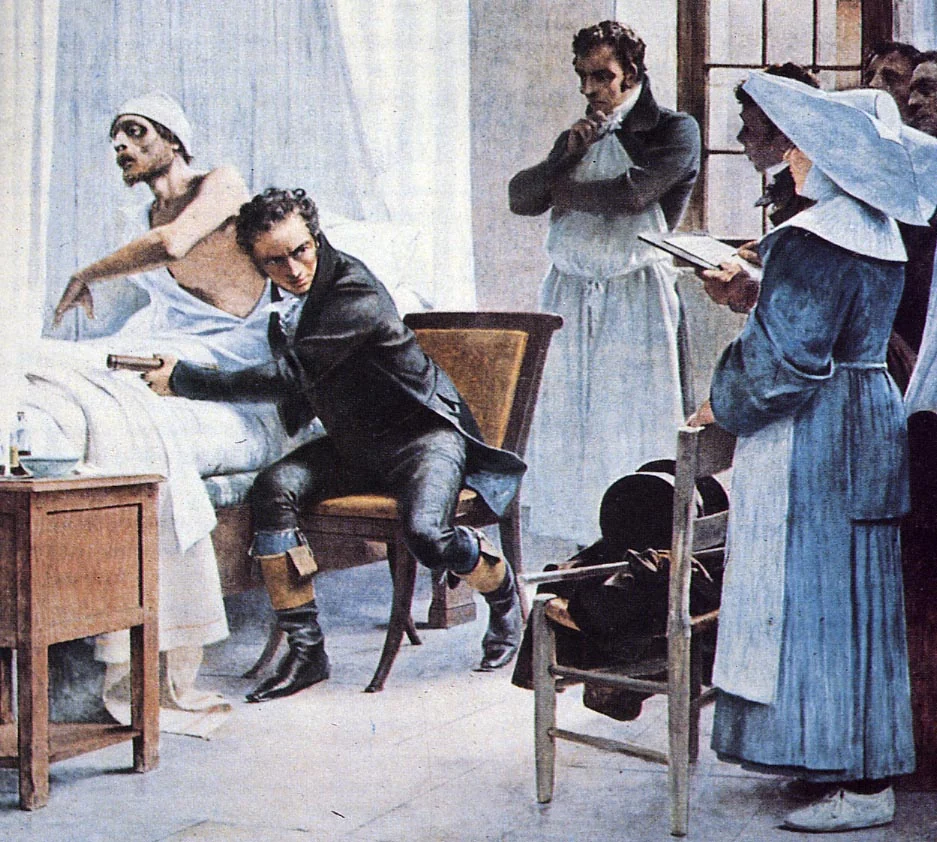
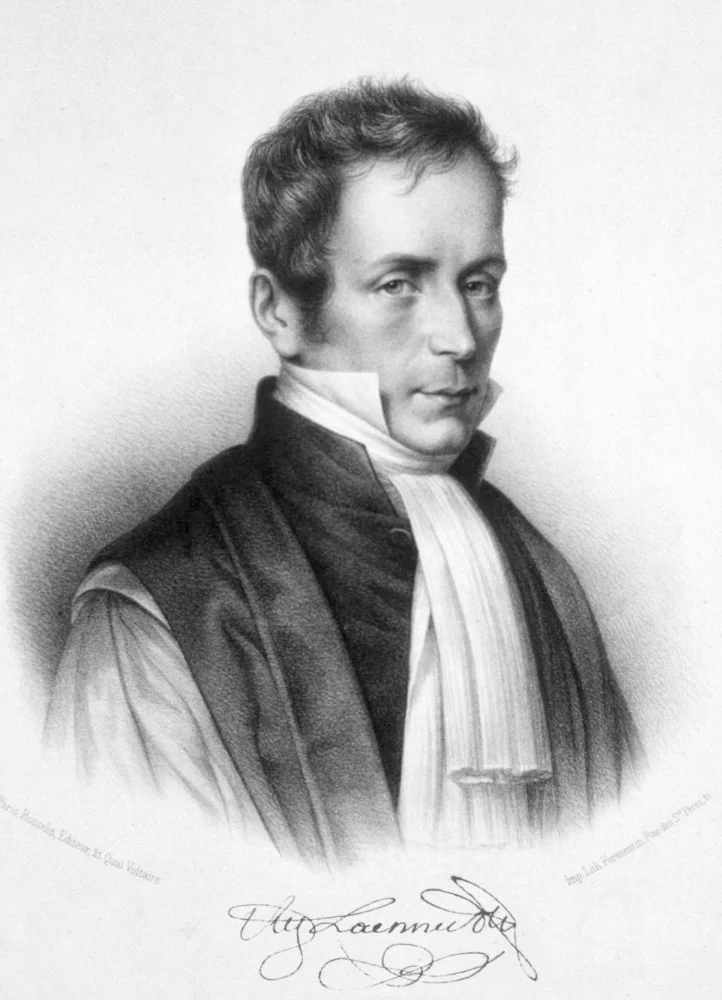
In 1816 a shy physician at a Paris hospital faced a young woman with a failing heart and a difficulty he could not politely solve: to hear the heart he would have had to lay his ear upon her chest. He rolled a sheet of paper into a tube instead, set one end against her and the other to his ear, and heard the beat more clearly than he ever had. From that embarrassment came the stethoscope, and with it a new way to know the inside of a living body — by its sounds. René Laennec spent the ten years left to him teaching medicine how to listen. The disease he learned to hear better than any man alive would be the one that killed him.
The ear on the chest
Before Laennec, a physician who wished to hear the heart or the lungs had one method, and it was a poor one. He pressed his ear directly to the patient's chest, a practice as old as Hippocrates that had advanced almost nothing in two thousand years. It was beaten by a heavy patient, whose flesh muffled everything beneath. It was unthinkable with most women, for whom the intimacy could not be asked. In daily practice many physicians simply went without, and read the chest by tapping it and laying on the hand, which told them little.
In the autumn of 1816, at the Hôpital Necker in Paris, Laennec was consulted by a young woman with the signs of a diseased heart. She was young, and she was stout, and both percussion and the laid-on hand failed him. The one examination that might have settled the case was the one her age and her sex placed beyond his reach.
A cylinder of paper
He remembered a children's game. A pin scratched at one end of a long wooden beam can be heard, faint and sharp, by an ear laid to the other; sound runs through solid matter better than through open air.1 On the thought, he took a quire of paper, rolled it tight into a cylinder, set one end over the woman's heart and his ear to the other. The beat returned to him stronger and cleaner than any he had ever caught by pressing flesh to flesh.2
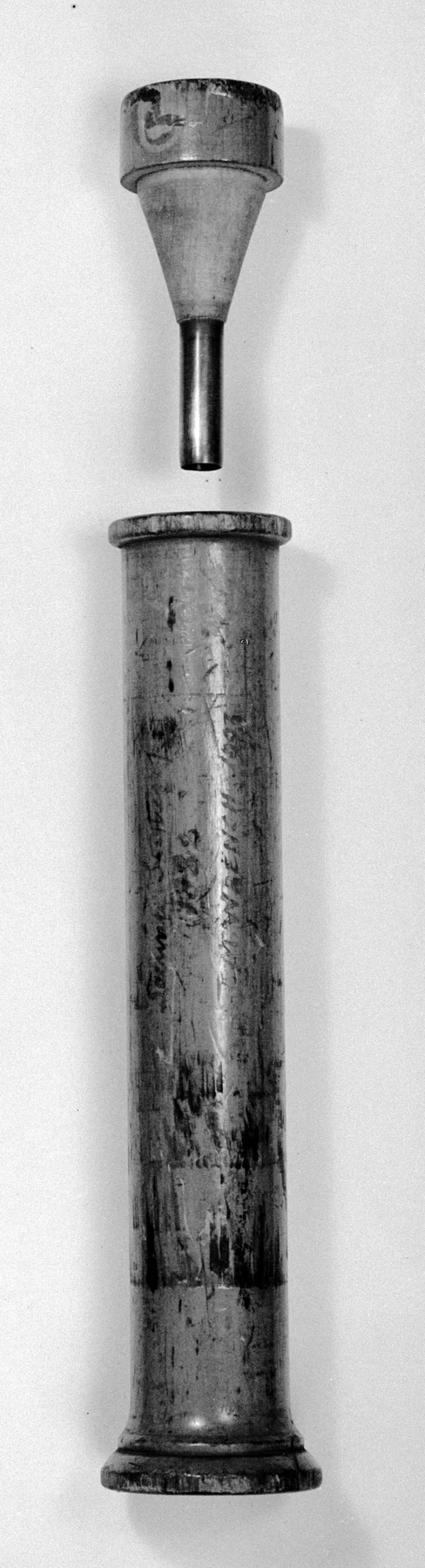
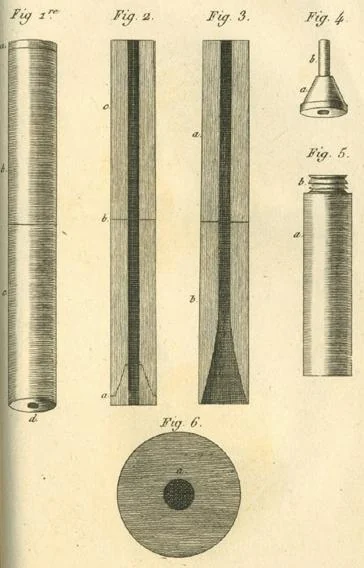
He had the principle, and he spent the following months making the instrument. The roll of paper became a hollow wooden cylinder about a foot long, plain enough to be turned on a lathe, fitted with a removable plug so that it suited either the breath of the lungs or the beat of the heart. He named it from the Greek for the chest one searches: a stethoscope.3 The plainness was the whole point. Any physician could own one and learn to use it on the living.
The new language
The instrument was the small part. What made Laennec great was what he did with what he heard. Over years at Necker he listened to the dying, set down each sound the chest could make, and then, when the patient died, opened the body to find what had made it.4 He matched the noise to the lesion, over and over, until one could stand for the other. A coarse bubbling he called the râle; a dry whistle, the rhonchus; a bleating, broken quality in the transmitted voice he named egophony; and a clear ringing of the spoken voice through the chest wall, pectoriloquy, he read as the sign of a cavity hollowed in the lung.5
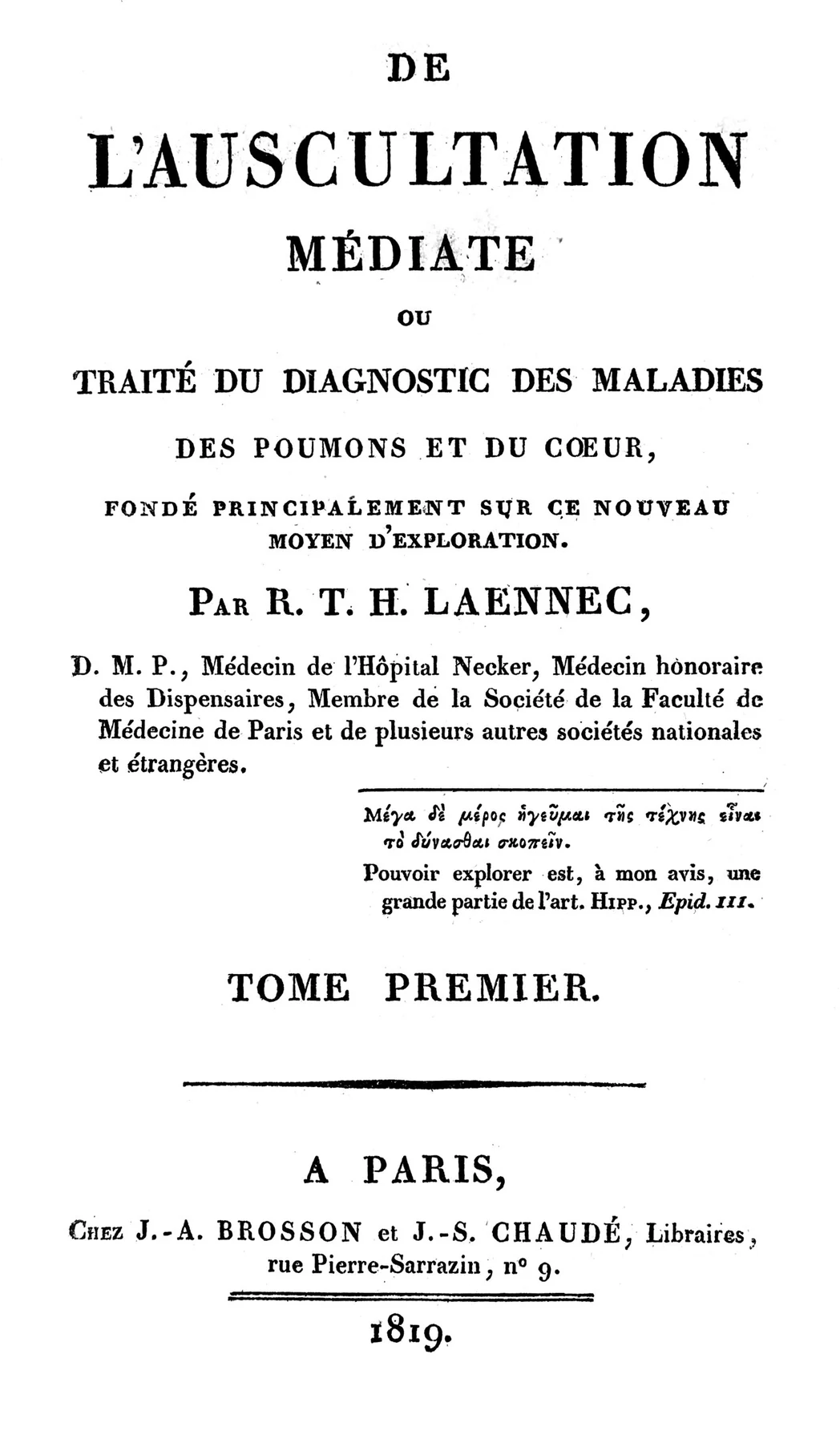
In 1819 he set it all into a treatise, De l'auscultation médiate, that taught a whole generation to hear disease.6 The living chest, which had been nearly mute to the physician, became a thing that could be read like a page. Above all it spoke of phthisis, the consumption that was quietly emptying the wards, whose cavities and rattles Laennec could now name in a patient who still walked and talked.7 For the first time the disease could be followed in the living, and not merely discovered in the dead. A physician could now put something like a date to the hollowing of a lung, and follow a cavity as it widened from one visit to the next. No cure travelled with that knowledge, and none would for nearly a century; yet blind waiting had become something a doctor could read, and that alone changed what could honestly be said at a bedside.
The reach of it
Auscultation did not win at once. The wooden tube looked absurd to older men who trusted their hands, and the skill took patience to acquire. But the young came to Paris to learn it, carried it home across Europe and the Atlantic, and within a generation no physician could be trained without it. The stethoscope became, and has stayed, the plain badge of the doctor at the bedside.
It changed the physician as much as the diagnosis, in a way not everyone welcomed. The cylinder drew the doctor's attention from what the patient said about the illness toward what the body disclosed beneath the words, and later historians have marked this as the point at which medicine began to attend to the organs as closely as to the person who carried them.8 Something real was gained, the cavity heard before it could ever be seen; something quieter was given up, and the bedside has been working out the balance ever since. Laennec had handed medicine a sense it never properly owned, and asked of the patient nothing more than to breathe and to speak.
What the chest says
The oldest instrument I carry is the one around my neck, and its design is two centuries old. The tubes are rubber now and there are two earpieces in place of one, but the act is exactly Laennec's at Necker: I put one end to a chest and listen. It is the first examination I was taught, and on most days still the first I perform, before any machine is sent for. Part of why I keep to it is habit and ritual. The rest is that auscultation asks of me something no scan does — to go quiet, and stand close, and attend to one person for the length of a held breath.
What Laennec did was harder than inventing a tube. He turned the body's noises into a language by the most patient method there is: he listened to the living, then looked inside the dead, and would not let himself name a sound until he had seen the thing that made it. That discipline, the sign matched to the lesion and neither trusted on its own, is the whole of physical diagnosis, and it is the part of my training the scanners have made easiest to skip. I can send a patient through a machine and have the cavity drawn for me in minutes. Laennec earned the same knowledge one body at a time, and the signs he paid for in the dead-house are the ones I still name at the bedside.
I think about how much of the man was in the work. He was a small, sickly Breton who had lost his own mother to phthisis as a young child, and he spent his short career bent over the chests of the dying, learning the exact voice of the disease that had taken her.9 Pectoriloquy, the words ringing clear through a wall of lung where a cavity has opened: he described it from a thousand patients, never seeing how precisely he was describing his own end.
By the summer of 1826 the signs were in his own chest. He had weakened through the year, and at last he asked his nephew Mériadec, whom he had trained in the method, to examine him.10 The young man took up the wooden cylinder his uncle had made, set it to the failing chest, and heard the râles and the hollow, speaking note of a cavity — the very signs Laennec had named, sounding now in the body of the man who named them. No physician alive could read them better than the patient himself. He died that August, at forty-five, of the consumption he had taught the world to hear, and he left the stethoscope to the nephew who had listened.11 It is, near enough in its working, the same instrument that hangs warm against me when I take it off at the end of a shift.
Read from the Ward
The oldest instrument I carry is the one around my neck, and its design is two centuries old. The tubes are rubber now and there are two earpieces in place of one, but the act is exactly Laennec's at Necker: I put one end to a chest and listen. It is the first examination I was taught, and on most days still the first I perform, before any machine is sent for. Part of why I keep to it is habit and ritual. The rest is that auscultation asks of me something no scan does — to go quiet, and stand close, and attend to one person for the length of a held breath.
What Laennec did was harder than inventing a tube. He turned the body's noises into a language by the most patient method there is: he listened to the living, then looked inside the dead, and would not let himself name a sound until he had seen the thing that made it. That discipline, the sign matched to the lesion and neither trusted on its own, is the whole of physical diagnosis, and it is the part of my training the scanners have made easiest to skip. I can send a patient through a machine and have the cavity drawn for me in minutes. Laennec earned the same knowledge one body at a time, and the signs he paid for in the dead-house are the ones I still name at the bedside.
I think about how much of the man was in the work. He was a small, sickly Breton who had lost his own mother to phthisis as a young child, and he spent his short career bent over the chests of the dying, learning the exact voice of the disease that had taken her.9 Pectoriloquy, the words ringing clear through a wall of lung where a cavity has opened: he described it from a thousand patients, never seeing how precisely he was describing his own end.
By the summer of 1826 the signs were in his own chest. He had weakened through the year, and at last he asked his nephew Mériadec, whom he had trained in the method, to examine him.10 The young man took up the wooden cylinder his uncle had made, set it to the failing chest, and heard the râles and the hollow, speaking note of a cavity — the very signs Laennec had named, sounding now in the body of the man who named them. No physician alive could read them better than the patient himself. He died that August, at forty-five, of the consumption he had taught the world to hear, and he left the stethoscope to the nephew who had listened.11 It is, near enough in its working, the same instrument that hangs warm against me when I take it off at the end of a shift.
- Laennec traced the idea to the principle that sound travels well through solid bodies, recalling the children's pastime of hearing a pin scratched at the far end of a wooden beam: R. T. H. Laennec, De l'auscultation médiate (Paris: Brosson et Chaudé, 1819), preface; Ariel Roguin, "Rene Theophile Hyacinthe Laënnec (1781–1826): The Man Behind the Stethoscope," Clinical Medicine & Research 4, no. 3 (2006): 230–35.↩
- On the 1816 consultation at the Hôpital Necker — a young woman whose age, sex and stoutness defeated direct auscultation and percussion, prompting Laennec to roll a quire of paper into a cylinder — see Laennec, De l'auscultation médiate (1819), preface; Jacalyn Duffin, To See with a Better Eye: A Life of R. T. H. Laennec (Princeton: Princeton University Press, 1998).↩
- On the wooden monaural cylinder (about one foot long, with a detachable plug for breath or heart sounds) and the naming of the "stethoscope" from the Greek stēthos (chest) and skopein (to examine), see Laennec, De l'auscultation médiate (1819); A. Sakula, "R T H Laennec 1781–1826: His Life and Work: A Bicentenary Appreciation," Thorax 36, no. 2 (1981): 81–90.↩
- On Laennec's anatomo-clinical method — correlating sounds heard in the living with lesions found at autopsy — see Duffin, To See with a Better Eye; Stanley Joel Reiser, Medicine and the Reign of Technology (Cambridge: Cambridge University Press, 1978).↩
- Laennec described and named the principal auscultatory signs — râles, rhonchi, egophony and pectoriloquy (the last a sign of pulmonary cavity) — in De l'auscultation médiate (1819); see also Roguin, "The Man Behind the Stethoscope."↩
- R. T. H. Laennec, De l'auscultation médiate, ou Traité du diagnostic des maladies des poumons et du cœur (Paris: Brosson et Chaudé, 1819).↩
- On Laennec's advances in diagnosing pulmonary tuberculosis (phthisis) in the living, see Sakula, "Laennec 1781–1826"; Roguin, "The Man Behind the Stethoscope."↩
- On the gradual spread of mediate auscultation and the stethoscope as the emblem of clinical medicine, see Reiser, Medicine and the Reign of Technology; Sakula, "Laennec 1781–1826."↩
- On Laennec's own frail health, his Breton childhood and the loss of his mother to tuberculosis when he was a young child, see Roguin, "The Man Behind the Stethoscope"; "René Laënnec," Encyclopædia Britannica.↩
- On Laennec asking his nephew and pupil Mériadec Laennec to examine him in his final illness, see Duffin, To See with a Better Eye; Roguin, "The Man Behind the Stethoscope."↩
- Laennec died of cavitary tuberculosis on 13 August 1826, aged forty-five, and bequeathed his watch, ring and stethoscope to his nephew Mériadec: Roguin, "The Man Behind the Stethoscope"; "René Laënnec," Encyclopædia Britannica.↩
- Chicago
Kim, D. Y. “A Cylinder of Paper.” Codex Chronica, June 28, 2026. https://codexchronica.com/a-cylinder-of-paper/.
- APA
Kim, D. Y. (2026, June 28). A Cylinder of Paper. Codex Chronica. https://codexchronica.com/a-cylinder-of-paper/
- Laennec, R. T. H. De l'auscultation médiate, ou Traité du diagnostic des maladies des poumons et du cœur. Paris: Brosson et Chaudé, 1819.
- Duffin, Jacalyn. To See with a Better Eye: A Life of R. T. H. Laennec. Princeton: Princeton University Press, 1998.
- Roguin, Ariel. "Rene Theophile Hyacinthe Laënnec (1781–1826): The Man Behind the Stethoscope." Clinical Medicine & Research 4, no. 3 (2006): 230–35.
- Sakula, A. "R T H Laennec 1781–1826: His Life and Work: A Bicentenary Appreciation." Thorax 36, no. 2 (1981): 81–90.
- Reiser, Stanley Joel. Medicine and the Reign of Technology. Cambridge: Cambridge University Press, 1978.
- "René Laënnec." Encyclopædia Britannica.