
For eleven years penicillin existed as a sentence in a journal and a smear of mould in a jar, and no one was the healthier for it. Turning it into a medicine was not a discovery but a feat of plumbing and patience, carried out in a converted pathology laboratory in Oxford by a handful of people whose names history has mostly mislaid, and finished, against every expectation, in the fermentation vats of the American Midwest. The drug that saved the wounded of the Second World War was grown, at first, in hospital bedpans.
The note that lay dormant
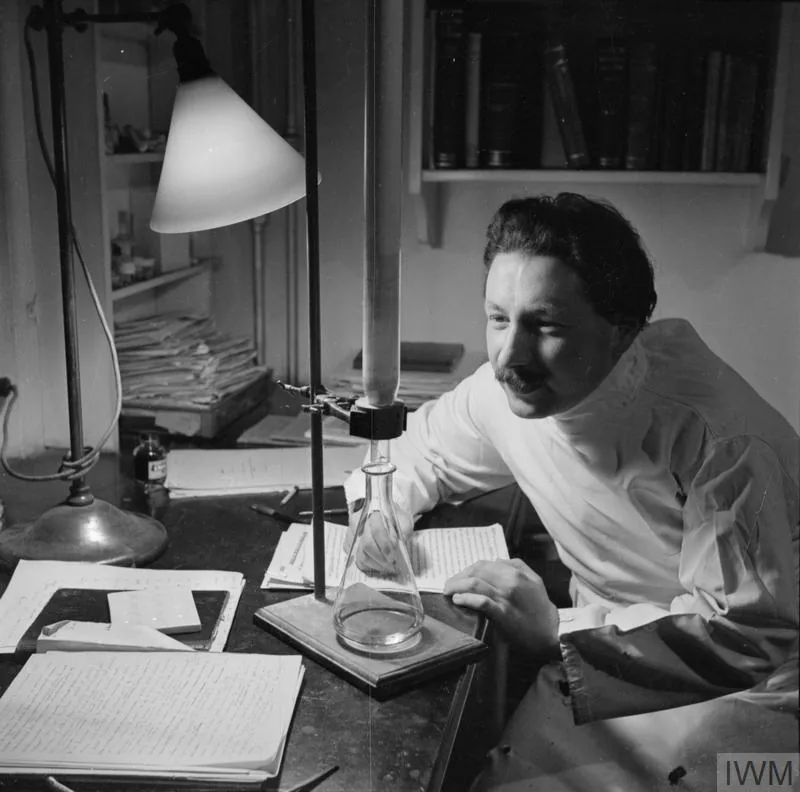
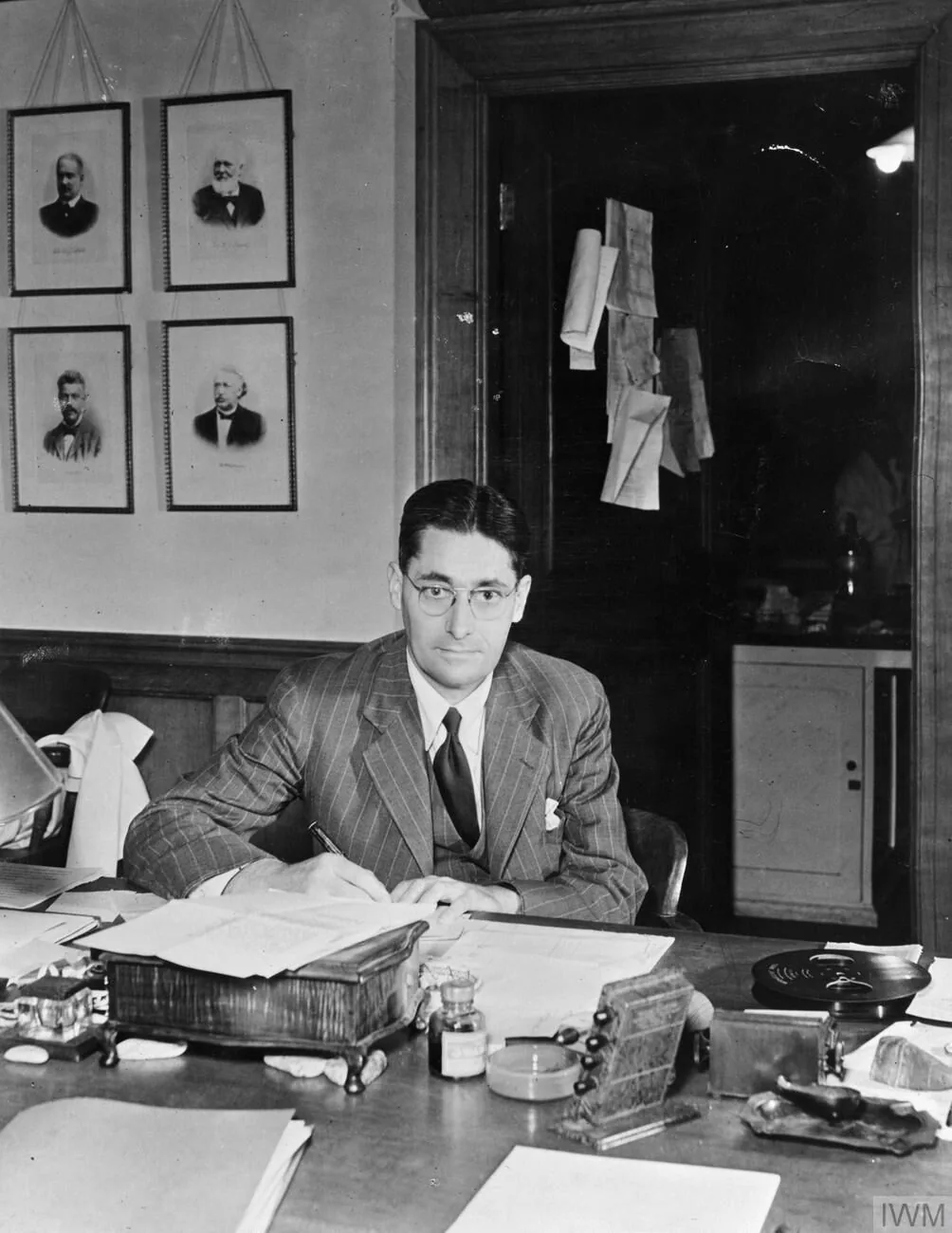
By the late 1930s Fleming's penicillin had passed almost entirely out of mind. It was revived not by a clinician hunting a cure but by two scientists at the Sir William Dunn School of Pathology in Oxford who were interested, to begin with, in a pure problem. Howard Florey, an Australian, was the school's professor and its driving will — exacting, restless, more physiologist and administrator than chemist, with a gift for marshalling other people's talents toward an end he had fixed upon. Ernst Chain was a German-Jewish biochemist who had fled Berlin in 1933, brilliant and quick to take offence, and it was Chain who, surveying the literature on natural antibacterial substances, came upon Fleming's nine-year-old paper and saw in it not a cure but a molecule worth understanding.1 The two resolved to study penicillin as chemistry. That it might become a drug was, at the outset, a secondary hope.
The third man mattered as much as either and was thanked far less. Norman Heatley was a young biochemist of no great seniority and extraordinary practical gift, the sort who could build whatever an experiment required out of whatever lay to hand. It was Heatley who would solve the problems that turned a laboratory curiosity into something one could draw up into a syringe, and it is a fair summary of the whole affair that a later Oxford colleague, Henry Harris, reduced it to four words: "without Heatley, no penicillin."2
The night of the mice
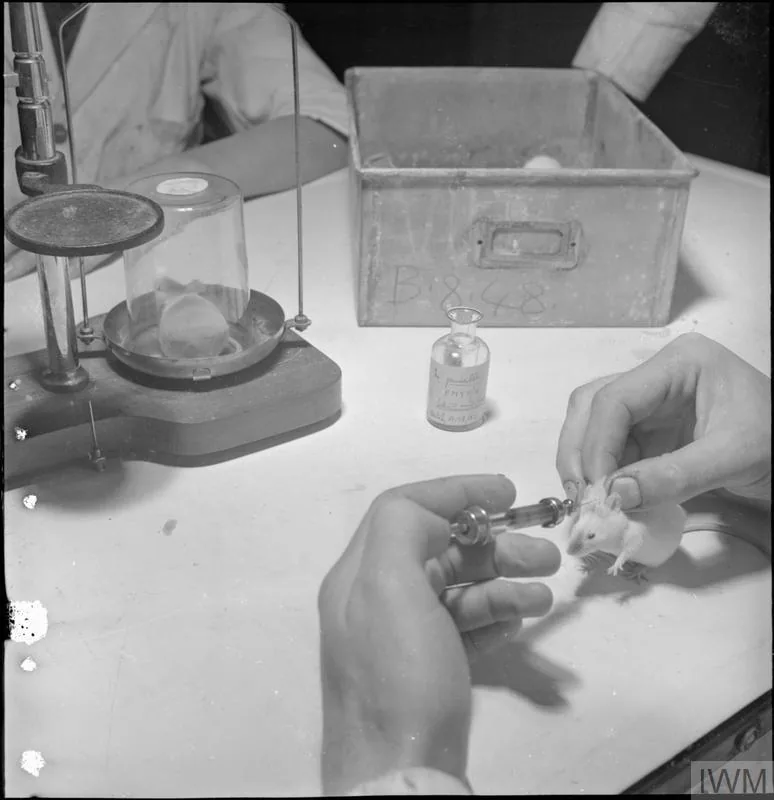
The decisive experiment was small enough to hold in one hand. On the twenty-fifth of May, 1940, the team infected eight mice with a lethal dose of streptococci and gave four of them injections of penicillin, leaving four as untreated controls.3 Heatley stayed in the laboratory through the night to give the final doses and walked home in the small hours; by the next morning all four untreated mice were dead and all four treated mice were alive. Chain is said to have called the result a miracle. Heatley, undemonstrative to the last, recorded in his diary only that it really looked as if penicillin might be of practical importance — and noted, with the same precision he brought to everything, that in the darkness on the way home he had put his underclothes on back to front.4
The mouse experiment converted a hope into an obligation. The team published their findings in The Lancet in August 1940, in a paper signed by the whole laboratory with the authors listed alphabetically, and turned at once to the problem that would consume the next several years.5 A thing that saved mice would have to be made in quantities enough to save people, and the war was closing in: France had just fallen, invasion seemed near, and the workers rubbed the linings of their coats with spores of the mould, so that if they had to flee and burn the laboratory behind them the strain could be raised again from the cloth on their backs.6
The penicillin factory
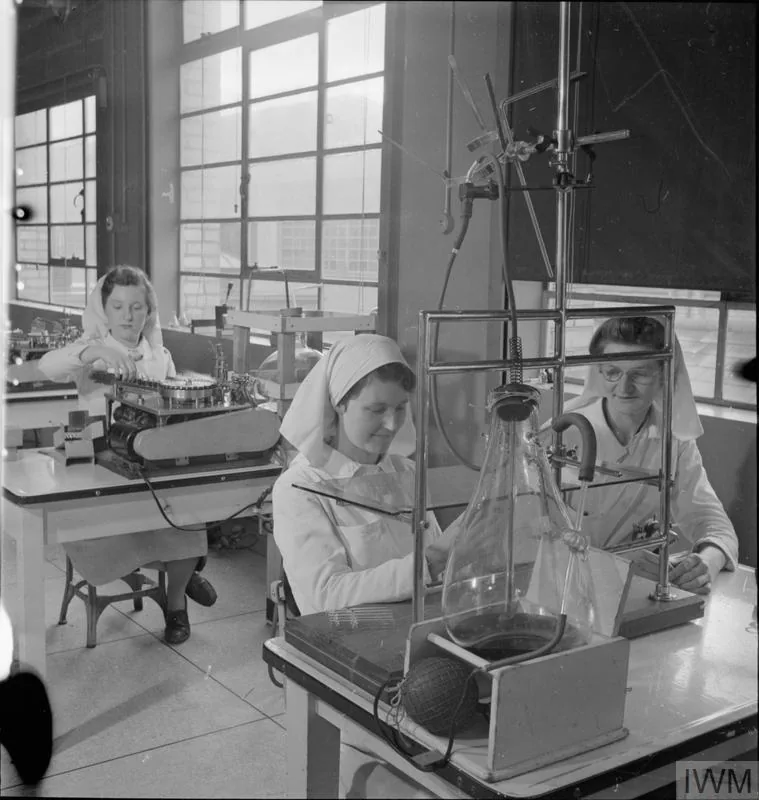
The obstacle was never whether penicillin worked. It was that there was so vanishingly little of it. The mould shed its drug into broth in concentrations so low that it took hundreds of litres of what the team called "mould juice" to recover a few milligrams of impure solid, and a single human being, dosed for a serious infection, might need the yield of two thousand litres or more.7 To make penicillin on that scale the Dunn School turned itself into a factory of the strangest kind. The mould was grown on the surface of broth in every flat vessel that could be found — biscuit tins, baths, milk churns and, most famously, hospital bedpans, whose shape proved so apt that a pottery was later commissioned to make ceramic culture vessels modelled on them.8 A team of six women, paid two pounds a week and remembered as the "penicillin girls," tended the cultures, seeding and harvesting the broth day after day: Ruth Callow, Claire Inayat, Betty Cooke, Peggy Gardner, Megan Lancaster and Patricia McKegney.9
Heatley supplied the machinery of the place. He devised a way to draw the penicillin out of the raw broth by shaking it into amyl acetate and then back into water by shifting its acidity, a back-extraction gentle enough not to destroy the fragile molecule, and built it into a continuous apparatus cobbled together from bottles, milk churns and yards of glass and rubber tubing, run through with broth as it came off the line.10 He also worked out how to measure what they had, defining a standard "Oxford unit" of penicillin by the width of the clear ring it cut in a lawn of bacteria on a plate, so that for the first time the stuff could be counted.11 Edward Abraham and Chain pushed the purification further with column chromatography. None of it was elegant and all of it was necessary; in effect a university department had become a small, improvised pharmaceutical works, producing by hand a medicine the world did not yet know it needed.
Albert Alexander
In February of 1941 they had at last accumulated enough penicillin to try it on a human being, and they chose, as the first patient, a man already beyond other help. Albert Alexander was a forty-three-year-old Oxford policeman with an overwhelming infection — abscesses across his face and in his lungs, one eye already removed, his blood poisoned and his death, by every contemporary expectation, certain.12 The textbook account, repeated for decades, is that his ordeal began with a scratch from a rose thorn while gardening; there is in fact no evidence for the roses, and good reason to think the wound was one of war, for Alexander had been sent to the south coast under the mutual-aid arrangements between police forces and may well have been hurt in a German air raid.13 However it began, by February 1941 it was killing him.
On the twelfth of February the young clinician Charles Fletcher gave Alexander an intravenous dose of penicillin, and the effect was beyond anything in the experience of the men at the bedside.14 Within a day his temperature had fallen, his appetite returned, the spreading abscesses began to dry; a man dying of sepsis was visibly coming back. And then the penicillin ran out. There was so little of it, and the need was so great, that the team took to recovering the unused drug from the patient's own urine and carrying it back across Oxford to be re-purified and given again — but even this could not keep pace, and after five days the supply was exhausted.15 Without it Alexander relapsed, and on the fifteenth of March, 1941, he died. Fletcher, who never forgot him, recorded that there had been no doubt at all about the improvement, and no sign of any poisoning by the drug across five days of continuous use; the treatment had not failed, the supply had.16 It is a distinction with terrible weight. After Alexander the team made a grim, practical decision and turned to treating sick children, whose smaller bodies needed smaller doses, so that the little penicillin they could make might actually finish the work it began.17
Corn, a melon, and the deep tank
Britain in 1941 could not make penicillin in quantity; its chemical industry was bent wholly to the war. Florey, rather than wait, took the decision that broke the bottleneck: in the summer of 1941 he and Heatley flew to the United States, carrying the precious mould, to persuade American science and industry to do what Oxford could not.18 At the Department of Agriculture's Northern Regional Research Laboratory in Peoria, Illinois, a centre built to find uses for farm surpluses, they found exactly the expertise they needed, and two changes made there transformed the yield. The Peoria chemists found that steeping the mould in corn steep liquor, a cheap waste product of the corn-belt mills, multiplied its output many times over; and they hunted for a more productive strain, a search to which a laboratory assistant, Mary Hunt, remembered ever after as "Mouldy Mary," supplied the winner, a strain growing on a cantaloupe melon from a Peoria market that outproduced all the rest.19
The deepest change was a matter of engineering. The Oxford mould grew only on the surface of its broth, which is why production had needed such an absurd sprawl of shallow vessels; the American laboratories worked out how to grow it instead submerged in great aerated tanks, deep-tank fermentation, where the mould could be cultured by the ten-thousand-gallon vatful.20 The effect on supply was vertical. Penicillin that had been measured by the spoonful in an Oxford laboratory was soon being made by American firms in quantities that could be reckoned against an army; by the Normandy landings of June 1944 there was enough to treat the Allied wounded as a matter of routine, and a drug too scarce to save one Oxford policeman in 1941 was, three years later, saving men by the thousand on the beaches of France.21
There is a sting in the tale of how this knowledge came home. American patents were taken out on the methods of producing penicillin: the chemist Andrew Moyer, who had done much of the corn-steep work, even left Heatley's name off a joint publication so that he could apply for the relevant patent as sole inventor. And so, at the war's end, British firms found themselves paying royalties to manufacture a drug that had been discovered in London and first made into a medicine in Oxford.22
The names that were left out
When the Nobel Prize in Physiology or Medicine was awarded in 1945, it went to three men: Fleming, Florey and Chain.23 The rules of the prize allow no more than three laureates, and so Norman Heatley, whose extraction and assay had been the practical hinge of the whole enterprise, received none of it. The wider public, meanwhile, fixed almost all its gratitude on Fleming, the man of the original accident, and very little on the Oxford team who had done the long labour of turning that accident into a cure — an imbalance Fleming himself, with characteristic honesty, named the "Fleming Myth" and tried in vain to correct.24 Heatley's recognition came late and quietly. In 1990, half a century after the night of the mice, the University of Oxford gave him the first honorary Doctorate of Medicine in its eight-hundred-year history, an honour it had never before conferred; Heatley, true to form, called it an enormous privilege, since he was not medically qualified.25
Read from the Ward
The most ordinary thing I do in a working day is to order an antibiotic. It takes a few seconds and almost no thought: a name, a dose, an interval, a signature, and somewhere a pharmacy sends up a small bag of clear fluid that will, in a great many cases, simply end an infection that a century ago would have ended the patient. Nothing about the act feels remarkable. It is precisely the thing the Oxford story should make impossible to take for granted, because everything in those few seconds rests on a column of labour the histories tend to skip: the bedpans, the back-extraction, the women paid two pounds a week, the deep tanks in Peoria, almost none of which was discovery at all.
This is the part medicine is worst at honouring. We tell our origin stories as moments of vision: the mould on the plate, the apple, the dream of the ring of carbon. We are far less interested in the years of grinding translation that turn a vision into something a nurse can hang on a drip stand, and so the people who do that work tend to vanish from the telling. Fleming is a household name; ask who Norman Heatley was, and even among doctors the room goes quiet. Yet the distance from Fleming's plate to Albert Alexander's bedside was crossed not by insight but by plumbing, and the distance from that bedside to the beaches of Normandy was crossed by chemical engineering — by the dull, decisive question of how to grow a mould in a tank instead of a dish. The lives were saved in the translation, and the translation is what we forget.
I think about Albert Alexander more than the textbooks invite me to, because his case is the founding instance of a problem I still meet. The drug worked. It was simply not available in enough quantity to finish what it had so plainly begun, and so a man who had started to recover was allowed to slip back and die — not because medicine lacked the cure, but because medicine could not yet make enough of it. That is not a museum problem. I have watched a patient wait for a therapy that exists, that is proven, that is merely somewhere else, on back-order or off the formulary, licensed in another country, rationed by cost or by supply; and to the patient in front of me a cure that cannot be got is, in its effects, no different from a cure that has not been found. Alexander is the first in a long line of patients for whom the science was ready and the supply was not, and the line runs unbroken into my own practice.
So when I read the Oxford story I do not read it, as it is usually told, as the happy second act in which clever men finished what Fleming began. I read it as the truer and harder story of the two: that the discovery is the least of it. To see that a mould kills bacteria took a sharp eye and a single morning. To make that fact into a medicine took a decade, a department turned into a factory, a transatlantic crossing with spores sewn into a coat, a continent's worth of fermentation tanks, a war to force the urgency, and a roster of people content to do indispensable work and be left off the prize. Medicine remembers the morning and forgets the decade. Standing at the drug chart, signing for the most ordinary thing in the world, I try to remember the decade — and to keep at least one name, Heatley's, against the long habit of letting it go.
- On Florey and Chain at the Sir William Dunn School, and Chain's encounter with Fleming's 1929 paper while surveying antibacterial substances (c. 1938), see Gwyn Macfarlane, Howard Florey: The Making of a Great Scientist (Oxford: Oxford University Press, 1979); Eric Lax, The Mould in Dr Florey's Coat (New York: Henry Holt, 2004).↩
- Sir Henry Harris's summary, "without Heatley, no penicillin," is widely quoted; on Heatley's indispensable practical role see Lax, The Mould in Dr Florey's Coat (2004), and Norman Heatley, Penicillin and Luck: Good Fortune in the Development of the Miracle Drug (Oxford, 2004).↩
- The mouse-protection experiment was carried out on 25 May 1940 (some accounts erroneously give 1939): eight mice infected with virulent streptococci, four treated with penicillin and four left as controls. See E. Chain et al., "Penicillin as a Chemotherapeutic Agent," The Lancet 236 (1940): 226-28; Macfarlane (1979).↩
- Heatley's diary for the night of the experiment records both his judgement that "it really looks as if penicillin may be of practical importance" and the detail that, dressing in the dark, he had put his underclothes on back to front. See Lax (2004); Heatley, Penicillin and Luck (2004).↩
- E. Chain, H. W. Florey, A. D. Gardner, N. G. Heatley, M. A. Jennings, J. Orr-Ewing, and A. G. Sanders, "Penicillin as a Chemotherapeutic Agent," The Lancet 236 (1940): 226-28 — the authors listed alphabetically.↩
- On the coat-lining stratagem, adopted amid the fear of invasion in 1940, see Lax, The Mould in Dr Florey's Coat (2004) — whence the book takes its title.↩
- On the yields — hundreds of litres of "mould juice" for a few milligrams, and on the order of two thousand litres of culture fluid to treat a single serious case — see Robert Bud, Penicillin: Triumph and Tragedy (Oxford: Oxford University Press, 2007); Macfarlane (1979).↩
- On surface culture in biscuit tins, baths, milk churns and bedpans, and the ceramic bedpan-shaped vessels later commissioned from a pottery, see "Alexander Fleming — Discovery and Development of Penicillin," American Chemical Society National Historic Chemical Landmark; Bud (2007).↩
- The six "penicillin girls" — Ruth Callow, Claire Inayat, Betty Cooke, Peggy Gardner, Megan Lancaster and Patricia McKegney — were paid £2 a week to inoculate and harvest the cultures. See Bud, Penicillin: Triumph and Tragedy (2007).↩
- On Heatley's back-extraction (into amyl acetate, then back into water by changing the acidity) and his continuous apparatus improvised from bottles, milk churns and glass and rubber tubing, see Macfarlane (1979); Lax (2004).↩
- Heatley defined the "Oxford unit" of penicillin activity by the diameter of the zone of inhibition on a seeded plate — a quantitative descendant of the cleared zone on Fleming's original dish. See Bud (2007).↩
- On Albert Alexander, a forty-three-year-old constable of the Oxford police, with abscesses of the face and lungs, one eye removed and overwhelming sepsis, see E. P. Abraham et al., "Further Observations on Penicillin," The Lancet 238 (1941): 177-89; "Albert Alexander (police officer)."↩
- On the absence of evidence for the rose-thorn story and the likelihood that the original wound was sustained in wartime (Alexander having been sent to the south coast under police mutual-aid, possibly injured in a German air raid), see University of Oxford, "75 Years of Penicillin in People" (2016), and the discussion in B. Sullivan, "Guns, Not Roses," The Conversation (2022).↩
- On 12 February 1941 Charles Fletcher administered an intravenous infusion of about 200 units (160 mg) of penicillin; within twenty-four hours Alexander's temperature fell and the infection began to recede. Abraham et al., The Lancet (1941).↩
- Penicillin was recovered from Alexander's urine, carried back across Oxford, re-purified and re-administered; even so the supply ran out by the fifth day. Abraham et al. (1941); Macfarlane (1979).↩
- Alexander relapsed and died on 15 March 1941. Fletcher recorded that the clinical improvement had been beyond doubt and that no toxic effect appeared across five days of continuous administration — the treatment had not failed, the supply had. See Lax (2004).↩
- After Alexander the team turned to sick children, whose smaller doses the available penicillin could actually sustain to a cure. Macfarlane (1979); Bud (2007).↩
- In the summer of 1941 Florey and Heatley flew to the United States with the mould to enlist American help with large-scale production. See Lax, The Mould in Dr Florey's Coat (2004).↩
- At the U.S.D.A. Northern Regional Research Laboratory, Peoria, Illinois, corn steep liquor greatly increased yields, and a high-yielding strain was found on a cantaloupe melon brought in by the laboratory assistant Mary Hunt ("Mouldy Mary"). See Bud (2007); "How World War II Put Penicillin into Every Pharmacy," National Geographic (2022).↩
- The decisive engineering advance was deep-tank submerged fermentation (in place of surface culture), enabling production by the ten-thousand-gallon tank. See Bud, Penicillin: Triumph and Tragedy (2007).↩
- By the Normandy landings of June 1944 production had risen to the point where penicillin could be supplied to the Allied wounded as a matter of routine. Bud (2007).↩
- On the American production patents, Andrew Moyer's omission of Heatley from a joint paper so as to patent as sole inventor, and the post-war royalties paid by British firms, see "Norman Heatley"; Bud, Penicillin: Triumph and Tragedy (2007).↩
- The 1945 Nobel Prize in Physiology or Medicine was awarded jointly to Alexander Fleming, Howard Florey and Ernst Chain "for the discovery of penicillin and its curative effect in various infectious diseases."↩
- The prize statutes permit at most three laureates in a year, excluding Heatley; on Fleming's disproportionate public fame and his own phrase, the "Fleming Myth," see Kevin Brown, Penicillin Man (2004).↩
- In 1990 Oxford awarded Heatley the first honorary Doctorate of Medicine in its roughly eight-hundred-year history; he is reported to have called it "an enormous privilege, since I am not medically qualified." See Lax (2004).↩
- Chicago
Kim, D. Y. “The Oxford Concentrate.” Codex Chronica, June 27, 2026. https://codexchronica.com/the-oxford-concentrate/.
- APA
Kim, D. Y. (2026, June 27). The Oxford Concentrate. Codex Chronica. https://codexchronica.com/the-oxford-concentrate/
- Abraham, E. P., E. Chain, C. M. Fletcher, A. D. Gardner, N. G. Heatley, M. A. Jennings, and H. W. Florey. "Further Observations on Penicillin." The Lancet 238, no. 6155 (1941): 177-89.
- Bud, Robert. Penicillin: Triumph and Tragedy. Oxford: Oxford University Press, 2007.
- Chain, E., H. W. Florey, A. D. Gardner, N. G. Heatley, M. A. Jennings, J. Orr-Ewing, and A. G. Sanders. "Penicillin as a Chemotherapeutic Agent." The Lancet 236, no. 6104 (1940): 226-28.
- Heatley, Norman G. Penicillin and Luck: Good Fortune in the Development of the Miracle Drug. Oxford, 2004.
- Lax, Eric. The Mould in Dr Florey's Coat: The Story of the Penicillin Miracle. New York: Henry Holt, 2004.
- Macfarlane, Gwyn. Howard Florey: The Making of a Great Scientist. Oxford: Oxford University Press, 1979.