
In September of 1928 a bacteriologist came back from his summer holiday to a bench of dirty culture plates, and on one of them, where it had no right to be, a fleck of blue-green mould had taken hold and cleared a ring in the carpet of bacteria around it. He paused over it long enough to call it curious, to photograph it, and to grow the mould in broth. For the next eleven years almost nothing came of this. That he noticed at all is the whole of the story; that noticing was not enough is the rest of it.
The untidy bench
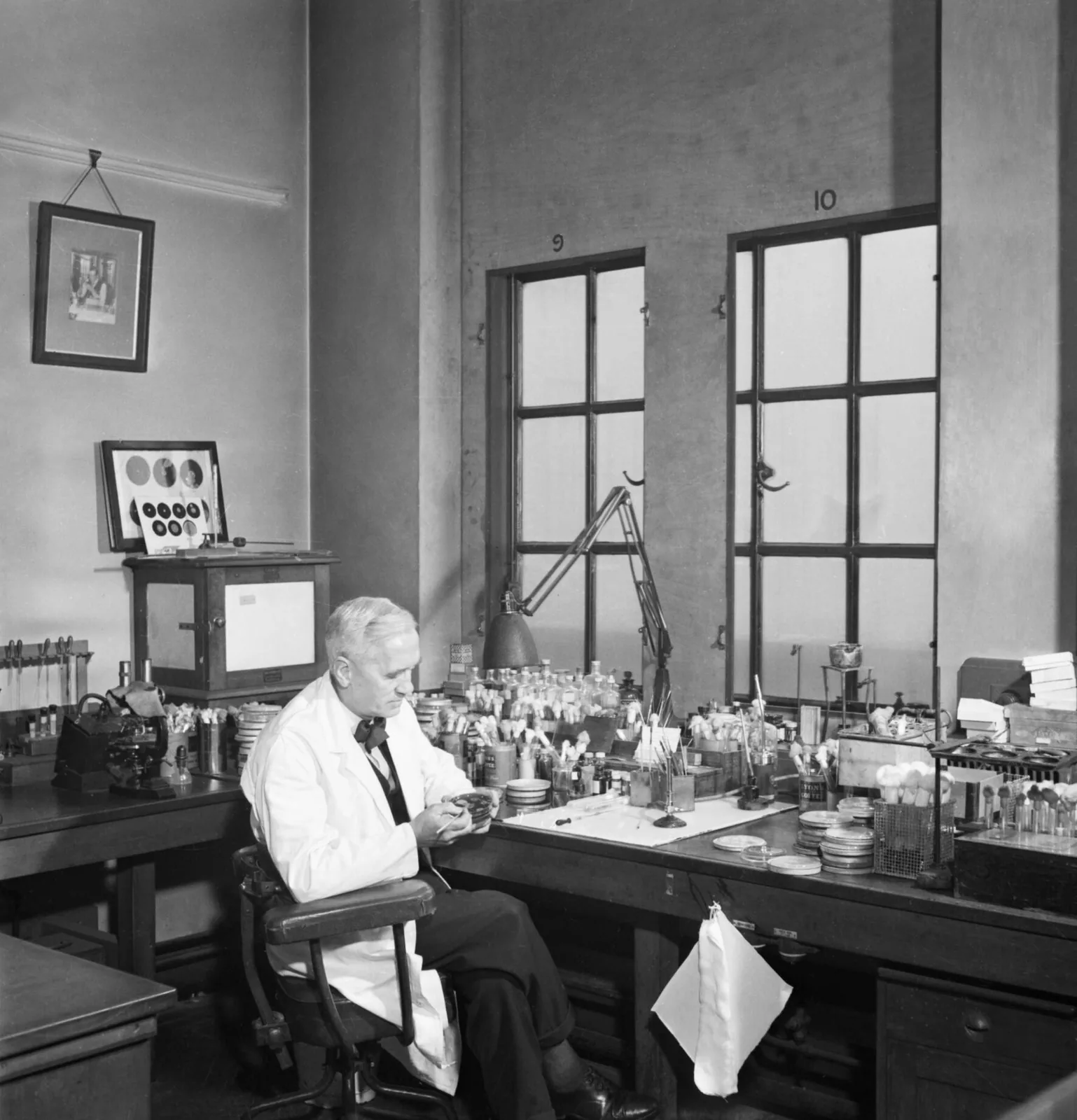
Alexander Fleming was, by temperament and reputation, an untidy worker. He had come to St Mary's Hospital in Paddington in 1906 and never really left, attaching himself to the Inoculation Department of Sir Almroth Wright, the combative champion of vaccine therapy, and he had the habit, half negligence and half method, of letting his old culture plates pile up for weeks before he cleared them. He amused himself by painting pictures in living bacteria, sketching ballerinas and soldiers in organisms chosen for their colours and letting them grow into the design.1 A man who plays with his cultures is a man who looks at them, and looking, in the end, was Fleming's gift.
He had looked to good effect once before. In 1922, nursing a cold, he let a drop of his own nasal mucus fall onto a plate of yellow bacteria and noticed some days later that the mucus had dissolved them. He had found a natural antibacterial substance, an enzyme he named lysozyme, present in tears and saliva and the whites of eggs.2 Lysozyme proved feeble against the organisms that actually cause disease, and the discovery made him no fame, but it had trained his eye for one particular sight: a clear zone where bacteria had been killed. When he saw that sight again, six years later, he knew at once what he was looking at.
He saw it on his return from holiday in the late summer of 1928. He had spent weeks studying the staphylococci, the round bacteria of boils and abscesses, and had stacked his used plates in a tray to one side of the bench, some of them lying above the level of the disinfectant in which they were meant to soak. Sorting through the pile, he found one plate carrying a sizeable colony of mould, and around that mould the staphylococcal colonies had turned translucent and were visibly dissolving away.3 His former assistant Merlin Pryce had dropped in to see him, and it was to Pryce that Fleming made the remark since polished by retelling into something more deliberate than it can have been at the time: that this was curious, that something in the mould seemed to be killing the bacteria. He photographed the plate. Then he set about growing the mould.
A chain of small accidents
The plate ought not to have shown him anything. We know this because a bacteriologist named Ronald Hare, who had worked at St Mary's in Fleming's day, spent his retirement trying to reproduce the famous result and could not — not, at least, by any straightforward method.4 When he seeded a plate with staphylococci, let them grow, and then dropped mould spores onto the established lawn, the mould grew but the bacteria were untouched; a colony of staphylococci past its youth is no longer vulnerable to penicillin. The lysis Fleming saw could occur only if the mould had been given a head start, growing and shedding its antibacterial substance before the bacteria around it had matured.
What gave it that head start was the London weather. Hare went back to the meteorological records for the summer of 1928 and found that the days before Fleming left for his holiday had been hot, warm enough for the staphylococci to race ahead of any mould; but on the twenty-eighth of July the heatwave broke into an unseasonable cold spell that held for the better part of nine days, exactly the stretch in which Fleming was away and his plate lay unincubated on the bench.5 In that cool window the mould, which favours lower temperatures, grew first and laid down its penicillin; when the warmth returned and the staphylococci finally grew, those nearest the mould met a poison already in the agar and dissolved. Had the plate been left in the incubator at blood heat, as a tidier worker would have left it, the bacteria would have won the race and Fleming would have seen nothing at all.
So the discovery was not one accident but a stack of them, each improbable and all in series: a stray spore of an uncommonly productive mould, drifting up most likely from the laboratory of the mycologist C. J. La Touche a floor below, where moulds were being cultured from the homes of asthmatic patients;6 a plate left out of the incubator; a freak reversal of the weather; and, on top of it all, an observer primed by lysozyme to recognise a cleared zone for what it was. The legend that the spore blew in through an open window is almost certainly false; his window was kept shut, and he told the story more than one way in later years. The truer account is the stranger of the two, because it required so many things to go right by going wrong.7
Penicillin
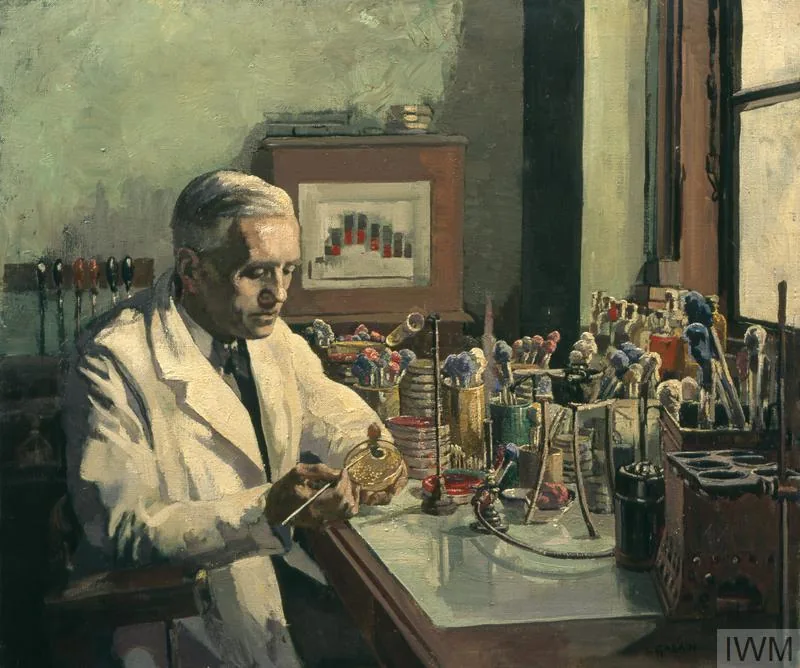
Fleming did the work that was his to do. He cultured the mould, a species of Penicillium that the American mycologist Charles Thom identified as Penicillium notatum, a strain since reassigned on genetic evidence to Penicillium rubens, and he grew it in broth, where it shed its active substance into the liquid.8 Rather than wrestle with the chemistry of that substance, he named the broth itself: in his paper of 1929 he proposed to call the filtrate "penicillin," for convenience, much as one might name a soup after the pot.9 He showed that this penicillin killed not only staphylococci but streptococci, pneumococci, the diphtheria bacillus and others, while sparing some bacteria and animal tissue — a selectivity that was its most remarkable property and the seed of everything that followed.
But he could not keep it. The activity of his broth faded within a fortnight at room temperature; penicillin was unstable, dilute, and slow to make, and Fleming was a bacteriologist, not a chemist with the means to extract and concentrate it.10 He found a use for it that fitted his trade: because penicillin spared the influenza bacillus, Pfeiffer's organism, while suppressing the commoner bacteria that overgrew it, he used the broth to clear his culture plates of unwanted species and isolate that one — penicillin as a laboratory weedkiller rather than a medicine.11 He made a few tentative trials on people. In January 1929 penicillin was applied to the infected nasal sinus of his assistant Stuart Craddock, to no real effect, and he passed samples to a surgeon for use on wounds; the results were inconclusive and went unrecorded.12 By the mid-1930s he had largely set the matter aside.
What he could not do, and what he could
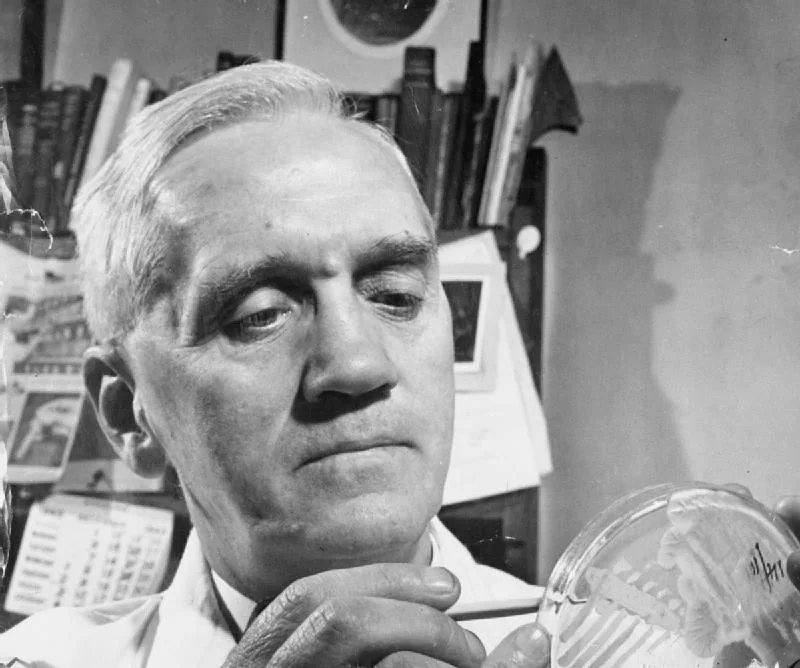
It became fashionable later, once penicillin had saved its hundreds of thousands, to ask reproachfully why Fleming had not seen what he had and pressed it further. The question mistakes the difficulty. Turning his broth into a drug meant purifying a fragile molecule that broke down under almost every condition the chemists tried, and concentrating it from a liquid in which it was present in maddeningly small amounts; this was a hard problem in organic chemistry, and it would defeat able chemists for a decade after Fleming's paper, until a particular set of techniques and a particular war made the difference.13 Fleming had neither the training nor the team to solve it, and he knew as much. He was unusually honest about the limits of what he had done; in later years, embarrassed by the adulation, he took to calling his own renown the "Fleming Myth," and gave the real credit for the drug to the men who made it work.14
What he did do was the part on which everything else depended, and it is easy to undervalue because it sounds so modest. He noticed. He characterised the substance with care, wrote it up plainly, and, above all, kept the mould alive and gave samples of it freely to anyone who asked, so that when, eleven years on, others came looking for an antibacterial worth pursuing, Fleming's Penicillium was there in the culture collection, waiting.15 A discovery is not only a thing seen; it is a thing preserved and handed on. The mould that an Oxford team would turn into the first antibiotic was descended from the very colony Fleming had photographed on his untidy bench.
Those who had seen it before
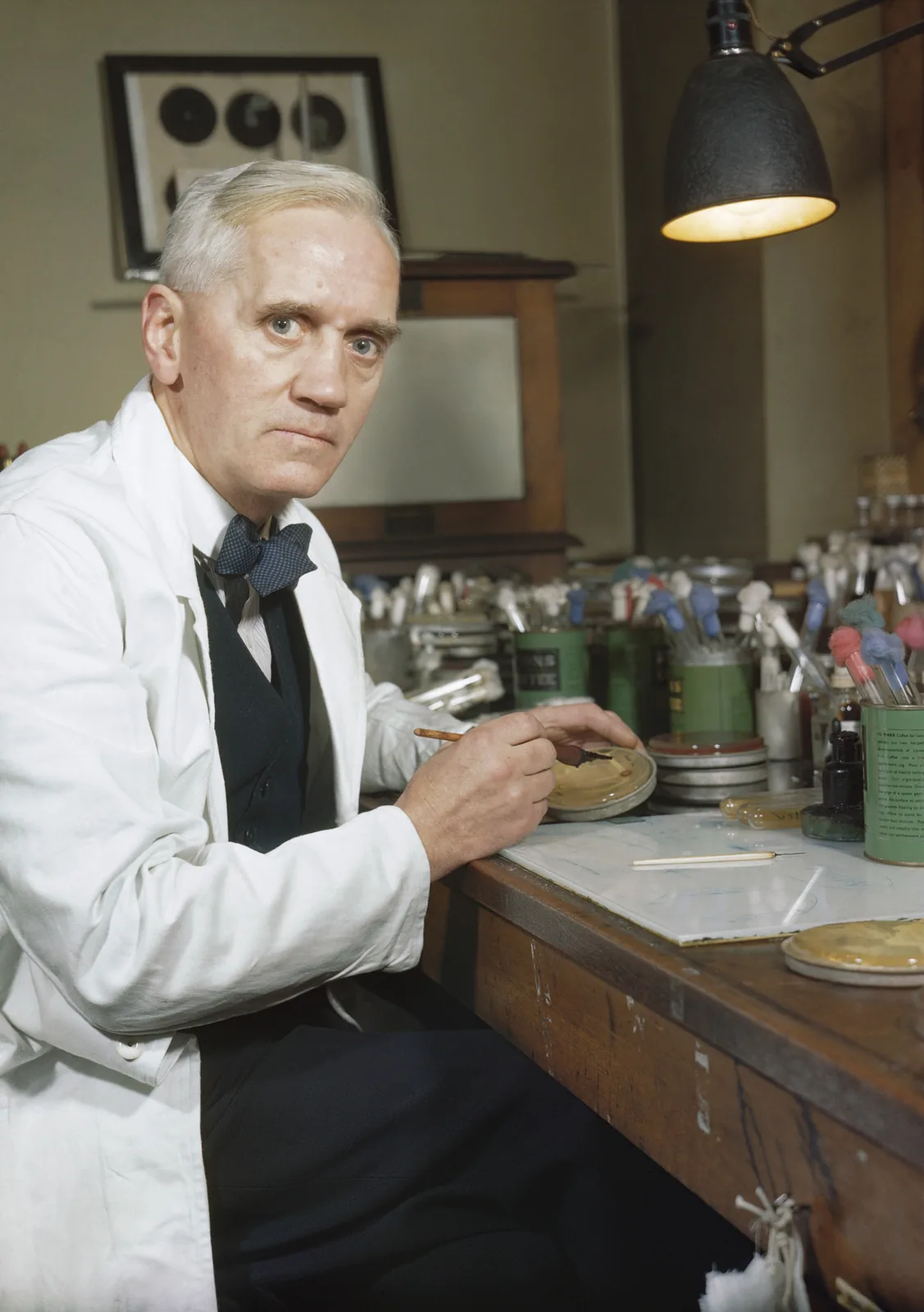
He was not even the first to see a mould kill bacteria. The phenomenon had been noticed and forgotten more than once: John Tyndall had reported a Penicillium overgrowing and clearing bacteria as early as 1875; the French physician Ernest Duchesne wrote a whole doctoral thesis in 1897 on the antagonism between moulds and microbes, then died young of tuberculosis with his work unread; others, in Italy and Belgium and beyond, brushed against the same fact and let it slip.16 Folk medicine had been pressing mouldy bread onto wounds for centuries without knowing why. The observation, in short, was not rare. What was rare was the conjunction of a man who saw it clearly, recorded it usefully, and kept the organism — and even then it took a second group, a decade later and a hundred miles away, to carry the thing the rest of the way. Fleming opened a door and described what lay beyond it. He did not walk through.
Read from the Ward
There is a particular sentence in my working life that I have learned to dread, and it arrives not as a crisis but as a line on a screen: the sensitivity report on a blood culture, the organism resistant to the first antibiotic, and the second, and then a column of capital R's marching across the page until the only thing left is a drug we hold in reserve precisely because we are running out of everything else. It is a quiet moment. Nothing alarms, nothing beeps. But I am watching, in real time and in a single patient, the thing Alexander Fleming saw coming from a very long way off.
Because Fleming did see it. The same man who could not turn his broth into a medicine understood, with eerie precision, how the medicine would one day fail. Accepting his share of the Nobel Prize in 1945, he set the triumph aside to deliver a warning so specific it now reads as prophecy: that the careless and the half-dosed, the man who buys penicillin in a shop and takes too little of it, would breed organisms taught to survive it, and that those organisms would spread, until someone, in his telling a Mrs X dying of a pneumonia her husband's negligence had armoured, succumbed to an infection penicillin could no longer touch.17 He was describing, in 1945, the resistant blood culture on my screen. More than a million people a year now die of infections that have learned the trick he foretold.
I find I cannot read Fleming's story as the parable of lucky genius it is usually made into, and not only because the luck was so absurdly compounded. What the story actually holds, for someone who treats infection for a living, is a lesson about the distance between seeing and curing. Fleming saw the whole of it, the killing and the selectivity and the promise and even the eventual failure, and could deliver almost none of it. The seeing was the easy part. He had the harder honesty to say so. There is no presentism worth indulging here, no Fleming who ought to have known better; purifying penicillin was a chemistry that beat good chemists for ten years, and the man who found the mould was right to admit it lay beyond him and to keep the mould alive for those who could.
That, I think, is the discipline the story asks of me. Not to mistake the diagnosis for the treatment, nor the insight for the cure. In the unit I am surrounded by things we can see perfectly and do nothing about: the failing organ we can name to the cell, the resistant organism we can sequence to the gene. The temptation is to believe that to understand a thing fully is already half to have beaten it. Fleming's bench is the standing refutation. He understood penicillin almost completely and could not save a single patient with it. The saving waited on other hands, in another city, with a war to force the pace; which is the story of the second plate, and the harder one.
And there is a darker symmetry I cannot quite look away from. We are, slowly, un-discovering penicillin. The clear ring on Fleming's plate is closing again, organism by organism, as the bacteria relearn the world they lived in before 1928 — and they are doing it for exactly the reason he named, because we have used the drug as carelessly as he begged us not to. The greatest gift medicine ever stumbled upon is being handed back. I write antibiotics every day in the full knowledge that each prescription draws down a fund that is not being replenished, and that the column of R's on my screen is the interest falling due. Fleming photographed the beginning of the antibiotic age on a plate he nearly threw away. Some mornings, reading a sensitivity report, I think I am watching the photograph of its end.
- On Fleming's untidy bench, his germ paintings, and his place in Almroth Wright's Inoculation Department at St Mary's, see Kevin Brown, Penicillin Man: Alexander Fleming and the Antibiotic Revolution (Stroud: Sutton, 2004).↩
- Alexander Fleming, "On a Remarkable Bacteriolytic Element Found in Tissues and Secretions," Proceedings of the Royal Society of London, Series B 93 (1922): 306-17. Lysozyme is plentiful in tears, saliva and egg white but weak against major pathogens; its chief role here was to train Fleming's eye for a zone of lysis.↩
- On the September 1928 plate — stacked above the disinfectant, the staphylococcal colonies turned translucent near the mould — see Ronald Hare, The Birth of Penicillin, and the Disarming of Microbes (London: George Allen & Unwin, 1970); Fleming (1929). Fleming's remark to D. Merlin Pryce survives only in later, much-retold accounts.↩
- Hare, The Birth of Penicillin (1970): a mature staphylococcal colony is no longer susceptible, so the lysis required the mould to grow first. Hare could reproduce Fleming's plate only by seeding the mould before the bacteria.↩
- On the meteorological reconstruction — a heatwave to 27 July 1928, then a roughly nine-day cold spell from the 28th, coinciding with Fleming's holiday and his unincubated plate — see Hare, The Birth of Penicillin (1970), drawing on Meteorological Office records.↩
- On the likely source of the spore: the mycologist C. J. La Touche, a floor below Fleming, was culturing moulds from the homes of asthmatic patients, and gave Fleming a series of specimens of which one showed the activity. See "Discovery of penicillin," and Hare (1970).↩
- Fleming suggested in 1945 that the spore came through a window facing Praed Street; co-workers later testified the window was kept shut and out of his reach, and he told the story inconsistently. The drifting-spore-from-La-Touche account is now the consensus.↩
- Charles Thom identified the mould as Penicillium notatum; whole-genome and phylogenetic analysis in 2011 reassigned Fleming's strain to Penicillium rubens, a species described by Philibert Biourge in 1923. See J. Houbraken, J. C. Frisvad and R. A. Samson, "Fleming's Penicillin Producing Strain Is Not Penicillium chrysogenum but P. rubens," IMA Fungus 2 (2011): 87-95.↩
- Alexander Fleming, "On the Antibacterial Action of Cultures of a Penicillium, with Special Reference to Their Use in the Isolation of B. influenzæ," British Journal of Experimental Pathology 10 (1929): 226-36 — the paper in which he names the filtrate "penicillin."↩
- On penicillin's instability (activity lost within about a fortnight at room temperature) and Fleming's lack of the chemical means to purify it, see Hare (1970); Brown, Penicillin Man (2004).↩
- Fleming used penicillin as a selective agent to suppress competing bacteria and isolate Haemophilus influenzae (Pfeiffer's bacillus) — reflected in the very title of the 1929 paper.↩
- On the January 1929 injection into Stuart Craddock's infected antrum (no effect, the organism being unsusceptible H. influenzae) and samples given to the surgeon Arthur Dickson Wright (no records survive), see "Discovery of penicillin"; Brown (2004).↩
- Purification and concentration of penicillin defeated able workers for roughly a decade; it was solved at Oxford from 1939 onward. See Gwyn Macfarlane, Howard Florey: The Making of a Great Scientist (Oxford: Oxford University Press, 1979).↩
- Fleming described his own fame as the "Fleming Myth" and credited Florey and Chain with turning the laboratory curiosity into a practical drug. See Brown, Penicillin Man (2004).↩
- Fleming kept the mould, deposited it in a culture collection and distributed samples; the Oxford working strain descended from his original colony. See Milton Wainwright, Miracle Cure: The Story of Penicillin and the Golden Age of Antibiotics (Oxford: Blackwell, 1990).↩
- On predecessors — John Tyndall's 1875 observation of Penicillium inhibiting bacteria, Ernest Duchesne's 1897 Lyon thesis (its author dead of tuberculosis in 1912), André Gratia and others — see History of penicillin; Wainwright (1990).↩
- Alexander Fleming, "Penicillin," Nobel Lecture, 11 December 1945 (the "Mr X / Mrs X" warning; "if you use penicillin, use enough"); see also his caution reported in the New York Times, 26 June 1945. Bacterial antimicrobial resistance is now associated with well over a million deaths a year.↩
- Chicago
Kim, D. Y. “A Curious Contamination.” Codex Chronica, June 27, 2026. https://codexchronica.com/a-curious-contamination/.
- APA
Kim, D. Y. (2026, June 27). A Curious Contamination. Codex Chronica. https://codexchronica.com/a-curious-contamination/
- Brown, Kevin. Penicillin Man: Alexander Fleming and the Antibiotic Revolution. Stroud: Sutton, 2004.
- Fleming, Alexander. "On a Remarkable Bacteriolytic Element Found in Tissues and Secretions." Proceedings of the Royal Society of London, Series B 93, no. 653 (1922): 306-17.
- Fleming, Alexander. "On the Antibacterial Action of Cultures of a Penicillium, with Special Reference to Their Use in the Isolation of B. influenzæ." British Journal of Experimental Pathology 10, no. 3 (1929): 226-36.
- Fleming, Alexander. "Penicillin." Nobel Lecture, 11 December 1945. Nobel Foundation.
- Hare, Ronald. The Birth of Penicillin, and the Disarming of Microbes. London: George Allen & Unwin, 1970.
- Houbraken, J., J. C. Frisvad, and R. A. Samson. "Fleming's Penicillin Producing Strain Is Not Penicillium chrysogenum but P. rubens." IMA Fungus 2, no. 1 (2011): 87-95.
- Wainwright, Milton. Miracle Cure: The Story of Penicillin and the Golden Age of Antibiotics. Oxford: Blackwell, 1990.