
On the twenty-fifth of April, 1953, two men at Cambridge published a letter of some nine hundred words in Nature, proposing a shape for the molecule of heredity and closing on a sentence so studied it has been quoted ever since. What is seldom quoted is a plainer line a few paragraphs above it, in which the same authors conceded that their structure "must be regarded as unproved." Both sentences were true. The most famous molecule of the century entered the world as a conjecture of surpassing elegance rather than a proof — and for a while the elegance was the whole of the argument.
"We wish to suggest"
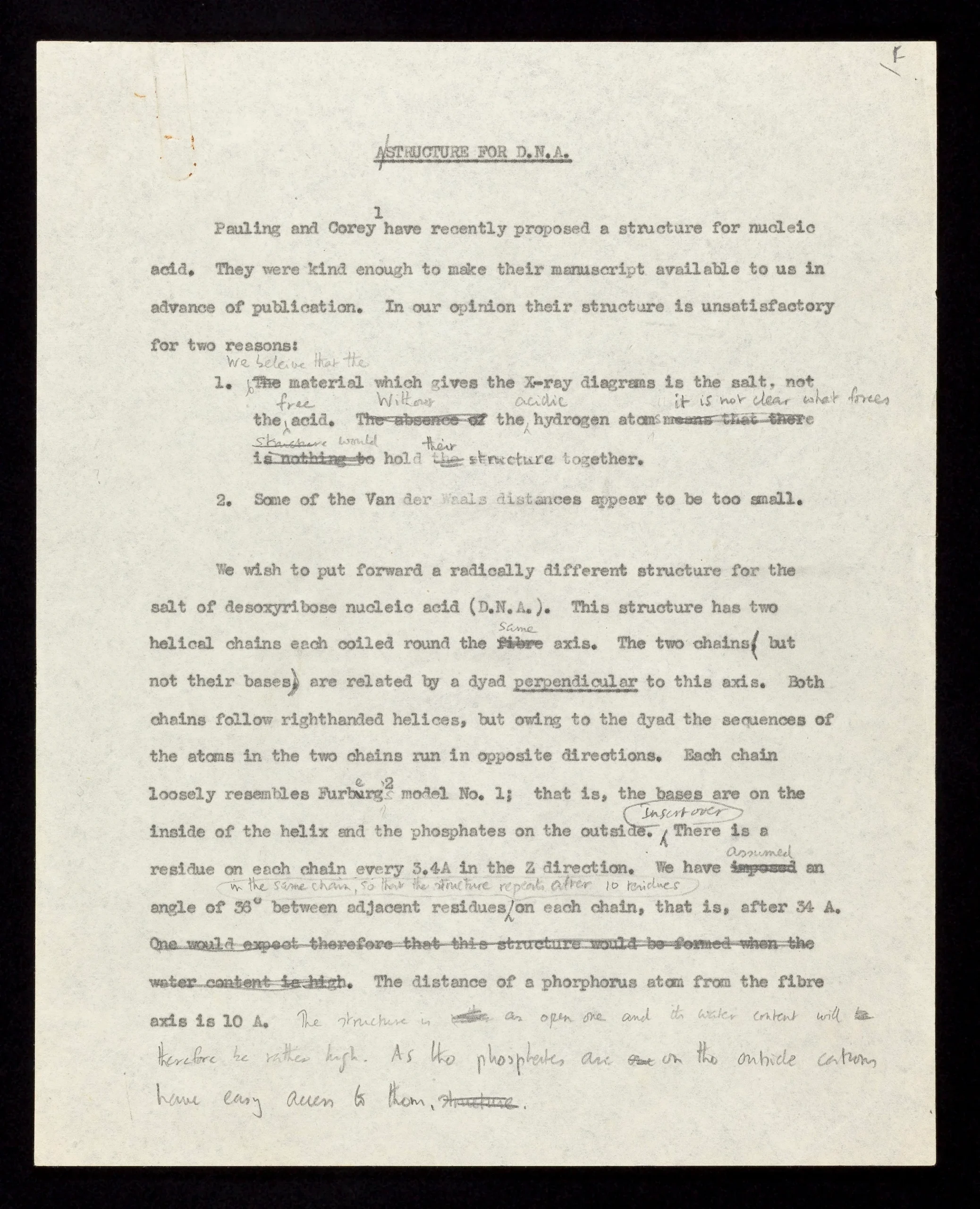
The letter opens on a verb that its later fame has quietly buried. "We wish to suggest a structure for the salt of deoxyribose nucleic acid (D.N.A.)," James Watson and Francis Crick began — suggest, not announce, not demonstrate.1 What followed was a page and a half of prose and a single diagram, drawn by Crick's wife Odile, of two ribbons winding about a shared axis. There was no experiment of their own in it. The thing had been built, over the preceding weeks, from plates of sheet metal and lengths of rod cut to order in the Cavendish machine shop, stood up on a laboratory bench and adjusted until the atoms no longer collided: a structure arrived at, as the authors frankly put it, by resting "mainly though not entirely on published experimental data and stereochemical arguments."2 They had solved it, that is, from other people's measurements and from the geometry of what could physically fit.
Their own laboratory had not always encouraged the attempt. Two years earlier, after a first model collapsed in embarrassment (three chains, the bases turned outward, a schoolboy's blunder over how much water the fibres held), Sir Lawrence Bragg, the Cavendish's director, had told the pair to leave DNA to the King's College group whose data they kept borrowing.3 That they returned to it at all was half insubordination. And when they had their answer, they were careful, in print, to mark its standing. The X-ray literature then published, they wrote, "is insufficient for a rigorous test of our structure"; the model was "roughly compatible" with it "but must be regarded as unproved until it has been checked against more exact results."4 They believed it because it was beautiful, and because it fitted. Proof would be somebody else's labour, and years in coming.
The rungs
What made it beautiful was the pairing. The two chains ran in opposite directions, their sugar–phosphate backbones on the outside and their bases turned inward, meeting in the middle like the rungs of a twisted ladder set three and a half ångström apart.5 Each rung was two bases, one from each strand, and only two couplings would fit the space: adenine opposite thymine, guanine opposite cytosine, a broad purine always answered by a slim pyrimidine. Erwin Chargaff had reported, some years before, that in every sample of DNA the amount of adenine ran close to that of thymine, and guanine to cytosine, without being able to say why.6 The structure explained his ratios in a single stroke: if A always binds T and G always C, their totals cannot help but match. In explaining them it did something no measurement had done: it made the molecule look inevitable.
The fit was not, however, obvious, and it very nearly did not come. The textbook diagrams of two of the bases were wrong. Thymine and guanine were conventionally drawn in what a chemist calls the enol form, and in that form the pairs will not close. It took Jerry Donohue, an American crystallographer sharing the pair's office for the year, to tell Watson that the books were mistaken and that the bases in a cell keep to their keto form.7 On the twenty-eighth of February 1953, shifting cardboard cut-outs of the corrected shapes across his desk, Watson saw that an A–T pair and a G–C pair had the very same outline, and could sit between the backbones interchangeably. The keystone of the double helix was the migration of a single hydrogen atom, pointed out by a third man whom the story has all but forgotten. It is a useful reminder of how many hands a two-handed discovery needs.
A copying mechanism, postulated
Then came the sentence the letter is remembered for: "It has not escaped our notice that the specific pairing we have postulated immediately suggests a possible copying mechanism for the genetic material."8 It is rightly admired, and it should be read closely, because every hedge in it is load-bearing. Postulated. Suggests. Possible. Five weeks later, on the thirtieth of May, the two men published a second letter that said outright what the first had only glanced at: because the chains are complementary, they may unwind, and each may serve as the template on which its lost partner is rebuilt, so that one molecule becomes two, each carrying the whole of the text.9 In the same paper they wrote, hedging even there, that "it therefore seems likely that the precise sequence of the bases is the code which carries the genetical information."
It is a mechanism of great beauty. It was also, in 1953, entirely unwitnessed. No one had seen a molecule of DNA divide and copy itself; the scheme was an inference from a shape, elegant and unobserved. The enzyme that stitches new DNA together was not isolated until 1956, and finding it did not prove the model's central claim: that each daughter keeps one old strand and one new.10 That proof came only in 1958, from a caesium-chloride tube in Pasadena, when Matthew Meselson and Franklin Stahl grew bacteria first on heavy nitrogen and then on light, spun their DNA in a density gradient, and watched the generations sort themselves by weight exactly as a strand-by-strand copying demanded — a band of hybrid density after one division, splitting cleanly in two after the next.11 It has been called the most beautiful experiment in biology. It was performed five years after the beautiful structure whose deepest claim it was the first to confirm.
Whether it was the right molecule at all
Stand back a further step, and the ground is softer still. In 1953 it was not settled that DNA was the stuff of the gene at all. Nine years earlier Oswald Avery and his colleagues at the Rockefeller had shown that the "transforming principle" which passes heredity from one strain of pneumococcus to another was pure DNA, and the demonstration had been met, very largely, with a shrug.12 DNA was widely thought too dull to carry inheritance — a monotonous chain of four repeating units, structurally inert, while the necessary complexity of the gene was assumed to reside in the variety of proteins. Even the elegant blender experiment of Alfred Hershey and Martha Chase, in 1952, which showed that a virus injects its DNA and leaves its protein coat outside, had not wholly closed the question.13
The double helix did not settle it by any new experiment. It settled it by making the alternative unimaginable. A molecule whose very geometry spelled out how it might be copied simply looked like a gene in a way that a chain of monotonous sugars never had; and the old scepticism drained away, over the middle years of the decade, less because anyone disproved it than because the structure had made a rival hypothesis feel absurd. That is a strange way for a science to decide a question of fact: to be argued out of a doubt by the beauty of a model rather than talked out of it by a result. And it is worth remembering, when the double helix is offered as the triumph of hard evidence, that its first and largest work was done by persuasion.
The half left unread
The famous closing line promised a copying mechanism, and there its promise stopped. It said nothing of the other and harder half of heredity: how a chain built from an alphabet of four letters could specify a protein spelled in twenty amino acids, how the text is not copied but read.14 The double helix had, in effect, changed the question. It converted the central problem of biology from one of chemistry into one of information: no longer what the gene is made of, but what it says, and by what cipher the saying is turned into flesh.
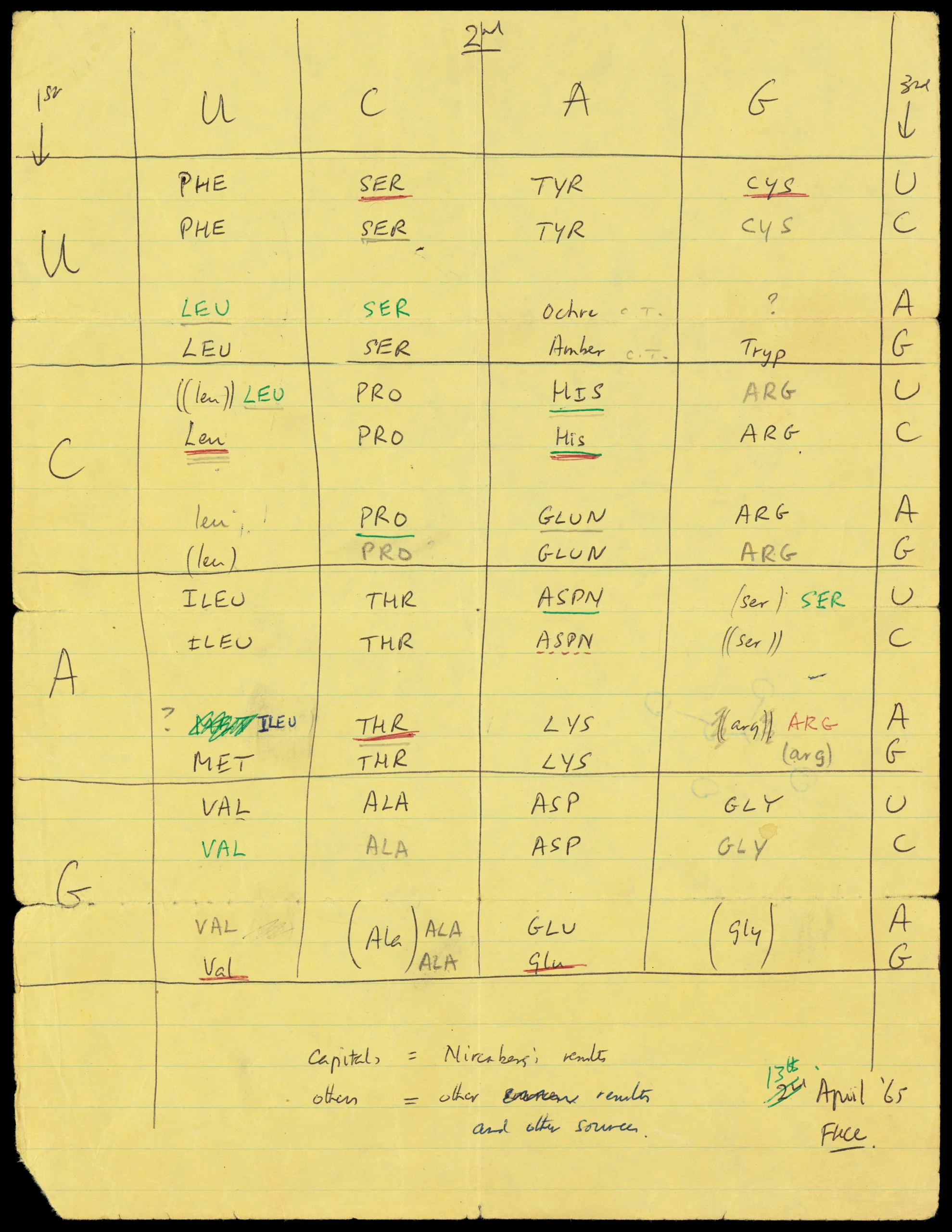
That problem consumed the rest of the decade and more. Crick supplied its grammar: a "sequence hypothesis," an "adaptor" molecule to ferry each amino acid to its place on the template (soon found, and named transfer RNA), and the principle he named, with a candour he later regretted, the "central dogma," that information flows from nucleic acid outward to protein and never back.15 The code itself was broken by other hands. In 1961 Marshall Nirenberg and Heinrich Matthaei fed a synthetic RNA of pure uracil into a cell-free extract and drew out a protein of pure phenylalanine, and the dictionary's first entry, that the triplet UUU means phenylalanine, was read.16 By 1966 the table was complete.
Only then, thirteen years after the model, did the sentence Watson and Crick had closed upon acquire its other half. They had shown, or rather supposed, how the genetic material is duplicated. What that material means (how its order of letters is turned into the working substance of a body) was not in the two ribbons at all. The structure of 1953 was not the answer to heredity. It was the reframing that made the answer askable, and it left the larger part of the work undone, in plain sight, for everyone who came after.
Read from the Ward
A report reaches me flagged in yellow. In one gene, in one patient, a single letter has changed, a C where the reference carries a T, and beneath the finding sit three words that quietly retract it: variant of uncertain significance. The laboratory has performed the miracle of 1953 and the miracle of 1958 both, and performed them flawlessly. It has copied this man's DNA through a billionfold amplification and read the order of his bases to an accuracy Rosalind Franklin's fibres could not have dreamed of. What it cannot tell me is what the sentence means: whether that altered letter is the cause of the tremor that brought him to my clinic, or merely one of the several million harmless misspellings that every human being carries and hands on. The copying is solved. The reading, seventy years on, is not, and I spend a good part of each week inside the half that Watson and Crick left unfinished.
Almost everything I lean on at the bedside descends from their page and a half: the sequencer, the amplification, the panels of genes I send a neurologist's questions to, the prenatal test, the tumour typed to choose its drug. All of it is copying and reading of the kind the double helix made conceivable. And all of it stops where interpretation begins. The elegant molecule told us how the text reproduces; it did not tell us how to understand a sentence we had never seen before, and much of medical genetics is still, patient by patient, that unfinished labour of understanding. Even the tidy rule that followed the structure has an edge I meet in my own corridor: the prion diseases, in which a protein propagates not by copying a sequence but by imposing a shape, one misfolded molecule templating the next — a heredity of form rather than of letters, which the all-sequence picture of 1953 never thought to expect.17 A man with Creutzfeldt–Jakob disease is dying, in part, of an exception to the all-sequence picture the double helix set in motion.
So when the yellow-flagged report comes back, I do a thing the two men at the Cavendish made possible and did not finish. I copy the man's genome, and I read his letters, and against the one that has changed I write, for now, a verdict in their own vocabulary: not yet proved. Watson and Crick suggested, in nine hundred words, how life is copied. How it is read (letter into meaning, sequence into a fate I can explain to the family in the room) they left to the rest of us. We are still at it, one uncertain variant at a time.
- James D. Watson and Francis H. C. Crick, "Molecular Structure of Nucleic Acids: A Structure for Deoxyribose Nucleic Acid," Nature 171, no. 4356 (April 25, 1953): 737–738. The opening sentence ("We wish to suggest a structure…") is verbatim; the paper runs to roughly nine hundred words and a single figure (drawn by Odile Crick).↩
- Watson and Crick, "Molecular Structure of Nucleic Acids," 737: the structure "rests mainly though not entirely on published experimental data and stereochemical arguments." On the model built physically from machined metal components in the Cavendish shop, see James D. Watson, The Double Helix: A Personal Account of the Discovery of the Structure of DNA (London: Weidenfeld & Nicolson, 1968), chaps. 26–28.↩
- On the failed three-chain model of 1951 (with its error over the water content of the fibres) and Bragg's consequent instruction that Watson and Crick abandon DNA to the King's College group, see Watson, Double Helix, chaps. 11–13; and Robert Olby, Francis Crick: Hunter of Life's Secrets (Cold Spring Harbor: CSHL Press, 2009), chaps. 8–9.↩
- Watson and Crick, "Molecular Structure of Nucleic Acids," 737: "The previously published X-ray data on deoxyribose nucleic acid are insufficient for a rigorous test of our structure. So far as we can tell, it is roughly compatible with the experimental data, but it must be regarded as unproved until it has been checked against more exact results. Some of these are given in the following communications" (verbatim).↩
- Watson and Crick, "Molecular Structure of Nucleic Acids," 737: two helical chains coiled round a common axis and running in opposite directions; bases on the inside, phosphates on the outside; one residue every 3.4 Å, a turn of the helix every 34 Å (ten residues), the phosphorus atoms about 10 Å from the axis. The full atomic coordinates were not published until Francis Crick and James Watson, "The Complementary Structure of Deoxyribonucleic Acid," Proceedings of the Royal Society of London A 223 (1954): 80–96.↩
- Erwin Chargaff, "Chemical Specificity of Nucleic Acids and Mechanism of Their Enzymatic Degradation," Experientia 6 (1950): 201–209. On Chargaff's failure to draw the complementary inference from his own ratios, see Horace Freeland Judson, The Eighth Day of Creation: Makers of the Revolution in Biology, expanded ed. (Cold Spring Harbor: CSHL Press, 1996), chap. 2.↩
- On Jerry Donohue's correction of the tautomeric (keto vs. enol) forms of thymine and guanine, without which the base pairs do not close, and Watson's recognition of the A–T and G–C pairing on 28 February 1953, see Francis Crick, What Mad Pursuit: A Personal View of Scientific Discovery (New York: Basic Books, 1988), chap. 5; and Watson, Double Helix, chap. 26.↩
- Watson and Crick, "Molecular Structure of Nucleic Acids," 737 (closing sentence, verbatim): "It has not escaped our notice that the specific pairing we have postulated immediately suggests a possible copying mechanism for the genetic material."↩
- James D. Watson and Francis H. C. Crick, "Genetical Implications of the Structure of Deoxyribonucleic Acid," Nature 171, no. 4361 (May 30, 1953): 964–967, which sets out the unwinding of complementary chains as a template mechanism and states that "it therefore seems likely that the precise sequence of the bases is the code which carries the genetical information" (verbatim).↩
- On Arthur Kornberg's isolation of DNA polymerase (from 1956) and the point that enzymatic synthesis in vitro did not by itself establish the semiconservative mechanism, see Judson, Eighth Day, chap. 6.↩
- Matthew Meselson and Franklin W. Stahl, "The Replication of DNA in Escherichia coli," Proceedings of the National Academy of Sciences 44, no. 7 (1958): 671–682, demonstrating semiconservative replication by density-gradient (15N/14N caesium-chloride) centrifugation. On its reputation as "the most beautiful experiment in biology" (a phrase generally traced to John Cairns), see Frederic L. Holmes, Meselson, Stahl, and the Replication of DNA: A History of "The Most Beautiful Experiment in Biology" (New Haven: Yale University Press, 2001).↩
- Oswald T. Avery, Colin M. MacLeod, and Maclyn McCarty, "Studies on the Chemical Nature of the Substance Inducing Transformation of Pneumococcal Types," Journal of Experimental Medicine 79 (1944): 137–158. On the muted and sceptical reception — coloured by the "tetranucleotide" view of DNA as a monotonous molecule and by the assumption that genes must be proteins — see Judson, Eighth Day, chap. 1; and Robert Olby, The Path to the Double Helix: The Discovery of DNA (London: Macmillan, 1974), chaps. 8–9.↩
- Alfred D. Hershey and Martha Chase, "Independent Functions of Viral Protein and Nucleic Acid in Growth of Bacteriophage," Journal of General Physiology 36 (1952): 39–56. On the experiment's real but incomplete effect on scientific opinion before 1953, see Judson, Eighth Day, chap. 1.↩
- On the "coding problem" — how a four-letter nucleotide sequence specifies a twenty-letter amino-acid sequence — as the question the structure posed but did not answer, see Judson, Eighth Day, chaps. 5–8; and Matthew Cobb, Life's Greatest Secret: The Race to Crack the Genetic Code (London: Profile, 2015).↩
- Francis H. C. Crick, "On Protein Synthesis," Symposia of the Society for Experimental Biology 12 (1958): 138–163, introducing the sequence hypothesis, the adaptor hypothesis (the adaptor soon identified as transfer RNA), and the "central dogma." Crick later restated and clarified the principle in "Central Dogma of Molecular Biology," Nature 227 (1970): 561–563, and remarked on his misuse of the word "dogma" in What Mad Pursuit, chap. 8.↩
- Marshall W. Nirenberg and J. Heinrich Matthaei, "The Dependence of Cell-Free Protein Synthesis in E. coli upon Naturally Occurring or Synthetic Polyribonucleotides," Proceedings of the National Academy of Sciences 47 (1961): 1588–1602. On the completion of the code by 1966 and the 1968 Nobel Prize to Nirenberg, Har Gobind Khorana and Robert Holley, see Cobb, Life's Greatest Secret, chaps. 9–11.↩
- On prion diseases as the transmission of a conformational (misfolded) state rather than of a nucleotide sequence, see Stanley B. Prusiner, "Novel Proteinaceous Infectious Particles Cause Scrapie," Science 216 (1982): 136–144. Prions transmit a shape, not a sequence, and so do not overturn the central dogma as Crick precisely defined it (a statement about the flow of sequence information); they nonetheless represent a form of heritable biological information absent from the all-sequence picture of 1953.↩
- Chicago
Kim, D. Y. “Structure of Nucleic Acids.” Codex Chronica, July 1, 2026. https://codexchronica.com/structure-of-nucleic-acids/.
- APA
Kim, D. Y. (2026, July 1). Structure of Nucleic Acids. Codex Chronica. https://codexchronica.com/structure-of-nucleic-acids/
- Avery, Oswald T., Colin M. MacLeod, and Maclyn McCarty. "Studies on the Chemical Nature of the Substance Inducing Transformation of Pneumococcal Types." Journal of Experimental Medicine 79 (1944): 137–158.
- Chargaff, Erwin. "Chemical Specificity of Nucleic Acids and Mechanism of Their Enzymatic Degradation." Experientia 6 (1950): 201–209.
- Cobb, Matthew. Life's Greatest Secret: The Race to Crack the Genetic Code. London: Profile Books, 2015.
- Crick, Francis H. C. "On Protein Synthesis." Symposia of the Society for Experimental Biology 12 (1958): 138–163.
- Crick, Francis H. C. "Central Dogma of Molecular Biology." Nature 227 (1970): 561–563.
- Crick, Francis. What Mad Pursuit: A Personal View of Scientific Discovery. New York: Basic Books, 1988.
- Crick, Francis H. C., and James D. Watson. "The Complementary Structure of Deoxyribonucleic Acid." Proceedings of the Royal Society of London A 223 (1954): 80–96.
- Hershey, Alfred D., and Martha Chase. "Independent Functions of Viral Protein and Nucleic Acid in Growth of Bacteriophage." Journal of General Physiology 36 (1952): 39–56.
- Holmes, Frederic L. Meselson, Stahl, and the Replication of DNA: A History of "The Most Beautiful Experiment in Biology." New Haven: Yale University Press, 2001.
- Judson, Horace Freeland. The Eighth Day of Creation: Makers of the Revolution in Biology. Expanded ed. Cold Spring Harbor: CSHL Press, 1996.
- Meselson, Matthew, and Franklin W. Stahl. "The Replication of DNA in Escherichia coli." Proceedings of the National Academy of Sciences 44, no. 7 (1958): 671–682.
- Nirenberg, Marshall W., and J. Heinrich Matthaei. "The Dependence of Cell-Free Protein Synthesis in E. coli upon Naturally Occurring or Synthetic Polyribonucleotides." Proceedings of the National Academy of Sciences 47 (1961): 1588–1602.
- Olby, Robert. The Path to the Double Helix: The Discovery of DNA. London: Macmillan, 1974.
- Olby, Robert. Francis Crick: Hunter of Life's Secrets. Cold Spring Harbor: CSHL Press, 2009.
- Prusiner, Stanley B. "Novel Proteinaceous Infectious Particles Cause Scrapie." Science 216 (1982): 136–144.
- Watson, James D., and Francis H. C. Crick. "Molecular Structure of Nucleic Acids: A Structure for Deoxyribose Nucleic Acid." Nature 171, no. 4356 (April 25, 1953): 737–738.
- Watson, James D., and Francis H. C. Crick. "Genetical Implications of the Structure of Deoxyribonucleic Acid." Nature 171, no. 4361 (May 30, 1953): 964–967.
- Watson, James D. The Double Helix: A Personal Account of the Discovery of the Structure of DNA. London: Weidenfeld & Nicolson, 1968.