
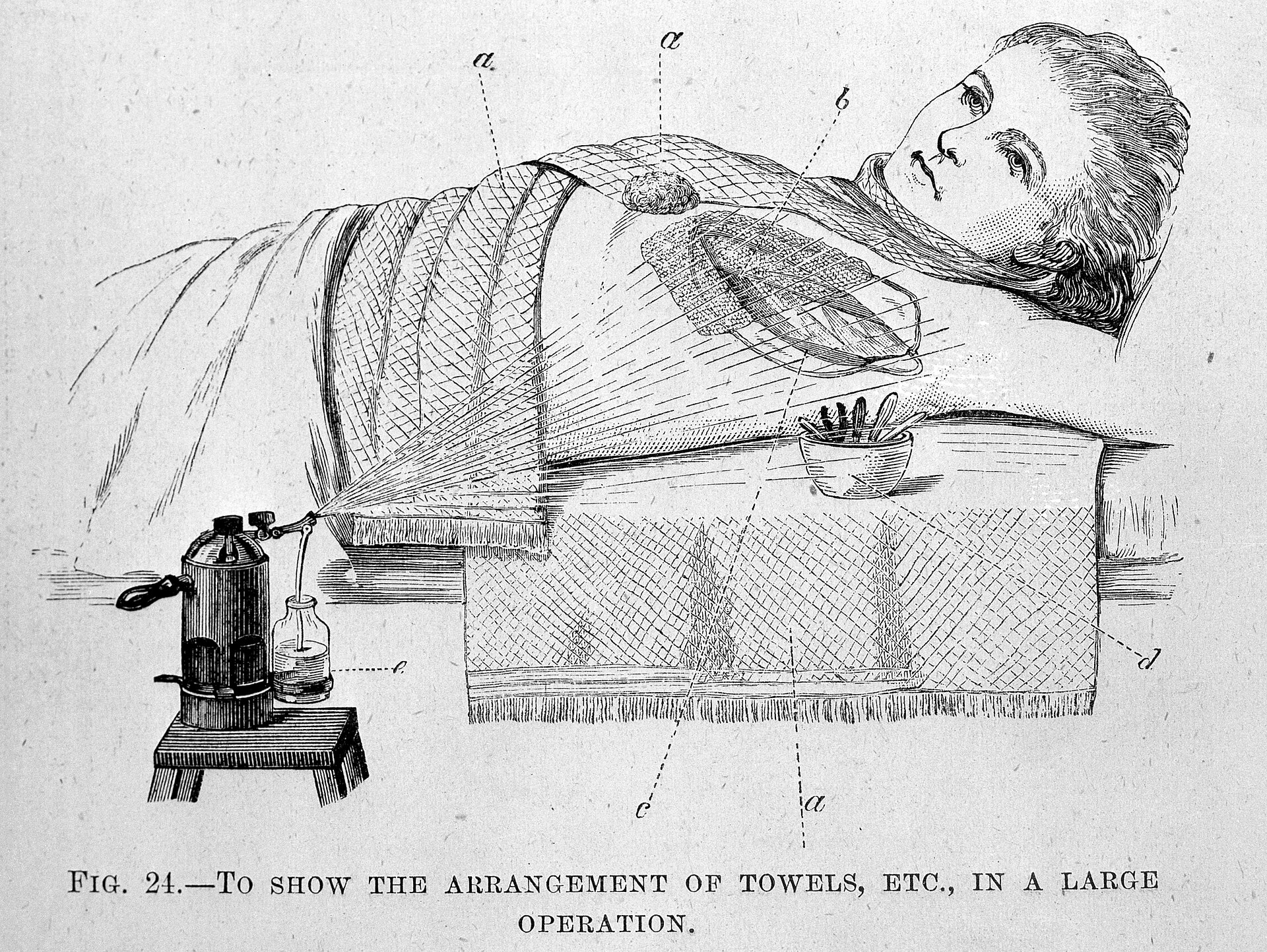
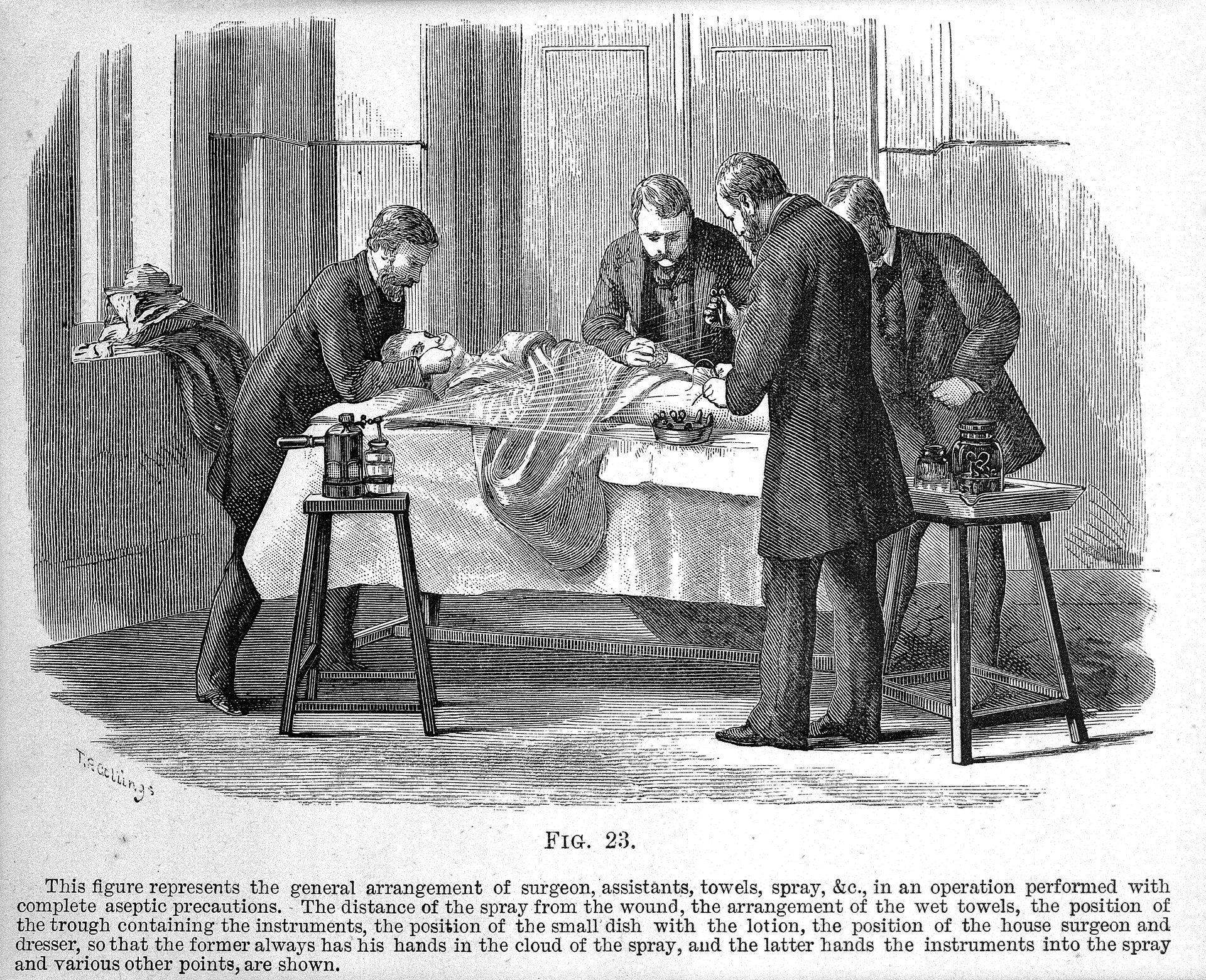
For sixteen years a fine rain fell in his operating theatres. It settled on the wound and the blade, on the surgeon's hands and the patient's upturned face: a mist of carbolic acid pumped into the air to kill what no one could yet see drifting there. It was the most visible thing in the whole of Listerism, and the most mistaken. The man who raised it lived to stand before a congress of his peers and call it a thing he was ashamed of.
The air made dangerous
The principle came first, and the spray was its overreach. Joseph Lister had taken from Louis Pasteur the news that the rot in a wound was not a chemical accident of the air but the work of living germs that travelled in it, and he had built his antiseptic surgery on the inference that a thing with a body could be poisoned at the wound's edge.1 He had already steeped his dressings in carbolic acid and packed his incisions with a carbolic putty. The next step seemed to follow of itself. If the deadly germs descended out of the atmosphere, then the atmosphere over an open wound had to be made hostile to them, and from about 1871 Lister set out to do for the air what he had done for the lint: to fill the whole space around the operating table with a germicide, so that a surgeon working inside a cloud of carbolic need not fear what was settling out of the room onto his work.2
The donkey engine
The machine that delivered the mist passed through a decade of restless improvement, which was Lister's way with everything he handled; his critics counted the changes and said each one confessed a fault in the last.3 He began with a small hand spray, an india-rubber bulb and bottle that an assistant squeezed, but it could not hold a cloud up for the length of an operation. It gave way to a larger apparatus on a tripod, charged with watery carbolic and driven by a long pump handle that a relay of dressers worked by turns until their arms failed. The students called it the donkey engine, and the name carried the affection and the ridicule together.4 By the middle of the decade there was a steam model: water boiled over a spirit lamp in the base, and the jet of steam drew the acid up a tube and threw it out as a fog that hung over everything.5 Whatever the version, the manner of its use is strange to picture now. The surgeon operated half-blinded in a chemical drizzle, his gown soaked through, the patient soaked, the open wound rinsed without pause in a solution strong enough to sting every eye in the room.
A knife into the Queen
The spray had its moment of highest sanction in the late summer of 1871. Queen Victoria, at Balmoral, developed an abscess the size of an orange beneath her arm, and Lister, then professor of surgery at Edinburgh, was sent for.6 He opened it under the carbolic spray, and one of his assistants, labouring at the pump, contrived to send a jet of it straight into the Queen's face. He drained the cavity, and when a packing of lint failed to keep it emptying he improvised a drain from a length of the spray's own india-rubber tubing, the first use of a rubber drainage tube in Britain, contrived upon the most exalted patient in the empire.7 She recovered. Lister liked afterward to say that he was the only man who had ever plunged a knife into the Queen and gone unpunished. The mist that fogged a monarch at Balmoral was the same mist that hung in the poorest accident ward in Glasgow, and for a season it stood as the badge of safe surgery, the sign that a theatre had crossed over into the new age.
The cure that bit back
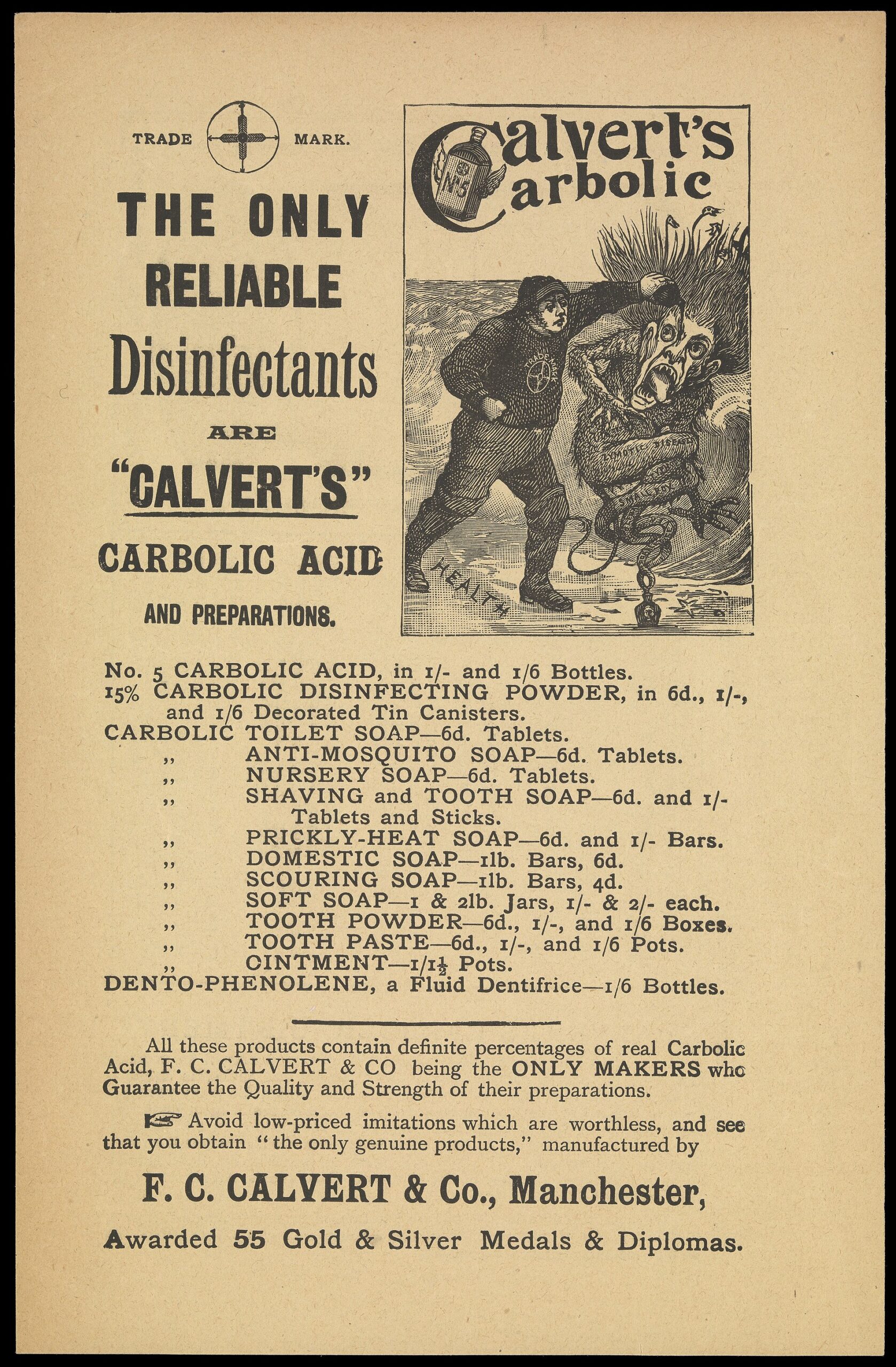
What the badge concealed was that the mist was itself a poison, and not to the germs alone. Carbolic acid passes through skin and lung into the blood, and the bodies beneath the spray, along with the bodies working it, began to show what it cost.8 The plainest sign was in the water. Urine passed pale would darken as it stood, going smoky, then the colour of olives, then close to black, the visible mark of phenol leaving a poisoned system, and it could appear by the second day.9 Surgeons and dressers who stood in the cloud day upon day were said to pass dark water of their own. Hands bathed in carbolic whitened and cracked and lost their feeling, and sometimes their skin. The fine droplets caught in the eyes and the throat, so that the whole theatre worked in a faint reek that followed it home in the hair and the clothes. The apparatus raised to shield the patient was steadily dosing the patient, and the surgeon with him, with a chemical that in any quantity could kill.
The wrong element
It was also aimed in the wrong direction. Lister had built the entire apparatus on the belief that the dangerous germs came down out of the air, for the good reason that the air was where Pasteur had caught them. The wards taught otherwise, and slowly. The germs that decided the fate of a wound came for the most part by touch: carried in on a sponge, on a length of silk, on a probe or a finger that had handled the last wound before this one.10 Against an enemy that arrived by contact, a fog in the air was a great deal of ceremony to little end. The men who pressed this were not cranks, and the method was already moving past Lister on the Continent, where the German surgeons above all were turning from drenching the field with chemical toward keeping it clean from the outset: instruments boiled, dressings baked in dry heat, hands scrubbed, and before long gowns and rubber gloves and steam sterilisers in the place of the bottle and the pump.11 This was asepsis, and it proved the durable form. It did not try to kill the germ at the wound. It saw to it that the germ never reached the wound at all.
I feel ashamed
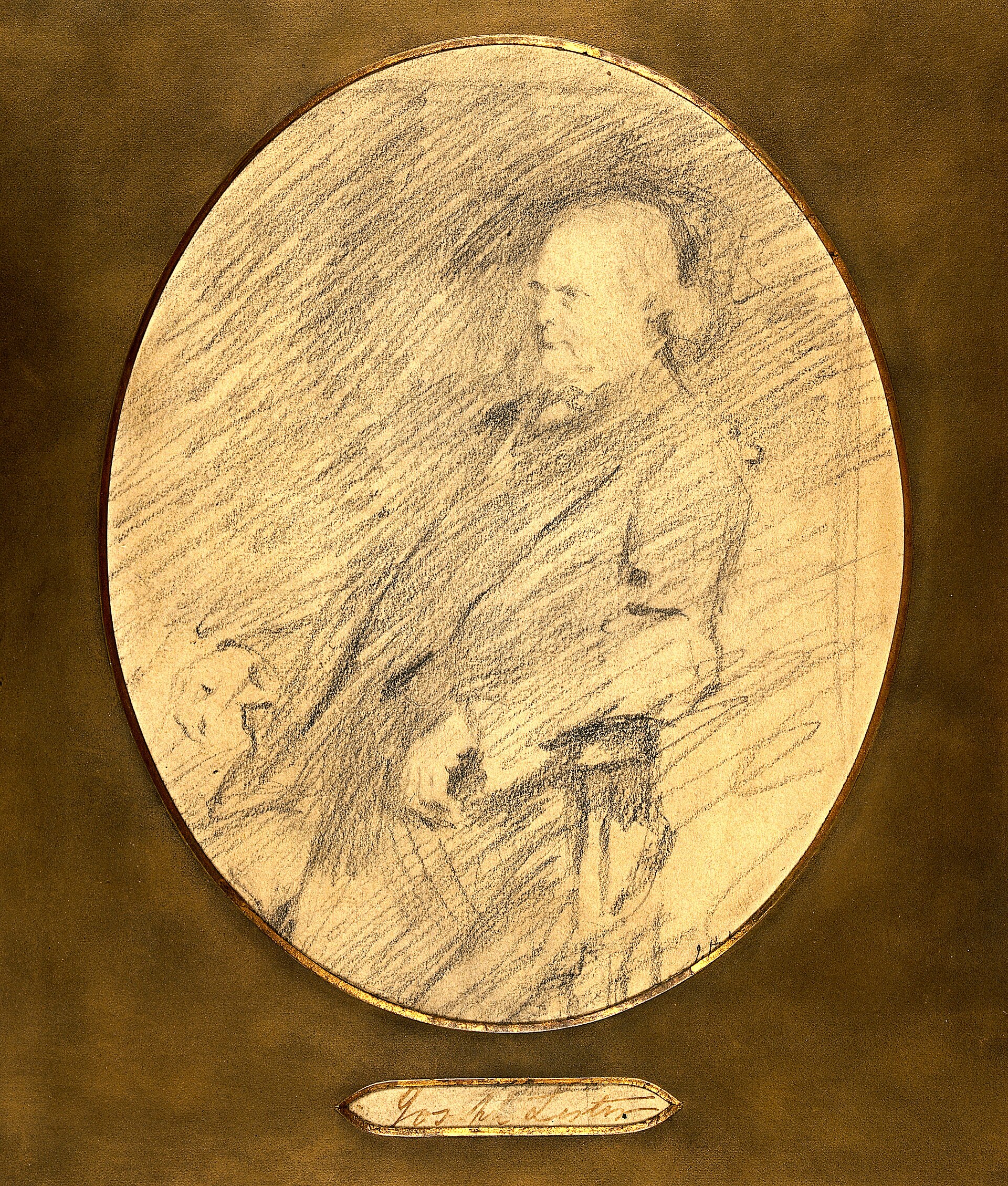
Lister set the spray down in 1887, without announcement, the way a man lays aside a tool he has carried too far.12 Three years later he did the thing almost no one of his eminence ever does. Before the International Medical Congress at Berlin, in 1890, he spoke of the very apparatus that had been the emblem of his system, and said: "As regards the spray, I feel ashamed that I should ever have recommended it for the purpose of destroying the microbes of the air."13 He laid the fault on no assistant, no instrument-maker, no fashion of the times. He had recommended it; he had been wrong; he said as much to the largest audience he would ever command. The principle he kept, for the principle was sound. The instrument he had loved he gave back, and the reek began at last to clear from the operating theatres of the world.14
Read from the Ward
I was trained to thread a catheter through the chambers of a failing heart and out into the pulmonary artery, in the sickest patients I had, to read the pressures off the far side of the lungs. For a generation that was the mark of serious intensive care, the manoeuvre you performed for the patient who was slipping away from you, and I learned to float one in the half-dark with a pressure waveform for my only map. We scarcely use them now. The trials came in and found that the patients who got the catheter did no better than the patients who did not, and some did worse, and so the instrument that had defined a certain bedside seriousness went quietly into the cupboard. I think of that every time I read Lister on the spray, because we did the first half of what he did and then flinched at the second. We took up a powerful instrument on a reasonable theory, performed it with devotion, let it cut both ways for years, and when the evidence finally caught us we simply stopped. No one stood at a podium and said they were ashamed. We moved the trolley to the back of the store and let the record go quiet.
That is the part I cannot get past. Medicine abandons its certainties constantly, far more often than the public is told, and the wards are full of yesterday's confident orders set down without ceremony: the bed rest we once prescribed, the tight numbers we once chased, the routes we kept open and the ones we kept shut. Half of what I was taught with assurance has been revised under me, which is not a scandal but the ordinary weather of the work. The scandal would be to pretend it had not happened. Lister's one sentence at Berlin is worth more than the spray it withdrew, because it names the price of having been certain. He had harmed patients in good faith with the device he believed was saving them, and when he saw it he said the word out loud. I have watched a great deal of good-faith harm in my own rooms, the drug that injured the patient it was meant to help, the monitor that bred its own needless interventions, and I have almost never heard anyone call it shame.
The theatres are quiet now where the engines used to hiss, and the smell that meant safety to a Victorian surgeon would empty a modern one in alarm. We keep a smell of our own, the sharp clean nothing of alcohol at every door, aimed this time at the hands, where the danger truly lives. I trust it as Lister trusted his mist, which is to say completely, and on evidence, and with a confidence I have learned from his example to hold a little loosely. Somewhere in what I will do this week without a second thought there is a fine carbolic rain of my own, a thing I perform with care and will be asked, or my successors will be asked, to set down. The question he leaves me is not whether I am wrong about something now. I am. It is whether, when I am shown it, I will manage his four plain words, or only wheel the trolley to the back of the store and say nothing at all.
- On Lister's debt to Pasteur's germ theory of putrefaction and the inference that putrefactive germs travelling in the air could be destroyed by a chemical at the wound, see Joseph Lister, "On the Antiseptic Principle in the Practice of Surgery," The Lancet 2 (1867): 353-56; and the companion plates in this series, On the Antiseptic Principle and The Swan-Neck Flask. The foundational paper is Louis Pasteur, "Mémoire sur les corpuscules organisés qui existent dans l'atmosphère," Annales des sciences naturelles (Zoologie), 4th ser., 16 (1861): 5-98.↩
- On the introduction of the carbolic spray from about 1871 to destroy germs in the air around the operation, see W. Watson Cheyne, Antiseptic Surgery: Its Principles, Practice, History and Results (London: Smith, Elder, 1882); Rickman John Godlee, Lord Lister (London: Macmillan, 1917); Michael Worboys, Spreading Germs: Disease Theories and Medical Practice in Britain, 1865-1900 (Cambridge: Cambridge University Press, 2000).↩
- On Lister's continual modification of his methods, and on his critics reading each change as an admission that the previous version had been defective, see Michael Worboys, "Joseph Lister and the Performance of Antiseptic Surgery," Notes and Records of the Royal Society 67, no. 3 (2013): 199-209.↩
- On the evolution of the apparatus — from a hand-held india-rubber spray needing an assistant, to a tripod-mounted machine driven by a long pump handle and worked by relays of dressers, nicknamed the "donkey engine" — see Cheyne, Antiseptic Surgery (1882) (the "hand spray producer," p. 54); "Joseph Lister's Antisepsis System," Science Museum (London); and the carbolic-spray objects, Science Museum Group Collection.↩
- On the steam spray (from the mid-1870s), in which water boiled over a spirit lamp produced a jet of steam that drew up and atomised the carbolic solution, see the carbolic steam spray objects, Science Museum Group Collection; "Carbolic Spray Used at Guy's Hospital," Old Operating Theatre Museum, London; and Lister's antiseptic steam spray producer (Marr, London, c. 1878), Hunterian Museum, Royal College of Surgeons of England.↩
- On Queen Victoria's axillary abscess at Balmoral in 1871, drained by Lister, see Lindsey Fitzharris, The Butchering Art: Joseph Lister's Quest to Transform the Grisly World of Victorian Medicine (New York: Scientific American / Farrar, Straus and Giroux, 2017); Godlee, Lord Lister (1917).↩
- On the use of the carbolic spray during the operation (an assistant directing a jet into the Queen's face), Lister's introduction of an india-rubber drainage tube — the first such use in Britain — and his later remark about being the only man to have "plunged a knife into the Queen," see Fitzharris, The Butchering Art (2017); "Joseph Lister and the Story of Antiseptic Surgery," Hektoen International (2017).↩
- On carbolic acid (phenol) as a percutaneous and respiratory poison ("carbolism"), absorbed through skin and lung with systemic effects on the kidneys, liver and nervous system, see "Phenol Toxicity," StatPearls (Treasure Island, FL: StatPearls Publishing); "Carbolic Spray Used at Guy's Hospital," Old Operating Theatre Museum.↩
- On carboluria — urine passed pale that darkens on standing (smoky, then olive-green, then near black) as a recognised sign of carbolic poisoning — see the contemporary account of H. A. von Bardeleben (1870), who put serious carbolic absorption at about one case in ten and noted the sign appearing "so early as the second day... the urine, which, pale at first, became gradually darker on standing"; "Carbolic Spray Used at Guy's Hospital," Old Operating Theatre Museum (which describes the staff effect as haemoglobinuria); and "Phenol Toxicity," StatPearls.↩
- On the recognition that wound infection was conveyed chiefly by contact (hands, instruments, dressings) rather than by the air, undercutting the rationale for the spray, see Worboys, Spreading Germs (2000), 73-107; Thomas Schlich, "Asepsis and Bacteriology: A Realignment of Surgery and Laboratory Science," Medical History 56, no. 3 (2012): 308-34.↩
- On the Continental development of aseptic technique — heat and steam sterilisation (after Robert Koch), Gustav Neuber's aseptic operating room, Ernst von Bergmann and Curt Schimmelbusch's steam sterilisers, and William Halsted's introduction of rubber gloves (c. 1890) — see "Joseph Lister's Antisepsis System," Science Museum; Schlich, "Asepsis and Bacteriology" (2012).↩
- On Lister's abandonment of the spray in 1887, once he accepted that the air mattered far less than contact and that the mist irritated the operators, see Godlee, Lord Lister (1917); "Carbolic Spray Used at Guy's Hospital," Old Operating Theatre Museum.↩
- Joseph Lister at the Tenth International Medical Congress, Berlin, 1890: "As regards the spray, I feel ashamed that I should ever have recommended it for the purpose of destroying the microbes of the air." See Godlee, Lord Lister (1917); British Medical Journal 2 (1890).↩
- On the supersession of the spray and of chemical antisepsis generally by aseptic technique, and the disappearance of the carbolic fog from operating theatres, see Worboys, Spreading Germs (2000); Schlich, "Asepsis and Bacteriology" (2012).↩
- Chicago
Kim, D. Y. “The Carbolic Spray.” Codex Chronica, June 28, 2026. https://codexchronica.com/the-carbolic-spray/.
- APA
Kim, D. Y. (2026, June 28). The Carbolic Spray. Codex Chronica. https://codexchronica.com/the-carbolic-spray/
- Cheyne, W. Watson. Antiseptic Surgery: Its Principles, Practice, History and Results. London: Smith, Elder, 1882.
- Fisher, Richard B. Joseph Lister, 1827-1912. London: Macdonald and Jane's, 1977.
- Fitzharris, Lindsey. The Butchering Art: Joseph Lister's Quest to Transform the Grisly World of Victorian Medicine. New York: Scientific American / Farrar, Straus and Giroux, 2017.
- Godlee, Rickman John. Lord Lister. London: Macmillan, 1917.
- "Joseph Lister and the Story of Antiseptic Surgery." Hektoen International: A Journal of Medical Humanities, 2017.
- "Joseph Lister's Antisepsis System." Science Museum, London (objects-and-stories), 2018.
- Old Operating Theatre Museum. "Carbolic Spray Used at Guy's Hospital by Sir Henry Howse." London, 2022.
- Schlich, Thomas. "Asepsis and Bacteriology: A Realignment of Surgery and Laboratory Science." Medical History 56, no. 3 (2012): 308-34.
- Worboys, Michael. "Joseph Lister and the Performance of Antiseptic Surgery." Notes and Records of the Royal Society 67, no. 3 (2013): 199-209.
- Worboys, Michael. Spreading Germs: Disease Theories and Medical Practice in Britain, 1865-1900. Cambridge: Cambridge University Press, 2000.