
By the 1860s a surgeon could work without haste. The ether let him take his time over a patient who felt nothing, and the scream that had ruled his trade since antiquity was silenced at last. Yet his patients were dying as never before. Anaesthesia had drawn the knife's old terror only to deliver men, unhurried and insensible, into the hands of a second killer that lived in the wards raised to cure them. The wound had become the danger, not the operation, and no one could say why a clean cut should rot.
The deadliest place
The hospitals of the mid-century had a disease of their own, and the surgeons had a name for it: hospitalism. A wound that would have healed quietly in a labourer's cottage turned, in the great wards, septic and then mortal. Four horrors went by their own names: pyaemia, septicaemia, erysipelas, and the spreading ulceration called hospital gangrene; between them they could carry off a third or a half of those who went under the knife.1 The larger and grander the hospital, the worse it tended to be, so that a poor man stood a better chance with his leg set on a kitchen table than beneath the high windows of an infirmary.
Nothing framed the puzzle better than a broken bone. A simple fracture, the skin unbroken, healed without much trouble; the same break with a wound torn over it, a compound fracture, suppurated, and the standard reply was to amputate before the rot reached the trunk. Even amputation failed about half the time.2 The whole difference between the bone that mended and the bone that killed was the open door of the wound. Something came in there. What it was, no one could agree.
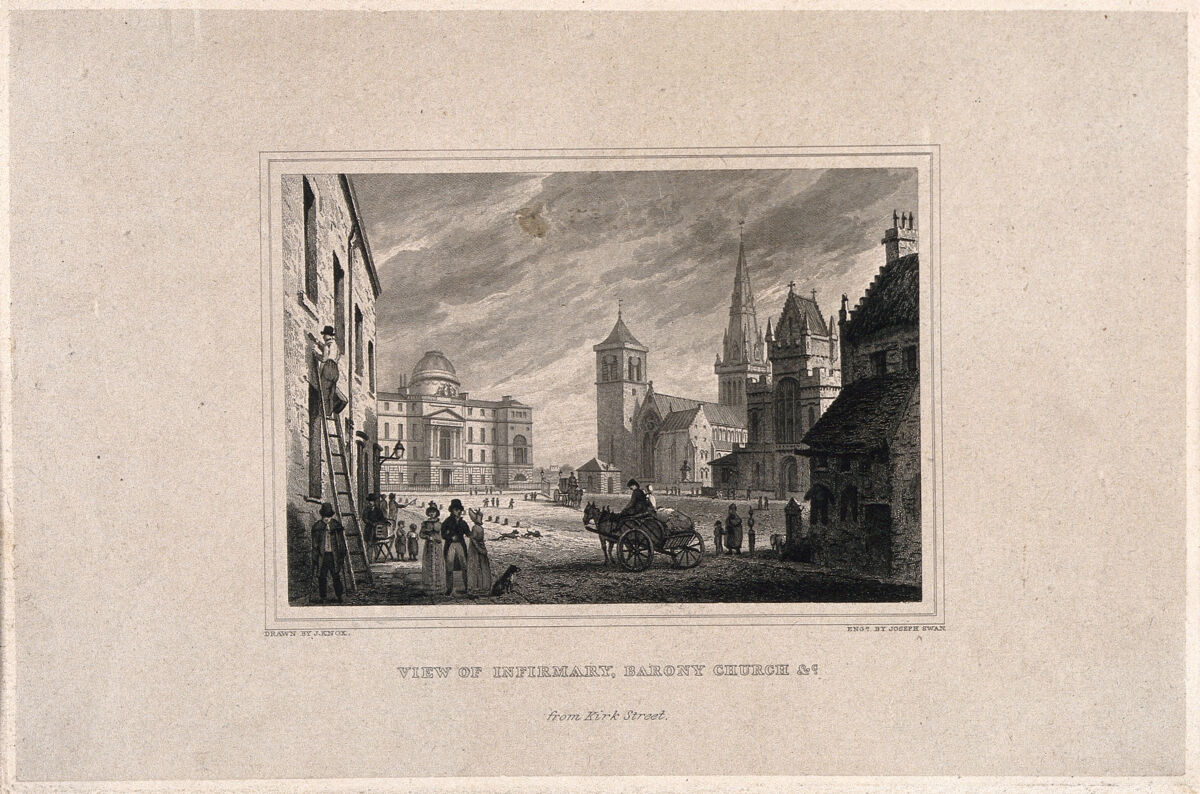
The reigning answer was the air itself, or the foul vapour of crowded rooms, the miasma that the sanitary reformers were then fighting with windows, drains and whitewash.3 The wards in which Lister took up his chair at the Glasgow Royal Infirmary were as trying as any in the kingdom: they stood on ground lately a graveyard, and a few feet beneath the windows lay the pit-burials of the parish poor, in a report Lister cited, "five thousand bodies in pits, holding eighty each," settling in the Glasgow clay.4
A chemist's light
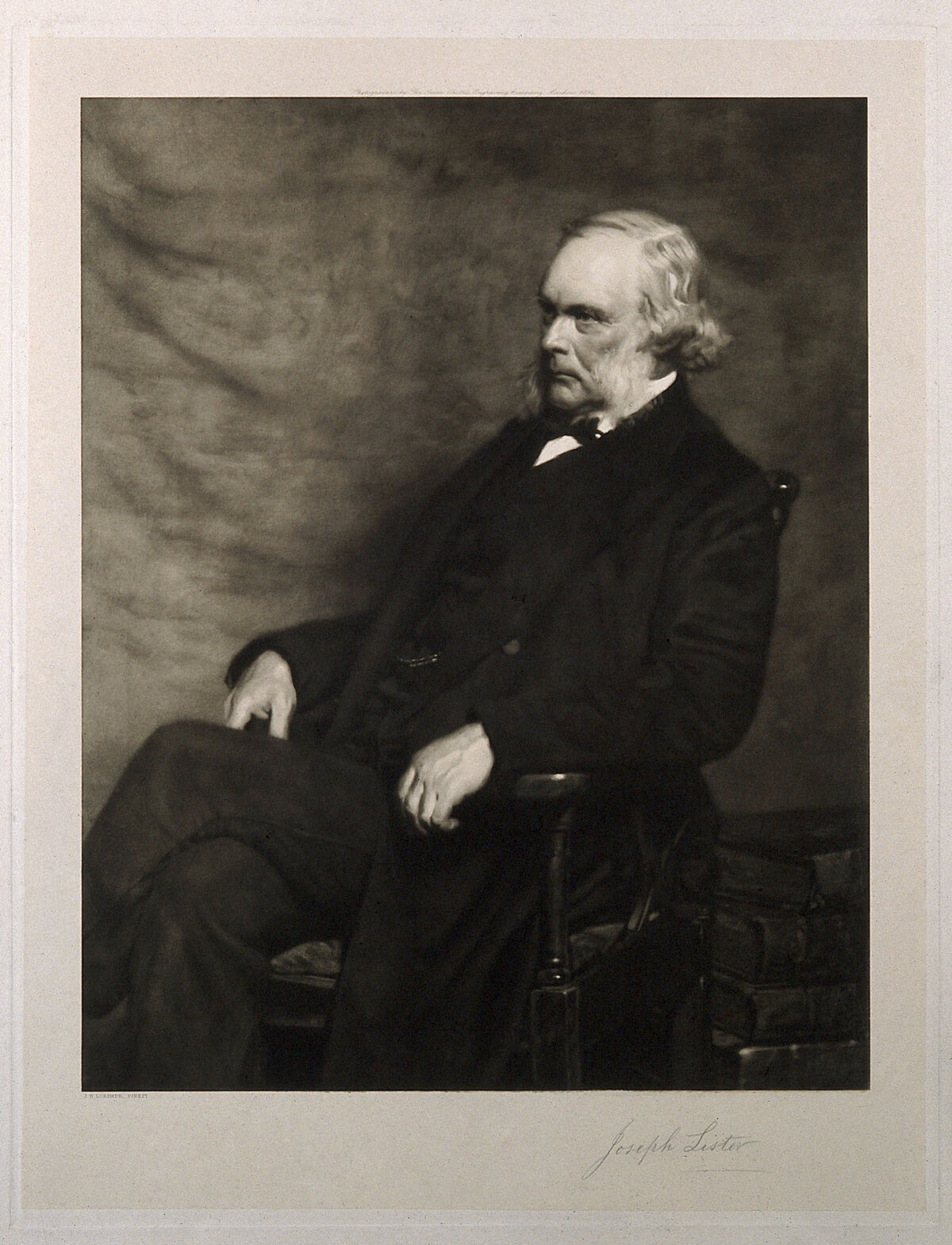
Lister was an unlikely revolutionary, being patient, devout, and slow to claim. He had been raised a Quaker in Essex, the son of Joseph Jackson Lister, a wine merchant whose hobby, the grinding of achromatic lenses, had quietly turned the microscope from a toy into an instrument a scientist could trust.5 The son grew up looking down such a barrel at the structure of small things, and came to surgery already persuaded that the body's troubles had causes one might actually see. He trained in London, served under the formidable James Syme at Edinburgh, married Syme's daughter, and in 1860 took the Regius chair of surgery at Glasgow.
There, about 1864, a colleague redirected his life without lifting a scalpel. Thomas Anderson, the professor of chemistry, drew his attention to the recent work of a French chemist on fermentation and putrefaction.6 Louis Pasteur had shown that the souring of milk and the rotting of broth were not chemical events provoked by the air but the labour of living organisms carried in it, and that the air could be let in while the organisms were kept out.7
For Lister the inference turned like a hinge. If it was not the air that rotted a wound but living germs travelling in the air, then the surgeon's task was not the impossible one of shutting air away from an open fracture. It was the achievable one of destroying the germs at the wound's edge. The enemy was not the atmosphere. It was something in the atmosphere, and a thing with a body could be poisoned.
Carbolic
He needed a poison mild enough to spare flesh and fierce enough to kill what he could not see. He recalled hearing that the town of Carlisle had been treating its sewage with carbolic acid, a coal-tar distillate, and that the treated outflow run onto the pastures had lost its stench and rid the grazing cattle of a parasite.8 If it could do that in a field, it might do it in a wound.
The compound fracture handed him his proving ground, for it carried its own controls: an injury grave enough that any success would show, and one whose natural history of suppuration and death was bitterly well known. On the twelfth of August, 1865, a cart ran over the leg of an eleven-year-old named James Greenlees in a Glasgow street and drove the bone through the skin. In the male accident ward Lister set the fracture, dressed it with lint steeped in carbolic acid, and had it renewed and watched.9 It did not suppurate. The boy kept the leg, and some six weeks later walked out of the infirmary on it. Over the next two years Lister refined the method case by case, and in 1867 he laid the first results before the profession: eleven compound fractures treated on the new plan, of whom only two had died.10
The principle
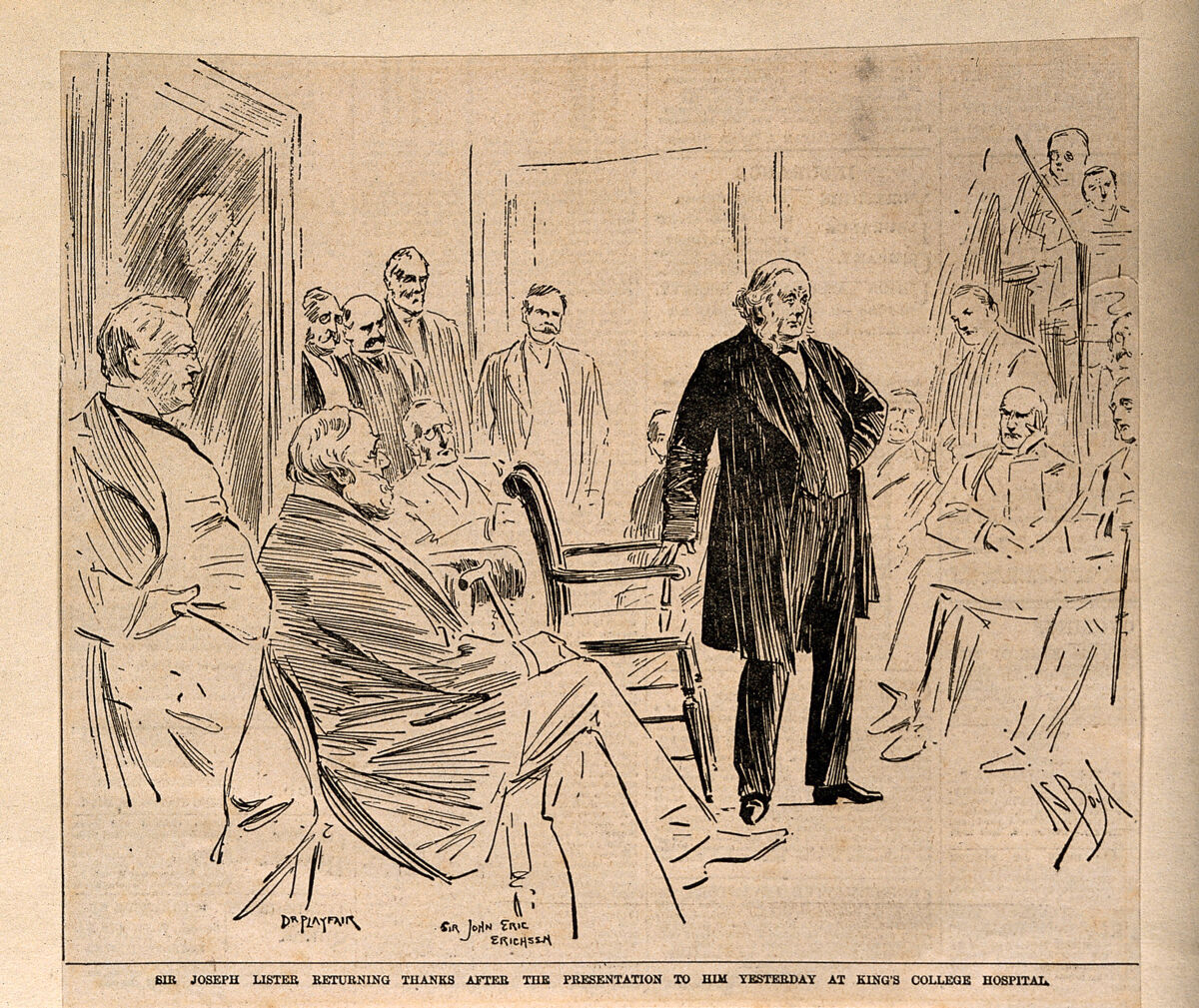
That same summer, before the British Medical Association at Dublin in August 1867, he gave the doctrine its name in an address soon printed in the Lancet: "On the Antiseptic Principle in the Practice of Surgery."11 He was scrupulous about his debt. "Allow me to tender you my most cordial thanks," he would write to Pasteur some years on, "for having, by your brilliant researches, demonstrated to me the truth of the germ theory of putrefaction, and thus furnished me with the principle upon which alone the antiseptic system can be carried out."12 The surgery was his; the idea beneath it he traced to a chemist who had never opened a body.
In 1870 he reached, at last, for numbers. In his Glasgow wards, he reported, amputation had killed sixteen of thirty-five before the antiseptic method and six of forty after, a fall from roughly forty-five in the hundred to fifteen.13 It reads like a thunderclap, and has been quoted as one ever since. Lister himself was more careful than his admirers. "These numbers," he added in the same breath, "are, no doubt, too small for a satisfactory statistical comparison."14 It may be the most honest sentence in the whole affair.
The argument that would not settle
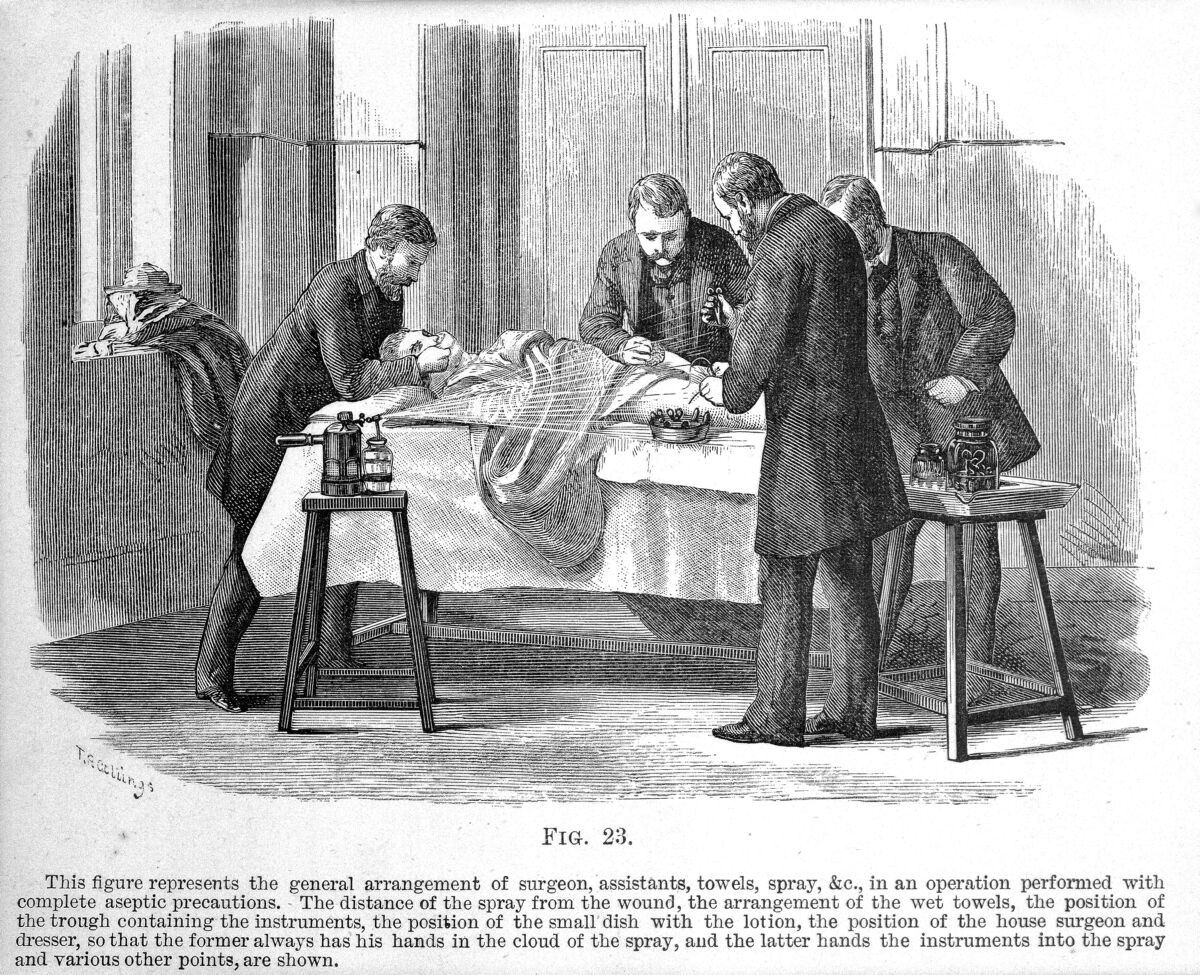
The miracle did not convince its first audience, and the reasons are worth more than the legend that buried them. The method was laborious and forever changing: soaked dressings, a putty of carbolic and oil, and from about 1871 a hand-pumped spray engine, the "donkey engine," that fogged the whole theatre with carbolic mist.15 Applied carelessly it failed, and many who tried it did so carelessly and pronounced it useless. English surgeons in particular held back; the Germans and Swiss took it up sooner, being readier to let laboratory theory govern the bedside.16
The sharper critics asked the question Lister never answered. Carbolic acid on wounds was not even his own; Lemaire in France and Bottini in Italy had used it years before, and what he claimed was not the chemical but the system and the theory under it.17 When William Savory and the combative Lawson Tait demanded the plain comparison, two like groups counted honestly side by side, Lister would not supply it, holding that "statistics can be made to prove anything or nothing."18 His own figures, set beside the whole infirmary's, were smaller than they looked: in the very years his wards improved, mortality across the rest of the Glasgow Royal Infirmary rose. A later reckoning found the city's falling death rate tracking not only the carbolic but the lifting of a long social misery, as typhus receded and wages and food improved.19 The "revolution" was in part a thing built afterwards, by disciples, around a man who had declined to prove his own case.
And he was wrong about the route. He had aimed the whole apparatus at the air, because it was in the air that Pasteur had caught his germs; but the germs that mattered in a wound came mostly by contact: on the hands, the instruments, the dressings, the surgeon's own unwashed fingers. The spray was a war waged on the wrong ground. Lister came to see it, gave up the engine in 1887, and three years later, before the congress at Berlin, said it without flinching: "As regards the spray, I feel ashamed that I should ever have recommended it for the purpose of destroying the microbes of the air."20 The system that finally won was not quite his. It was asepsis: not the drenching of a contaminated field but the exclusion of germs from the start, by steam-sterilised instruments, scrubbed hands, and in time rubber gloves and masks. The carbolic reek cleared from the theatres for good.21
Read from the Ward
I placed a central line last week the way I have placed a hundred: cap, mask, sterile gown, the patient hidden under a drape with a single window cut to the skin, the skin painted and left to dry. The ritual takes longer than the procedure, a checklist watches me perform it, and if I break the sterile field I begin again. None of it would have struck Lister as strange. He would have known the drape for his dressing, the painted skin for his carbolic lint, the discipline of it for the price he always said it cost. What he could not have known is that we were proven right where he had only been lucky: the catheter in the great vein is the compound fracture of our age, a clean wound held open into the body, and the ritual around it has all but shut the door he found.
What lasted from Lister was never the carbolic, and never the spray, and not even the famous numbers, which would not survive a morning's audit today. What lasted was a single idea, harder and plainer than any of its instruments: that infection has a source and a route, that the route runs from somewhere to the wound, and that a route which exists can be cut. Strip away the coal-tar and the brass engine, and that sentence is still standing, and nearly everything I do to keep a patient from dying of his own treatment is a gloss upon it.
I admire him the more, not the less, for how much of him was mistaken. He chased the germs through the air while they rode in on his hands. He clung to a spray he ought to have dropped years before he did. And beneath every one of those errors he had hold of the one true thing, and he held it through a decade of ridicule until the proof came up level with the principle, which is, if we are honest, the ordinary sequence in medicine, where being right and being able to show it are seldom granted in the same season. We are still at that work of separation: the true infection from the false alarm, the line that must come out from the one that may safely stay.
The donkey engines sit in glass cases now, brass and faintly absurd, and the students laugh at them, which is the kindest fate that can attend a wrong idea. I think about the boy more than the engine. James Greenlees went home on the leg they would otherwise have taken, and grew up, and asked of his two legs whatever an ordinary Glasgow life asks, and never knew that the lint on his shin had opened the cleanest century surgery had yet known. I scrub in before the first case while it is still dark outside, the way it is done everywhere now, water to the elbows and the long count under the tap. It is the most ordinary act in the building. It is also, when you follow it back, the whole of it.
- On "hospitalism" and the four ward diseases — pyaemia, septicaemia, erysipelas and hospital gangrene — with ward mortality of a third to a half, see Michael Worboys, Spreading Germs: Disease Theories and Medical Practice in Britain, 1865-1900 (Cambridge: Cambridge University Press, 2000); and F. F. Cartwright, "Antiseptic Surgery," in Medicine and Science in the 1860s, ed. F. N. L. Poynter (London: Wellcome Institute of the History of Medicine, 1968), 77-103.↩
- On the simple/compound fracture contrast and the roughly even odds of death after amputation for compound fracture, see Cartwright, "Antiseptic Surgery"; and Lister's own framing in "On a New Method of Treating Compound Fracture, Abscess, etc.," The Lancet 1 (1867): 326-29.↩
- On miasma theory and the sanitary movement as the rival explanation of ward mortality, see Worboys, Spreading Germs; Christopher Hamlin, Public Health and Social Justice in the Age of Chadwick (Cambridge: Cambridge University Press, 1998).↩
- Joseph Lister, "Effects of the Antiseptic System of Treatment upon the Salubrity of a Surgical Hospital," The Lancet 1 (1870): 4-6, 40-42, on the wards above the cathedral burial-ground ("five thousand bodies... in pits, holding eighty each" — a figure Lister quoted from a Lancet report to describe his wards); analysed in Ulrich Tröhler, "Statistics and the British Controversy about the Effects of Joseph Lister's System of Antisepsis for Surgery, 1867-1890," Journal of the Royal Society of Medicine 108 (2015): 280-87.↩
- On Joseph Jackson Lister's achromatic microscope objective (1830) and the family's Quaker household, see "Joseph Jackson Lister," Encyclopædia Britannica; Richard B. Fisher, Joseph Lister, 1827-1912 (London: Macdonald and Jane's, 1977).↩
- On Thomas Anderson, Regius Professor of Chemistry at Glasgow, directing Lister to Pasteur's papers around 1864 (Lister's first carbolic application followed in August 1865), see Fisher, Joseph Lister; Cartwright, "Antiseptic Surgery."↩
- Louis Pasteur, "Mémoire sur les corpuscules organisés qui existent dans l'atmosphère," Annales des sciences naturelles (Zoologie), 4th ser., 16 (1861): 5-98; and the companion plate in this series, The Swan-Neck Flask.↩
- On carbolic acid (phenol) as a coal-tar product and the Carlisle sewage precedent that suggested it to Lister, see Cartwright, "Antiseptic Surgery"; Fisher, Joseph Lister.↩
- On James Greenlees (aged 11), admitted 12 August 1865 with a compound fracture of the leg and dressed with carbolic acid, see Lister, "On a New Method" (1867); Michael Worboys, "Joseph Lister and the Performance of Antiseptic Surgery," Notes and Records of the Royal Society 67 (2013): 199-209.↩
- Lister, "On a New Method of Treating Compound Fracture" (1867): the opening series of eleven compound fractures, two of them fatal; see also Tröhler, "Statistics" (2015).↩
- Joseph Lister, "On the Antiseptic Principle in the Practice of Surgery," The Lancet 2 (1867): 353-56 — the address to the British Medical Association at Dublin, 9 August 1867 (republished BMJ 2 [1867]: 246-48).↩
- Lister to Louis Pasteur, 10 February 1874, thanking him for demonstrating "the truth of the germ theory of putrefaction"; quoted in Fisher, Joseph Lister; the letter is reproduced in the Œuvres of Pasteur.↩
- Lister, "Effects of the Antiseptic System" (1870): sixteen deaths in thirty-five amputations before the antiseptic period, six in forty after — about 45 per cent falling to about 15. Tabulated and discussed in Tröhler, "Statistics" (2015). (A later recomputation by J. P. Bull gives 33 cases / 43 per cent; the figures in the text are Lister's own.)↩
- Lister, "Effects of the Antiseptic System" (1870): "These numbers are, no doubt, too small for a satisfactory statistical comparison."↩
- On the carbolic spray and the hand-pumped "donkey engine" (in use from about 1871), see W. Watson Cheyne, Antiseptic Surgery: Its Principles, Practice, History and Results (London: Smith, Elder, 1882); Rickman John Godlee, Lord Lister (London: Macmillan, 1917).↩
- On the slower British and faster German/Swiss reception of antisepsis, see Worboys, Spreading Germs, 80-99; Thomas Schlich, "The Days of Brilliancy Are Past: Skill, Styles and the Changing Rules of Surgical Performance, ca. 1820-1920," Medical History 59 (2015): 379-403.↩
- On Jules Lemaire's (1863) and Enrico Bottini's (1866) earlier use of carbolic acid on wounds, and Lister's claim resting on system and theory rather than the chemical, see Tröhler, "Statistics" (2015); Worboys, Spreading Germs, 83.↩
- On Lister's refusal to furnish comparative statistics ("statistics can be made to prove anything or nothing") and the demands of William Savory (1879) and Lawson Tait, see Cartwright, "Antiseptic Surgery," 100; Tröhler, "Statistics" (2015).↩
- On mortality rising across the rest of the Glasgow Royal Infirmary while Lister's wards improved, the smallness of his numbers, and the coincident easing of the mid-century social crisis (receding typhus, rising wages and nutrition), see David Hamilton, "The Nineteenth-Century Surgical Revolution — Antisepsis or Better Nutrition?," Bulletin of the History of Medicine 56 (1982): 30-40; Tröhler, "Statistics" (2015).↩
- Joseph Lister at the Tenth International Medical Congress, Berlin, 1890: "As regards the spray, I feel ashamed that I should ever have recommended it for the purpose of destroying the microbes of the air." He had abandoned the apparatus by 1887. See Godlee, Lord Lister.↩
- On the supersession of carbolic antisepsis by aseptic technique — steam sterilisation (Ernst von Bergmann, Curt Schimmelbusch), scrubbed hands, and later rubber gloves (William Halsted) — see Worboys, Spreading Germs; Schlich, "The Days of Brilliancy Are Past."↩
- Chicago
Kim, D. Y. “On the Antiseptic Principle.” Codex Chronica, June 28, 2026. https://codexchronica.com/on-the-antiseptic-principle/.
- APA
Kim, D. Y. (2026, June 28). On the Antiseptic Principle. Codex Chronica. https://codexchronica.com/on-the-antiseptic-principle/
- Cartwright, F. F. "Antiseptic Surgery." In Medicine and Science in the 1860s, edited by F. N. L. Poynter, 77-103. London: Wellcome Institute of the History of Medicine, 1968.
- Cheyne, W. Watson. Antiseptic Surgery: Its Principles, Practice, History and Results. London: Smith, Elder, 1882.
- Fisher, Richard B. Joseph Lister, 1827-1912. London: Macdonald and Jane's, 1977.
- Godlee, Rickman John. Lord Lister. London: Macmillan, 1917.
- Hamilton, David. "The Nineteenth-Century Surgical Revolution — Antisepsis or Better Nutrition?" Bulletin of the History of Medicine 56, no. 1 (1982): 30-40.
- Lister, Joseph. "On a New Method of Treating Compound Fracture, Abscess, etc." The Lancet 1 (1867): 326-29, 357-59, 387-89, 507-09; 2: 95-96.
- Lister, Joseph. "On the Antiseptic Principle in the Practice of Surgery." The Lancet 2, no. 2299 (1867): 353-56.
- Lister, Joseph. "Effects of the Antiseptic System of Treatment upon the Salubrity of a Surgical Hospital." The Lancet 1 (1870): 4-6, 40-42.
- Worboys, Michael. "Joseph Lister and the Performance of Antiseptic Surgery." Notes and Records of the Royal Society 67, no. 3 (2013): 199-209.
- Tröhler, Ulrich. "Statistics and the British Controversy about the Effects of Joseph Lister's System of Antisepsis for Surgery, 1867-1890." Journal of the Royal Society of Medicine 108, no. 7 (2015): 280-87.
- Worboys, Michael. Spreading Germs: Disease Theories and Medical Practice in Britain, 1865-1900. Cambridge: Cambridge University Press, 2000.