
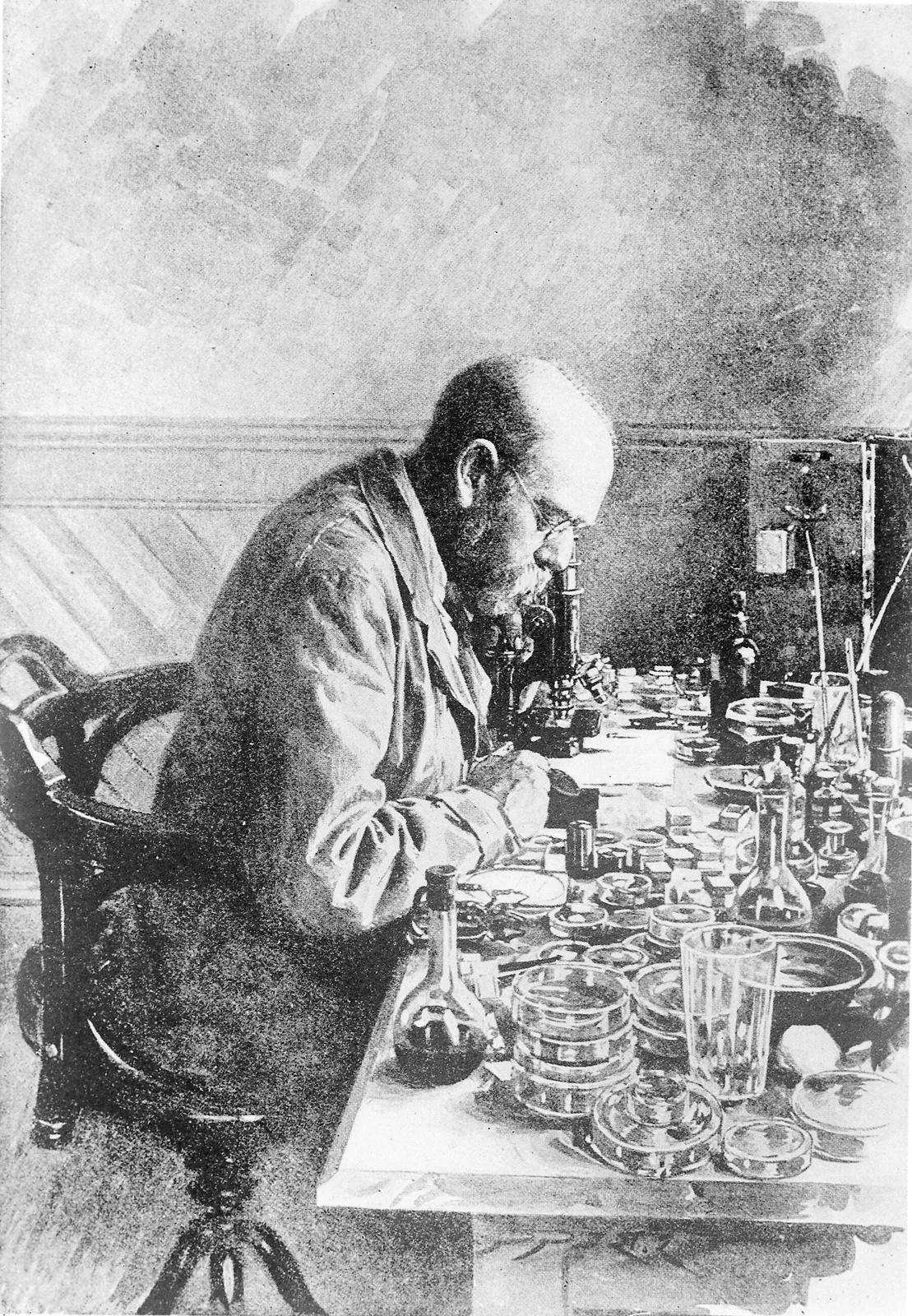
Medicine likes to say that Robert Koch handed it four clean rules for proving a germ guilty of a disease — a standard so exacting it might be printed on a card and hung above the bench. The rules were not quite four, not quite his, and not quite kept: their author loosened the strictest of them in public, within eight years of his greatest triumph, and the two most memorable tests of them were carried out by men who swallowed a living culture to settle who was right.
The standard of proof
Before Koch, to say that a particular animalcule caused a particular disease was to make a guess wearing the clothes of a claim. Cholera was a poison of the air; childbed fever was a contagion carried on the hands; the pox of the dairies was somehow the pox of the cow. The verb did all the work and proved none of it. What Koch supplied, out of his labour on anthrax and then on tuberculosis, was not another germ but a way of holding any such sentence to account — a sequence of conditions a microbe had to satisfy before it could be convicted. It must be found in every case of the disease. It must be taken out of the diseased body and grown, away from that body, in pure culture. That culture, given to a healthy host, must reproduce the illness; and from the new sufferer the same organism must be recovered once more.1 Presence, isolation, reproduction, recovery: a chain that could be laid down link by link in front of witnesses.
The force of the thing was that it turned a rhetorical question into an experimental one. An analogy could now be made to earn its keep or be dismissed, and the loose talk of ferments and miasmas met, for the first time, a bar it could be asked to clear. Those conditions are printed today as four numbered rules and called Koch's postulates, as settled a fixture of the medical mind as the times table. Almost every word of that description is a tidying-up, and the tidying is where the interest lies.
Whose rules, and how many
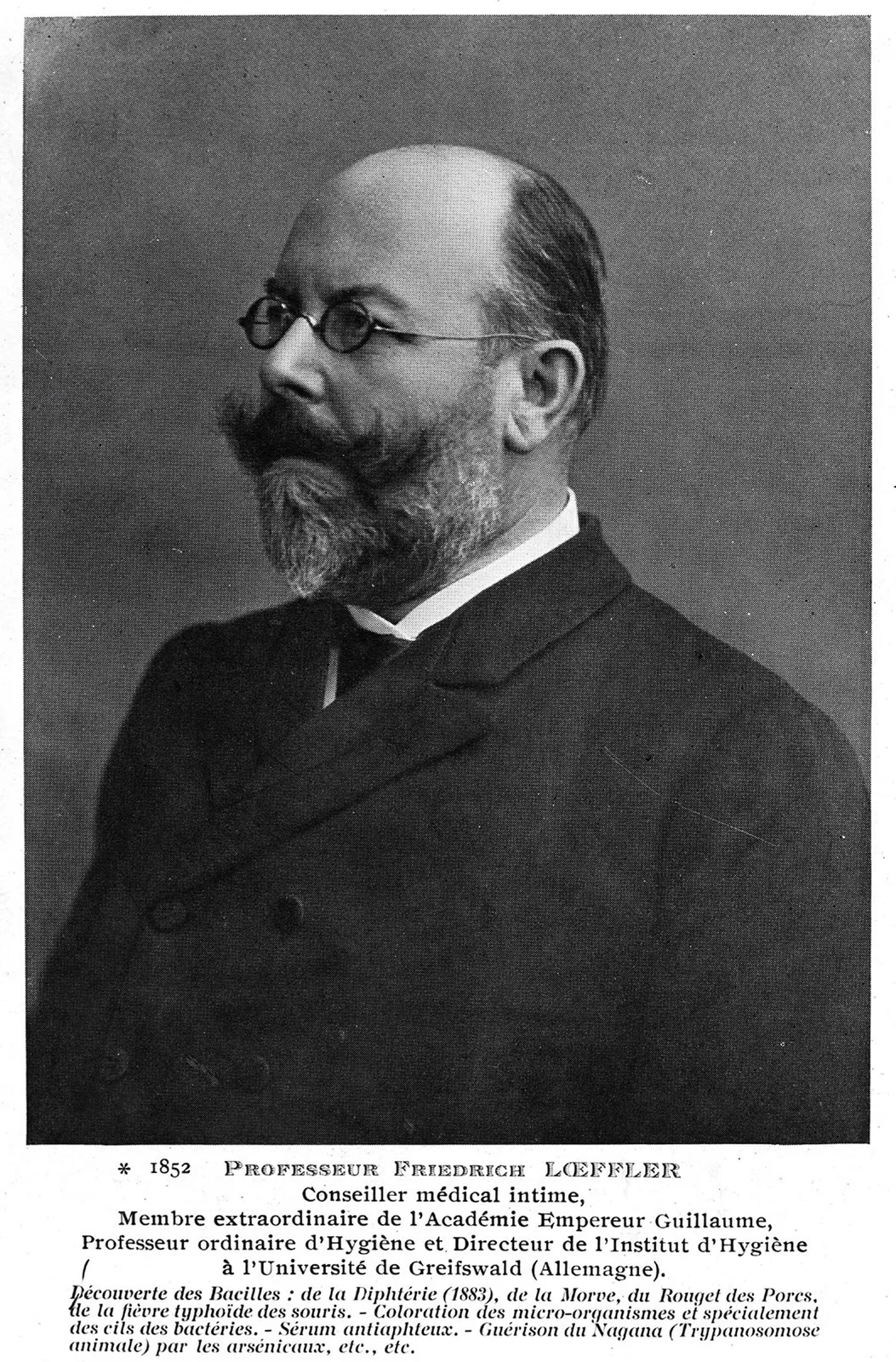
Koch never called them postulates. The word, with its cool ring of geometry, was fastened to the criteria by others (the term was Loeffler's, then hardened into dogma by the textbooks that followed), and there is little sign Koch himself would have welcomed its false promise of self-evidence.2 Nor were the criteria his to give. The essential demand — that to convict a living contagion one must show it present, isolate it, and reproduce its work — had been set down in 1840 by the anatomist Jacob Henle, who taught the young Koch at Göttingen, at a moment when no method on earth could meet it.3 Henle had the logic and none of the means; his pupil, forty years on, supplied the stains and the plates that turned a philosopher's demand into a bench routine. Even the familiar enumeration owes as much to another hand. Edwin Klebs had glimpsed the diphtheria rod in 1883; it was Koch's pupil Friedrich Loeffler who, having isolated that organism in 1884, laid the conditions out in orderly form, and noted in the very same paper that his bacillus could be cultured from the throats of the perfectly well, an exception sitting at the cradle of the rule.4 The count, too, is folklore. Koch himself generally gave three conditions, not four; the fourth, the recovery of the organism from the second host, is a later convenience. The gold standard was an alloy, and had been from the start.
The rule its maker broke
The sharpest witness against the postulates as scripture was Koch. In August 1890, before the Tenth International Medical Congress in Berlin — the same platform from which, that autumn, he would launch the calamity of tuberculin — he addressed the logic of proof head-on. A whole class of diseases, he admitted, would not submit to the third condition at all. Typhoid, diphtheria, leprosy, relapsing fever, Asiatic cholera: for none of these was there an animal in which a pure culture reliably brought on the human illness. Rather than read them out of the germ theory, Koch bent the rule to fit them. If the first two conditions were satisfied, the organism found regularly and exclusively in the disease and grown in pure culture, then, he declared, the causal relation was validly established, third condition or no.5 The most exacting standard in medicine had been softened, in public, by the man who forged it. He softened it because the microbes gave him no choice; the world of infection was already larger than the rule built to police it.
The old man who drank cholera
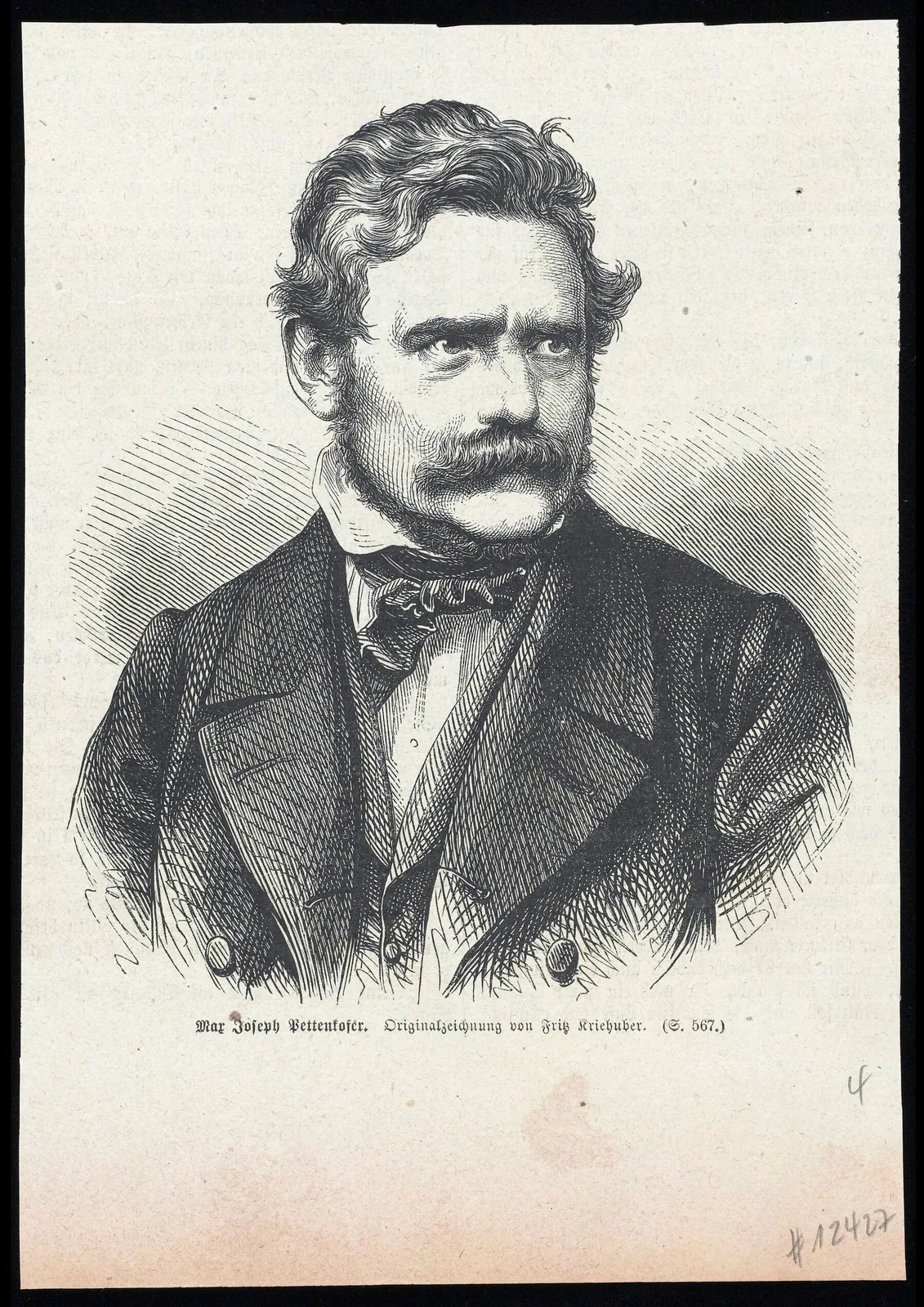
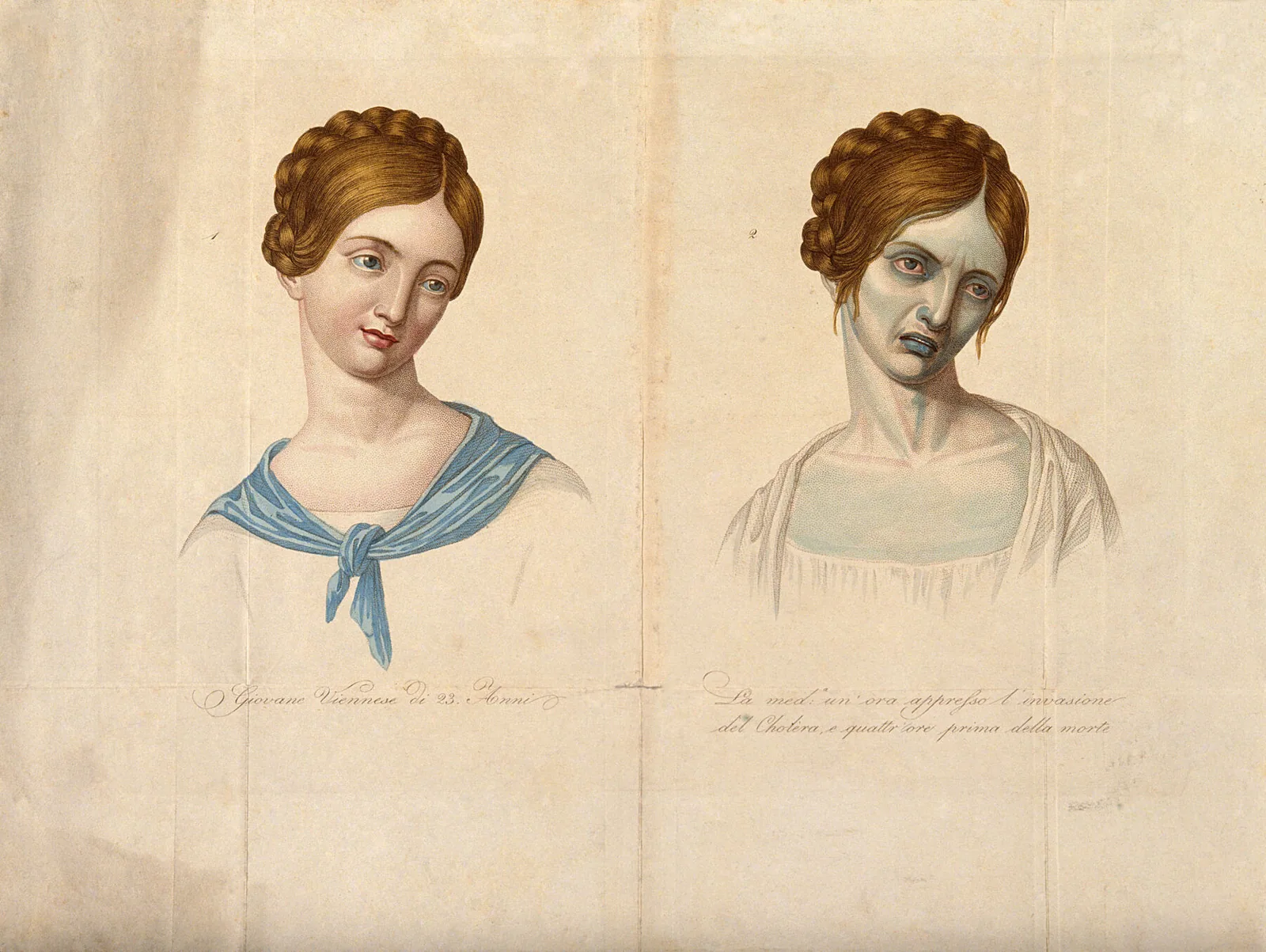
Cholera was the disease that would not lie down, and it produced the strangest experiment in the whole history of the postulates. Max von Pettenkofer, the eminent hygienist of Munich, believed to his marrow that Koch had mistaken a passenger for the driver. The comma bacillus was real enough, he allowed, but it was not the whole cause; the true author of an epidemic was the soil, the local ground and its water and season, which ripened a harmless germ into a poison. On the seventh of October 1892, at the age of seventy-three, he set out to prove it upon his own body. He neutralised his stomach acid, and before witnesses drank down a broth swarming with Vibrio cholerae, perhaps a thousand million organisms, drawn from a culture supplied — with what private feelings one can only guess — by Koch's own laboratory.6 He did not die. He passed several days of violent diarrhoea and recovered; his assistant Rudolf Emmerich, who swallowed a second draught a week later, was far sicker and also lived.7 Pettenkofer declared himself vindicated: the germ alone had not sufficed. He was wrong about the soil, and wrong about nearly the whole of it; yet the obstinate old man had blundered into a genuine flaw in the edifice. The bacillus was necessary and, by itself, not enough; whether it felled a man turned partly on the man. Koch's clean chain had no link for that.
The young man who drank a germ
Ninety-two years is a long time for an argument to hold its shape, and when it broke surface again the gesture was the same and the purpose reversed. By the settled doctrine of the twentieth century, the stomach ulcer was a disease of acid and worry, and everyone knew that nothing living could withstand the acid bath of the stomach. So when a Perth pathologist, Robin Warren, kept finding spiral bacteria curled on gastric biopsies, and a young trainee named Barry Marshall cultured the organism in 1982 and named it the cause of ulcers, the profession simply declined to believe them.8 The obstacle was Koch's third condition. There was no animal in which the germ would reliably raise the human disease, and so no way to close the chain of proof. In July 1984 Marshall closed it on himself. He had his own stomach examined and found sound, then drank a cloudy broth of the organism cultured from a patient, and within days was nauseated and gastritic, a fresh biopsy now showing the bacteria at work on an inflamed stomach wall.9 He had made himself the missing animal. The world took another decade to be convinced, but in 2005 Warren and Marshall were awarded the Nobel Prize, and the duodenal ulcer passed from the surgeons and the stress-doctors to a fortnight of antibiotics.10 The one condition no ethical experiment could meet had been met by a man willing to be his own guinea pig.
The chain and the web
Between those two draughts the ground had shifted beneath the rules entirely. Viruses came first to embarrass them: obligate parasites that would grow in no dish of broth, and that dwelt in the well as readily as in the sick, they failed the second condition not by mishap but by their nature. In 1937 the virologist Thomas Rivers, conceding the point, rewrote the conditions for agents that live only inside other cells, and warned that a blind adherence to Koch could hinder discovery as surely as it guarded against error.11 The chronic diseases strained the frame further still. When the question grew to be whether tobacco caused the cancer of the lung — an agent one cannot inject, a tumour one cannot raise to order, a cause neither necessary nor sufficient — Koch's chain was simply the wrong instrument, and in 1965 Austin Bradford Hill offered in its place nine "viewpoints," strength and consistency and biological gradient among them, a way of weighing likelihood rather than forging proof.12 Molecular biology completed the reformation: in 1988 Stanley Falkow recast the postulates around genes rather than whole organisms, and a later generation learned to name a pathogen from its sequence alone, never having grown it at all.13 What each revision concedes is the very thing Koch's method was built to keep out: that a disease is more often a web of causes than a chain, host and germ and circumstance drawing on it together, and that the single sufficient microbe he taught us to hunt is the exception got up as the rule.
Read from the Ward
The report appears on the screen with a name on it, and the name is the easy part. A sputum grows a yeast; the tip of a line grows a staphylococcus of the kind that lives by the million on clean skin; a catheterised bladder yields an organism that was almost certainly there yesterday and the day before. The laboratory has told me only that the germ is present — Koch's first condition, and by a wide margin his weakest — and it now falls to me, at two in the morning, to furnish the rest of the proof out of my own head. Is this the cause of the fever in front of me, or a passenger the net happened to catch?14 There is no pure culture at the bedside and no guinea pig down the corridor. There is only the judgement, run silently and in reverse a dozen times a shift, of whether this organism, in this patient, is doing this harm.
It is the most ordinary act of my working life, and it is Koch's problem exactly, stripped of its certainty. I live inside the exceptions he already glimpsed. My patients are thick with organisms that are present without being guilty and, now and then, guilty without being sufficient: the colonised airway, the contaminated blood bottle, the quiet germ that turns on a body we have disarmed ourselves with drugs and lines and time. Koch wanted a chain he could lay before witnesses; the patient hands me a web I must weigh alone, and weigh again when the picture changes at dawn. So I reach, as he did in Berlin, for the looser standard — the sequence, the biomarker, the response to treatment read backwards as a kind of evidence — and I try not to mistake the tidiness of the report for the tangle of the person.
Tonight it is a line infection, probably. I name one organism among the several the laboratory has offered, and I treat it as the enemy, knowing the proof is not closed and will not close; knowing, too, that a truer answer is already growing somewhere in the dark of the incubator, in a culture I sent an hour ago and will have to read, and judge, when the morning comes.
- The conditions are given here in the composite form in which they are usually taught, drawn from Koch's papers on tuberculosis (1882) and cholera (1884) and from his 1890 Berlin address; the fourth clause, re-isolation of the organism from the experimental host, is a convention added by later writers. See K. Codell Carter, "Koch's Postulates in Relation to the Work of Jacob Henle and Edwin Klebs," Medical History 29 (1985): 353–74; and Alfred S. Evans, "Causation and Disease: The Henle–Koch Postulates Revisited," Yale Journal of Biology and Medicine 49 (1976): 175–95.↩
- On the term "postulates" as a later, largely Anglophone attribution, and on Koch's own preference for the language of conditions and rules of proof, see Carter, "Koch's Postulates" (1985); and Christoph Gradmann, Laboratory Disease: Robert Koch's Medical Bacteriology (Baltimore: Johns Hopkins University Press, 2009).↩
- Jacob Henle, Von den Miasmen und Contagien und von den miasmatisch-contagiösen Krankheiten (Berlin, 1840). Henle taught Koch at Göttingen, and the criteria are for that reason often called the Henle–Koch postulates; see Carter, "Koch's Postulates" (1985).↩
- Edwin Klebs observed the diphtheria organism in 1883; Friedrich Loeffler isolated and cultured it and set out the conditions of proof in "Untersuchungen über die Bedeutung der Mikroorganismen für die Entstehung der Diphtherie beim Menschen, bei der Taube und beim Kalbe," Mittheilungen aus dem Kaiserlichen Gesundheitsamte 2 (1884): 421–99, where he also remarked that the bacillus could be found in healthy throats. See Carter, "Koch's Postulates" (1985).↩
- Robert Koch, "Über bakteriologische Forschung," address to the Tenth International Medical Congress, Berlin, 4–9 August 1890. Koch conceded that typhoid, diphtheria, leprosy, relapsing fever, and Asiatic cholera did not satisfy the third condition, and held that fulfilment of the first two — the regular and exclusive presence of the organism, grown in pure culture — sufficed to establish causation. See Evans, "Causation and Disease" (1976); and Gradmann, Laboratory Disease (2009).↩
- On Pettenkofer's localist "soil" (Boden) theory of cholera and the self-experiment of 7 October 1892 — the neutralised stomach, the estimated 109 organisms, and the culture obtained from Koch's laboratory — see Alfredo Morabia, "Epidemiologic Interactions, Complexity, and the Lonesome Death of Max von Pettenkofer," American Journal of Epidemiology 166 (2007): 1233–38; and Thomas D. Brock, Robert Koch: A Life in Medicine and Bacteriology (Berlin: Springer, 1988).↩
- On Rudolf Emmerich's repetition of the draught about a week later, and the more severe illness he suffered, see Morabia, "The Lonesome Death of Max von Pettenkofer" (2007).↩
- On the acid-and-stress model of peptic ulcer, Robin Warren's observation of spiral bacteria on gastric biopsies, Marshall's culture of the organism in 1982, and the profession's resistance, see Barry J. Marshall and J. Robin Warren, "Unidentified Curved Bacilli in the Stomach of Patients with Gastritis and Peptic Ulceration," The Lancet 323 (1984): 1311–15; and the Nobel Foundation, "The Nobel Prize in Physiology or Medicine 2005" (press materials).↩
- On Marshall's July 1984 self-experiment — endoscopic confirmation of a healthy stomach, ingestion of a broth culture of the organism (then styled Campylobacter pyloridis, later Helicobacter pylori), and the ensuing acute gastritis with biopsy evidence of colonisation — see Barry J. Marshall, J. A. Armstrong, D. B. McGechie, and R. J. Glancy, "Attempt to Fulfil Koch's Postulates for Pyloric Campylobacter," Medical Journal of Australia 142 (1985): 436–39. The observational study and first culture appeared earlier in Marshall and Warren, "Unidentified Curved Bacilli" (1984).↩
- The Nobel Prize in Physiology or Medicine 2005 was awarded jointly to Barry J. Marshall and J. Robin Warren "for their discovery of the bacterium Helicobacter pylori and its role in gastritis and peptic ulcer disease." See the Nobel Foundation, 2005.↩
- Thomas M. Rivers, "Viruses and Koch's Postulates," Journal of Bacteriology 33 (1937): 1–12 — presidential address to the Society of American Bacteriologists — arguing that obligate intracellular agents cannot satisfy the demand for pure culture and that rigid adherence to the postulates could impede the study of viral disease.↩
- Austin Bradford Hill, "The Environment and Disease: Association or Causation?," Proceedings of the Royal Society of Medicine 58 (1965): 295–300, proposing nine "viewpoints" (strength, consistency, specificity, temporality, biological gradient, plausibility, coherence, experiment, analogy) for reasoning about causation where experiment and reproduction are impossible.↩
- Stanley Falkow, "Molecular Koch's Postulates Applied to Microbial Pathogenicity," Reviews of Infectious Diseases 10, suppl. 2 (1988): S274–76; and, on identification of pathogens from nucleic-acid sequence without culture, David N. Fredricks and David A. Relman, "Sequence-Based Identification of Microbial Pathogens: A Reconsideration of Koch's Postulates," Clinical Microbiology Reviews 9 (1996): 18–33.↩
- On the clinical distinction between colonisation and infection — the everyday judgement that a cultured organism is a bystander rather than a cause, and the standing advice not to treat asymptomatic bacteriuria — see Lindsay E. Nicolle et al., "Clinical Practice Guideline for the Management of Asymptomatic Bacteriuria: 2019 Update by the Infectious Diseases Society of America," Clinical Infectious Diseases 68 (2019): e83–e110.↩
- Chicago
Kim, D. Y. “Koch's Postulates.” Codex Chronica, July 3, 2026. https://codexchronica.com/kochs-postulates/.
- APA
Kim, D. Y. (2026, July 3). Koch's Postulates. Codex Chronica. https://codexchronica.com/kochs-postulates/
- Brock, Thomas D. Robert Koch: A Life in Medicine and Bacteriology. Berlin: Springer, 1988.
- Carter, K. Codell. "Koch's Postulates in Relation to the Work of Jacob Henle and Edwin Klebs." Medical History 29 (1985): 353–74.
- Evans, Alfred S. "Causation and Disease: The Henle–Koch Postulates Revisited." Yale Journal of Biology and Medicine 49 (1976): 175–95.
- Falkow, Stanley. "Molecular Koch's Postulates Applied to Microbial Pathogenicity." Reviews of Infectious Diseases 10, suppl. 2 (1988): S274–76.
- Gradmann, Christoph. Laboratory Disease: Robert Koch's Medical Bacteriology. Baltimore: Johns Hopkins University Press, 2009.
- Hill, Austin Bradford. "The Environment and Disease: Association or Causation?" Proceedings of the Royal Society of Medicine 58 (1965): 295–300.
- Marshall, Barry J., J. A. Armstrong, D. B. McGechie, and R. J. Glancy. "Attempt to Fulfil Koch's Postulates for Pyloric Campylobacter." Medical Journal of Australia 142 (1985): 436–39.
- Marshall, Barry J., and J. Robin Warren. "Unidentified Curved Bacilli in the Stomach of Patients with Gastritis and Peptic Ulceration." The Lancet 323 (1984): 1311–15.
- Morabia, Alfredo. "Epidemiologic Interactions, Complexity, and the Lonesome Death of Max von Pettenkofer." American Journal of Epidemiology 166 (2007): 1233–38.
- Rivers, Thomas M. "Viruses and Koch's Postulates." Journal of Bacteriology 33 (1937): 1–12.