
In the winter of 1895 a German physicist sat in a darkened room and watched a faint green glow fall where no light could reach. Seven weeks later he had given medicine the thing it had wanted since the first physician laid hands on the first patient: a way to see inside the living body without cutting it open. Wilhelm Röntgen named the discovery the X-ray, after the algebraic sign for a quantity unknown, and declined to own it. The same ray that would find the bullet and the broken bone had already begun, unnoticed, to burn the hands that held it.
The glow in the dark
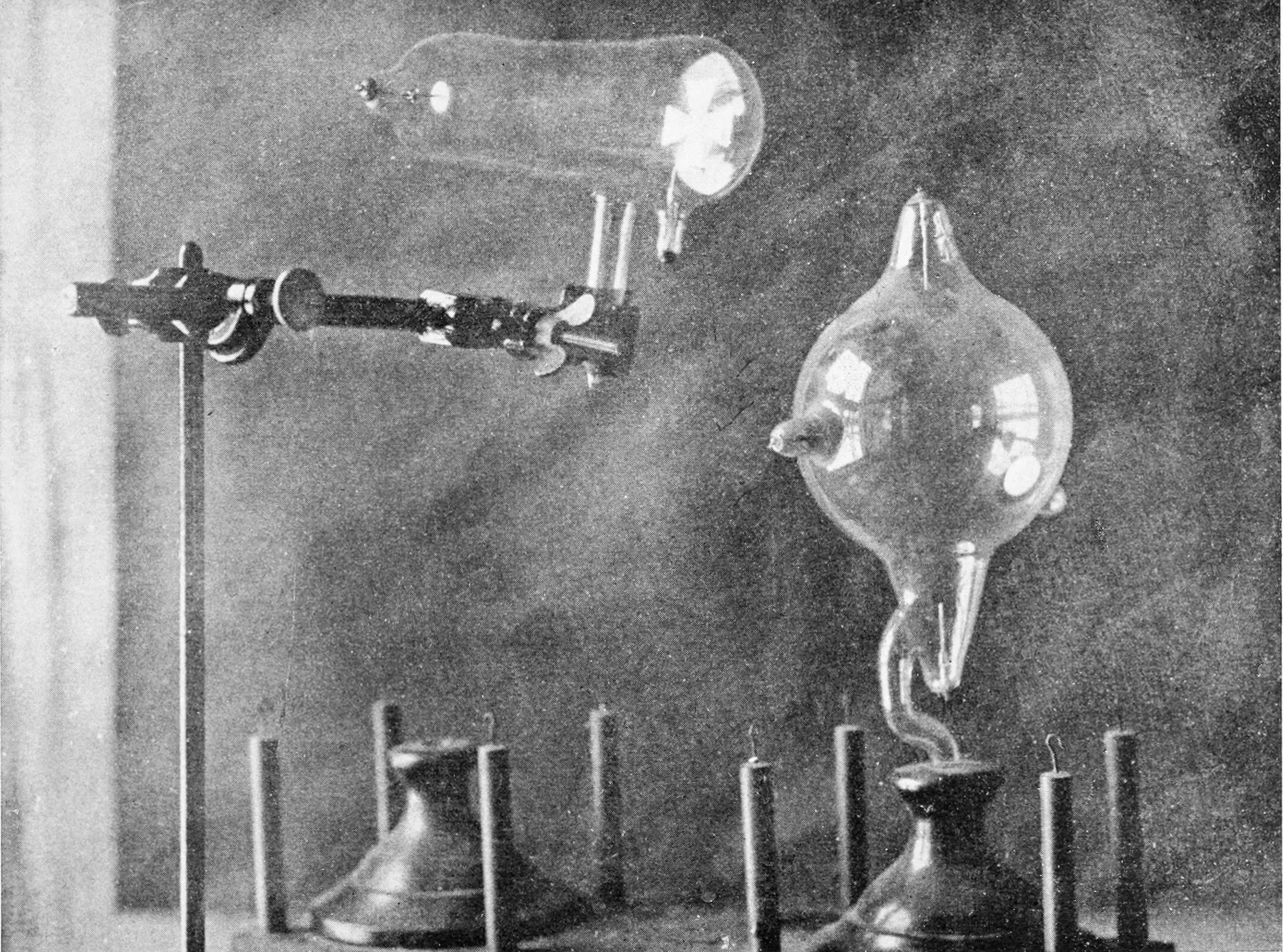
Röntgen was fifty, the respected and unflashy director of the physics institute at Würzburg, when the accident found a man prepared to take it seriously. On the evening of the eighth of November 1895 he was passing a current through a Crookes tube, a pear of evacuated glass that threw off cathode rays, the whole of it shrouded in black card so that no light could escape. A small screen painted with barium platinocyanide, lying on a bench some way off, had begun to glow.1 Cathode rays were known to travel only a few centimetres in air. Whatever was crossing the room to wake that screen was something else.
He did not announce it. For close on seven weeks he shut himself in the laboratory, took his meals there, and said almost nothing to anyone, repeating the observation a hundred ways until he could no longer doubt it. When his wife asked what was the matter, he answered that if he told people what he was seeing, they would say Röntgen had gone mad.2 He established that the new rays passed through cloth and flesh, that they darkened a photographic plate, and that denser matter cast the deeper shadow. Not knowing what they were, he gave them the name that mathematics keeps for the unknown quantity, and called them X-rays.3 The story is usually told as a lucky accident. The luck was real, and so was the glimpse; the discovery was the seven weeks of a careful man refusing to believe himself until the evidence left him no room.
The hand
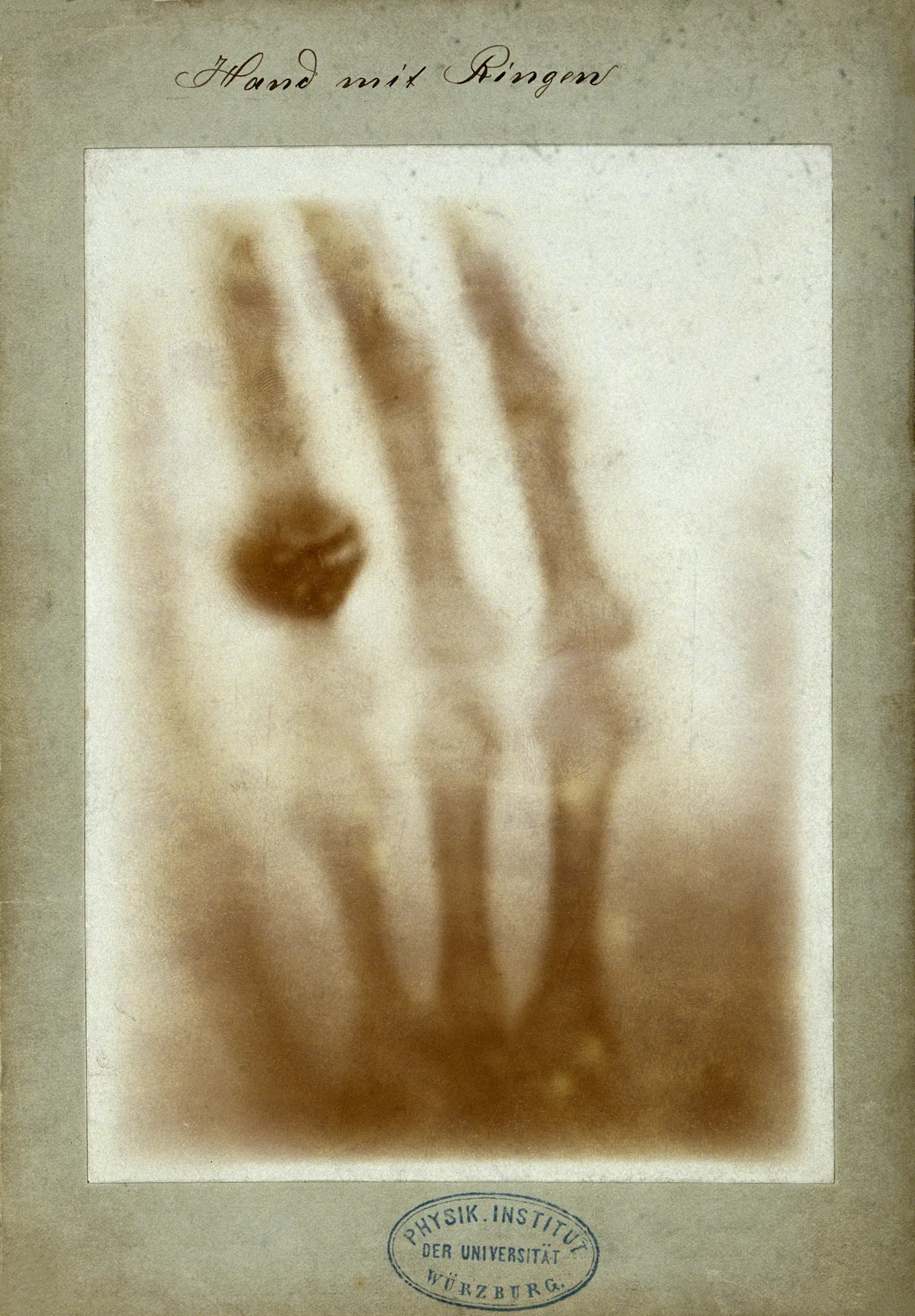
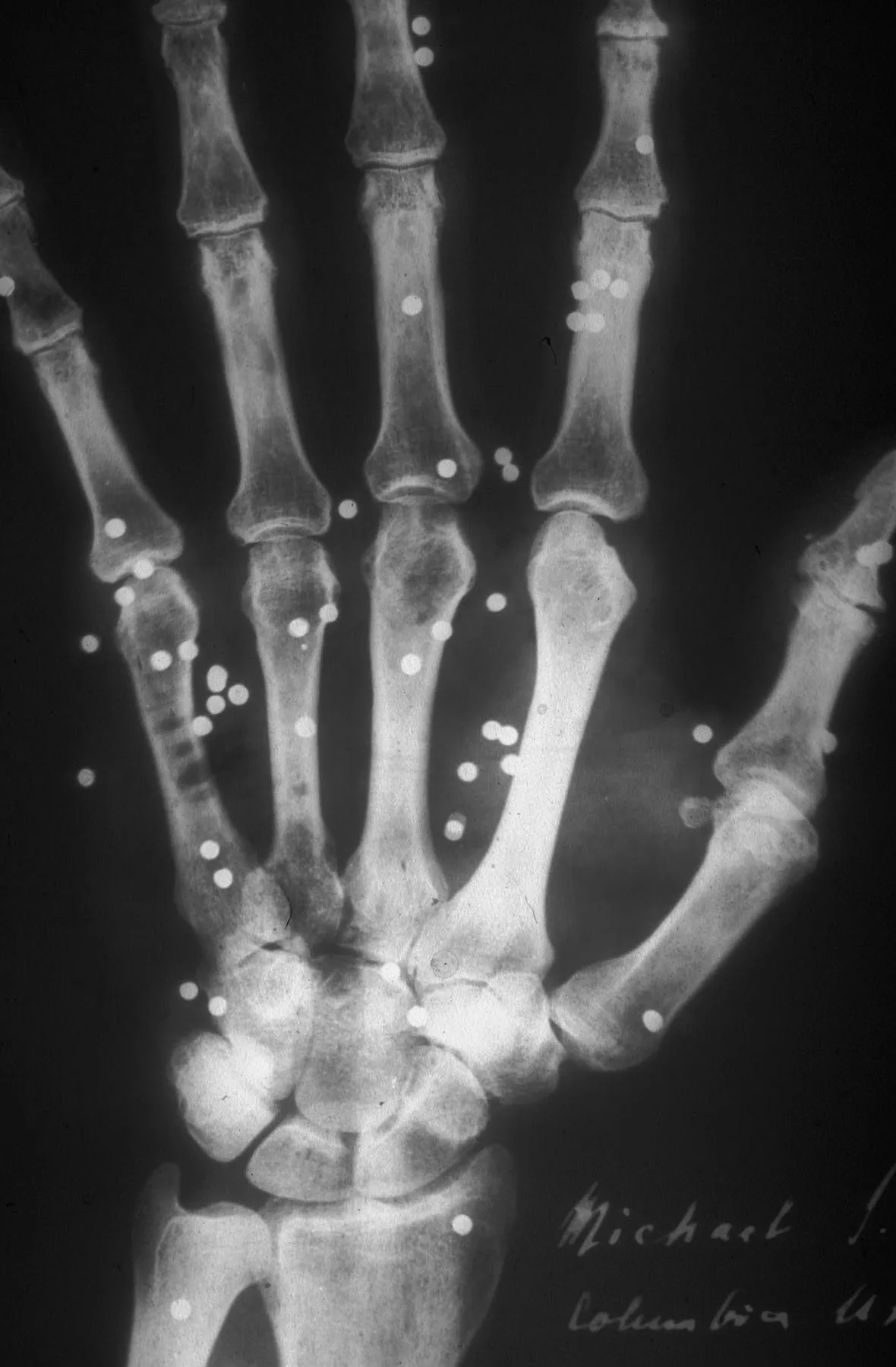
On the twenty-second of December he brought his wife, Anna Bertha, into the laboratory and asked her to lay her hand on a photographic plate while he directed the rays through it for a long exposure.4 What the plate gave back, once he developed it, was the inside of her living hand: the bones of the fingers in pale grey, the flesh a faint shadow around them, and the wedding ring hanging dark and solid upon bone. She is said to have looked at it and exclaimed that she had seen her death.5 The picture is remembered as the first of its kind, the hand with the rings, and it carried a force that no sentence of his careful German could.
Six days later, on the twenty-eighth, he submitted a short paper, On a New Kind of Rays, to the physical-medical society of Würzburg.6 Until that fortnight the interior of a living person had been a closed country, entered by the knife or, with any certainty, only on the autopsy table once the patient was past helping. Röntgen had opened a window in the side of the living body, and asked nothing of the patient but that they hold still.
The sensation
The news did not so much spread as detonate. Within weeks of the new year the newspapers of Europe and America were printing the picture of the bones of a hand, and the phrase Röntgen rays had entered every language that had a press.7 The public took it first as a marvel and a parlour trick, sitting for portraits of their own skeletons and joking uneasily about a ray that might see beneath one's clothes. The profession took it faster and more seriously. By February 1896 a Dartmouth physics professor had made a plate of a boy's fractured forearm for his physician brother, and the image guided the setting of the bone, among the first clinical uses of the rays in America; within the year surgeons across the world were finding broken bones, swallowed coins, needles and bullets that had been pure guesswork the season before.8
Röntgen took out no patent. He held that the discovery belonged to the world at large and that it was not his to tax, and he let the manufacturers build their machines unencumbered while the use of the rays ran ahead of everyone.9
The unseen price
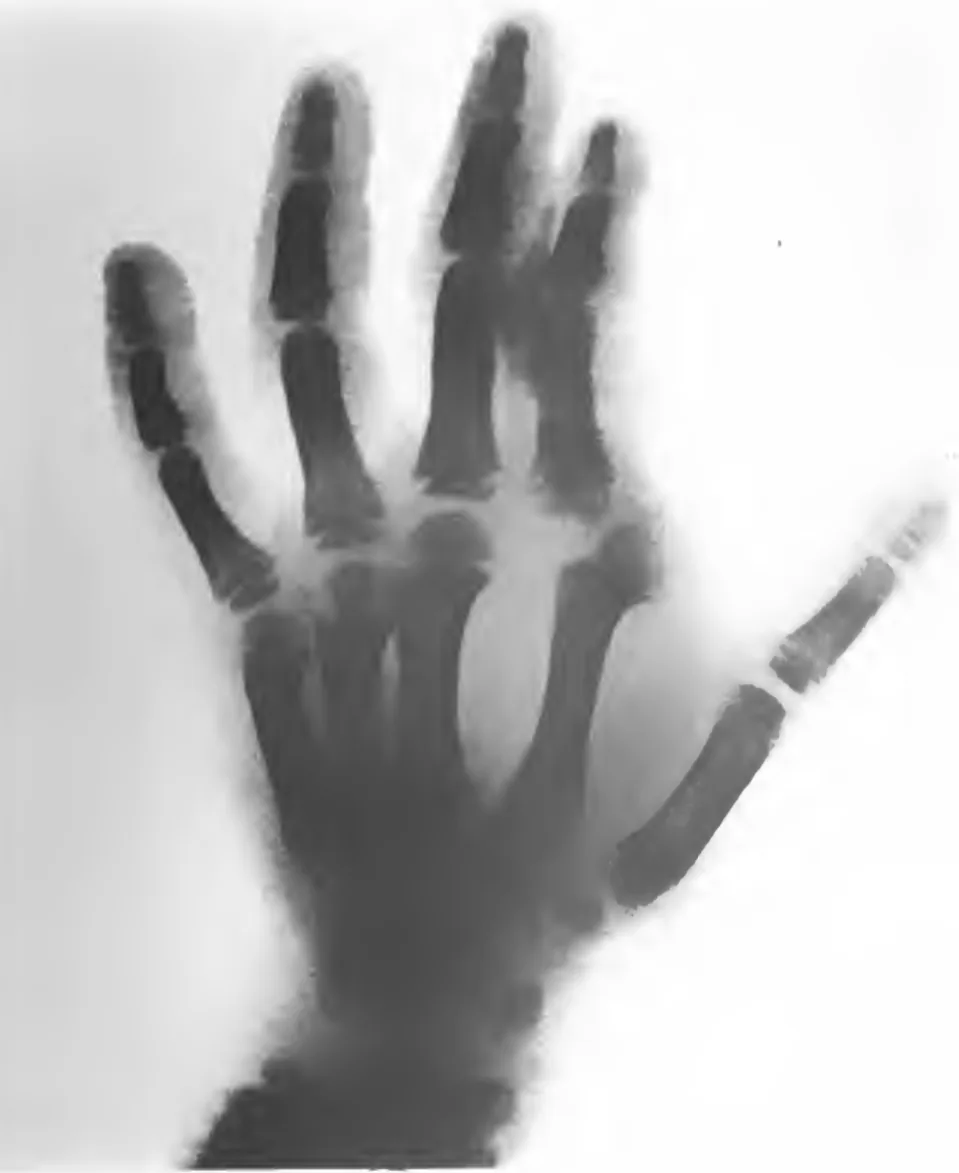
There was a price, and most of it was paid before anyone understood it was owed. For several years it was widely believed that the rays passed through flesh as harmlessly as ordinary light, and the men and women who worked the new tubes did so with their hands in the beam, judging an exposure by the reddening of their own skin.10 Then the skin began to ulcerate. Hair fell out where the beam had played, and burns appeared that would not heal. Clarence Dally, who built and demonstrated X-ray tubes for Thomas Edison, worked for years with his hands in the rays, lost first his hair and then the skin of his hands, then his arms to amputation, and died in 1904 of a spreading cancer, among the first people killed by the thing he was showing the public.11
The harm was slow to be believed because it broke the rule by which the body learns danger. A flame announces itself at once. The ray gave no warning at the moment of exposure and rendered its bill months or years later, in a tissue that had felt nothing at the time. A generation of early radiologists lost fingers and hands and lives teaching the rest of us, by their own ruin, that to see by the ray was also to be touched by it.
The unknown, given away
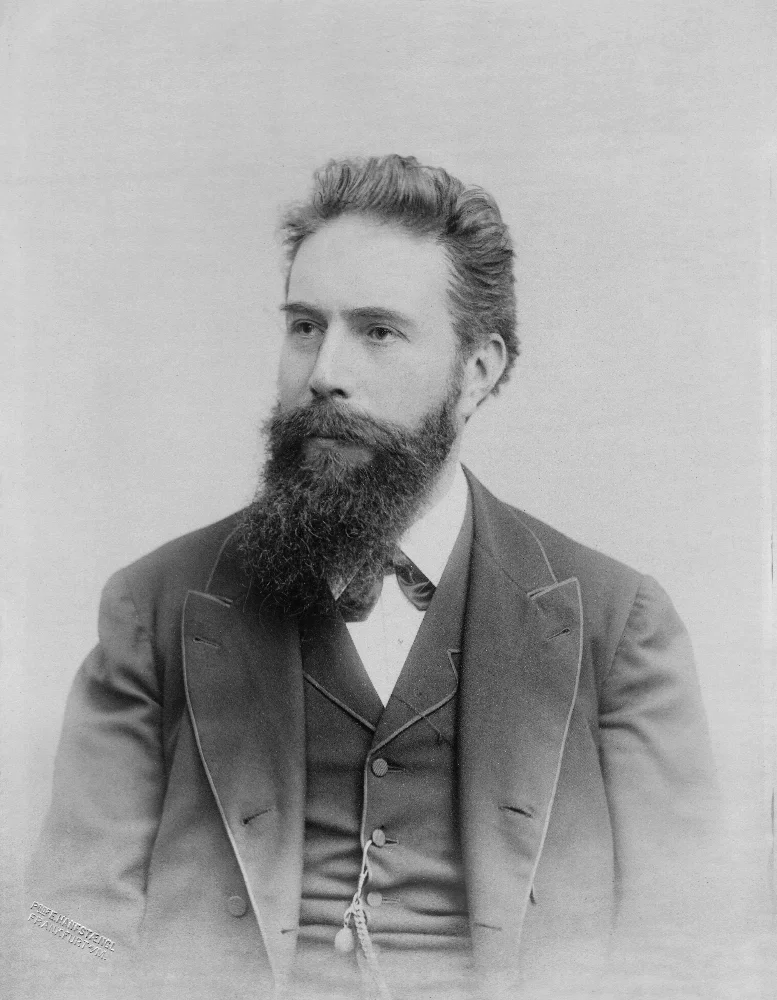
In 1901, when the Nobel Prizes were awarded for the first time, the prize in physics went to Röntgen.12 He gave the money to his university, declined to deliver the customary lecture, and kept his reticence to the end, a man made world-famous by a ray he had named for its mystery and had then refused to own. German still calls the rays after him, Röntgenstrahlen, which is the monument he never asked for.
Read from the Ward
I have looked inside more living bodies than any surgeon of Röntgen's century, and I have never once opened one to do it. In a single night on the unit I will read the grey weather of a chest film, send a patient through the scanner to ask whether the sudden weakness down one side is a clot I can still pull out in time, and watch a needle find a vein on a screen without breaking the skin to look for it. None of it strikes me as remarkable until I stop, as I did in writing this, and remember that the whole of it began with the inside of one woman's hand, held over a plate in Würzburg while she waited to be frightened.
What Röntgen gave my trade was a new sense. Before him the living interior was a thing inferred: from the pulse under the finger, the note Laennec's tube carried up from the chest, the surgeon's hand once the body was already open. After him it could be seen, ahead of the knife, while there was still time to choose what to do. The plain film, the scan, the screen that steadies my needle, the whole apparatus by which modern medicine knows the body before it touches it, descends from a green glow on a forgotten bench.
I try not to read the early innocence about the danger as foolishness, because their reasoning is the one I would have made. Light pours through a window and harms no one. Sunlight warms without wounding. Why should this quieter light, that passed so gently through a hand as to draw out its bones, be any crueller than the rest? They had no way to know that the gentleness was itself the danger, that a ray which announced nothing at the skin could still be spending the body's account. The radiologists who lost their hands were not careless people. They were paying the tuition for a lesson the ray was uniquely fitted to hide.
That lesson is the quiet spine of how I use the thing now, though I seldom spell it out to a patient. Every image I order is a dose, and a real part of the discipline is restraint: the child I do not scan because the answer is not worth the radiation, the repeat film I talk a colleague out of, the standing arithmetic of how much sight is worth how much harm. Röntgen's ray is still the cleanest case in medicine of a gift that charges you for its use, and the charge falls on the very tissue it lit up.
Anna Bertha, I have come to think, read the plate more exactly than her husband did. He saw a new kind of ray. She looked at the bones of her own living hand and said she had seen her death, and she was right in two ways: in the plain way, that the living come at last to this, and in a way she could not have meant, that the light which had shown her the bones belonged to a family of light that could, in the end, help bring them nearer. We have spent the century since learning to keep the first sight and to ration the second. The window Röntgen opened in the side of the living body is the most useful thing my century inherited from his. It has never once been free.
- On the observation of 8 November 1895 — the barium platinocyanide screen fluorescing at a distance cathode rays could not reach, the tube shrouded in black card — see Otto Glasser, Wilhelm Conrad Röntgen and the Early History of the Roentgen Rays (London: John Bale, Sons & Danielsson, 1933); Wilhelm Conrad Röntgen, "Über eine neue Art von Strahlen," Sitzungsberichte der Physikalisch-Medicinischen Gesellschaft zu Würzburg (1895): 132-41.↩
- On the roughly seven weeks of secret, methodical work, meals taken in the laboratory, and Röntgen's remark that people would think he had gone mad, see Glasser, Early History of the Roentgen Rays; German Röntgen-Museum, quoted in "'I Have Seen My Death': How the World Discovered the X-Ray," PBS NewsHour.↩
- Röntgen named the rays "X" after the symbol for an unknown quantity, having established their penetration of various materials and their action on a photographic plate: Röntgen, "Über eine neue Art von Strahlen" (1895); "Wilhelm Conrad Röntgen," Encyclopædia Britannica.↩
- The radiograph of Anna Bertha Ludwig's hand was made on 22 December 1895: Glasser, Early History of the Roentgen Rays; "Close to the bone: Wilhelm Röntgen," Science Museum, via Google Arts & Culture.↩
- The words "I have seen my death," attributed to Anna Bertha on seeing the bones of her own hand, are widely repeated but anecdotal; see "'I Have Seen My Death,'" PBS NewsHour. Treated here as reported tradition, not verbatim record.↩
- Röntgen, "Über eine neue Art von Strahlen," communicated to the Physikalisch-Medicinische Gesellschaft zu Würzburg on 28 December 1895.↩
- On the immediate international sensation of early 1896 and the spread of the term "Röntgen rays," see "The Nobel Prize in Physics 1901 — Perspectives," NobelPrize.org; Glasser, Early History of the Roentgen Rays.↩
- On the radiograph of Eddie McCarthy's fractured forearm made at Dartmouth in February 1896 by Edwin B. Frost (physics professor and later astronomer) for his brother Gilman D. Frost (physician), and its use in managing the fracture, see Peter K. Spiegel, "The First Clinical X-ray Made in America — 100 Years," American Journal of Roentgenology 164 (1995): 241-43. Foreign-body and fracture localisation followed within months.↩
- On Röntgen's refusal to patent, holding that the discovery belonged to the world, see "Wilhelm Conrad Röntgen," Encyclopædia Britannica; "The Nobel Prize in Physics 1901," NobelPrize.org.↩
- On the early belief that the rays were as harmless as light, and operators gauging exposure by skin reddening, see K. Sansare, V. Khanna and F. Karjodkar, "Early Victims of X-rays: A Tribute and Current Perception," Dentomaxillofacial Radiology 40, no. 2 (2011): 123-25.↩
- On Clarence Dally — Edison's assistant, whose work demonstrating X-ray tubes led to burns, amputations and death from carcinoma in 1904 — see Sansare et al., "Early Victims of X-rays"; "Clarence Dally — The Man Who Gave Thomas Edison X-Ray Vision," Smithsonian Magazine.↩
- Röntgen received the first Nobel Prize in Physics in 1901, donated the prize money to the University of Würzburg, and gave no Nobel lecture: "The Nobel Prize in Physics 1901," NobelPrize.org.↩
- Chicago
Kim, D. Y. “A New Kind of Ray.” Codex Chronica, June 28, 2026. https://codexchronica.com/a-new-kind-of-ray/.
- APA
Kim, D. Y. (2026, June 28). A New Kind of Ray. Codex Chronica. https://codexchronica.com/a-new-kind-of-ray/
- Glasser, Otto. Wilhelm Conrad Röntgen and the Early History of the Roentgen Rays. London: John Bale, Sons & Danielsson, 1933.
- Röntgen, Wilhelm Conrad. "Über eine neue Art von Strahlen." Sitzungsberichte der Physikalisch-Medicinischen Gesellschaft zu Würzburg (1895): 132-41.
- Spiegel, Peter K. "The First Clinical X-ray Made in America — 100 Years." American Journal of Roentgenology 164 (1995): 241-43.
- Sansare, K., V. Khanna, and F. Karjodkar. "Early Victims of X-rays: A Tribute and Current Perception." Dentomaxillofacial Radiology 40, no. 2 (2011): 123-25.
- "The Nobel Prize in Physics 1901." NobelPrize.org.
- "Wilhelm Conrad Röntgen." Encyclopædia Britannica.