
On the sixteenth of October, 1846, a Boston dentist put a young printer to sleep — and the oldest companion of surgery, the scream, at last fell silent.
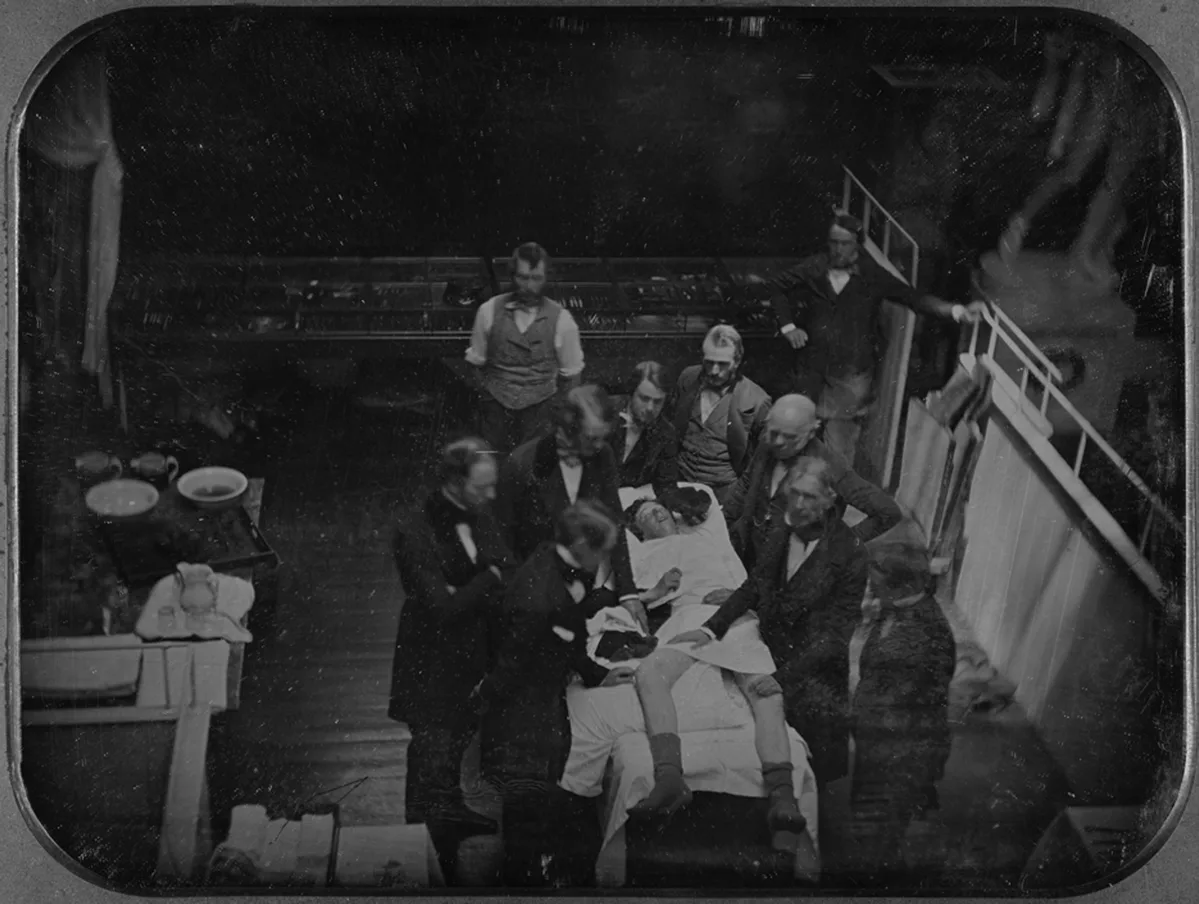
The world measured in screams
For as long as men had cut into the living body, they had done so against a clock measured in screams. The surgeon's first virtue was speed; his amphitheatre was a place of straps, of attendants chosen for their strength, of a patient fortified by brandy and the certain knowledge that the next minutes would be the worst of his life. Pain was not a complication of surgery. It was surgery's very condition — ancient, total, and assumed to be eternal.
Speed was not bravado but mercy. Robert Liston, the great London operator, could take a leg off at the thigh in well under a minute, and the men who held the watch understood that every second beneath the knife was a second the patient spent at the edge of dying from the agony itself. What such speed bought was narrow. A surgeon could amputate a limb, cut for a stone in the bladder, lay open an abscess, lift away what sat upon the surface, and almost nothing further. The chest and the belly were forbidden country; to enter them slowly enough to work was to keep a waking man pinned in torment past what any body could endure. The frontier of surgery was drawn not by anatomy but by how much suffering a strapped-down patient could be made to survive.
The unlikely dentist
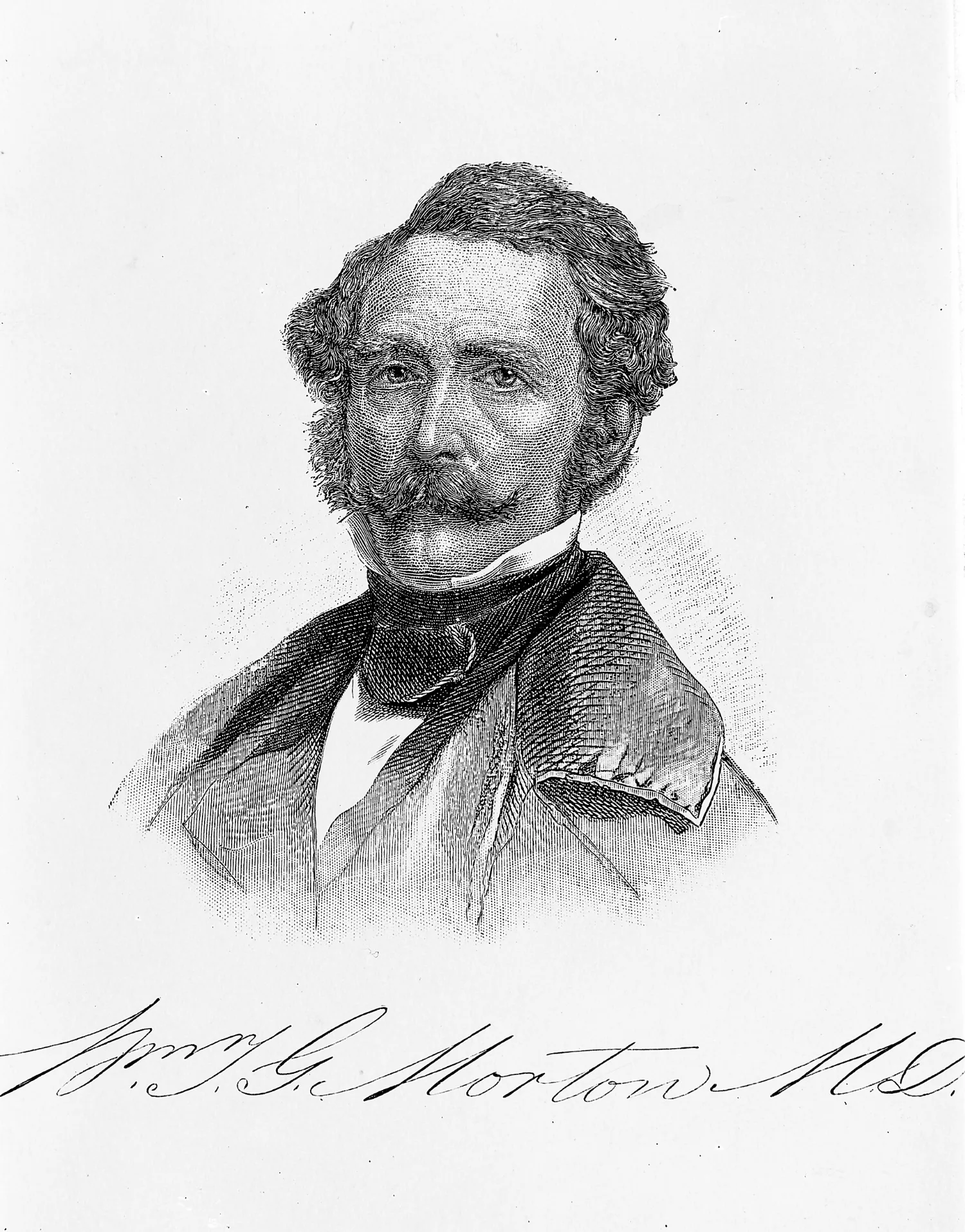
William Thomas Green Morton was not a man whom history had marked for greatness. A Boston dentist of restless ambition and uncertain credentials, he had spent the autumn of 1846 experimenting upon himself, his spaniel, and the occasional patient with the vapour of sulphuric ether — a sweet, volatile liquid known to chemists for three centuries and to students chiefly as the stuff of intoxicating frolics. What Morton suspected was that a man made insensible by ether might be cut without feeling the knife at all.1
He was not the first to suspect it, and he knew the ground was treacherous. Two winters before, his former partner, the Hartford dentist Horace Wells, had carried a different gas — nitrous oxide — to Boston and asked to prove it before an audience. The bag was drawn away too soon, the patient groaned, the room hissed humbug, and Wells went home a broken man.2 Morton meant to leave nothing to that kind of chance. He took quiet counsel from the chemist Charles Jackson, who understood ether's properties, and he practised in secret until, on the last evening of September, a man named Eben Frost came into his rooms with a raging tooth and a dread of the forceps. Morton soaked a cloth, Frost slipped under, and the tooth came away without a sound. That extraction, witnessed and written up, was the thing that bought Morton his morning at the hospital.3
The sixteenth of October
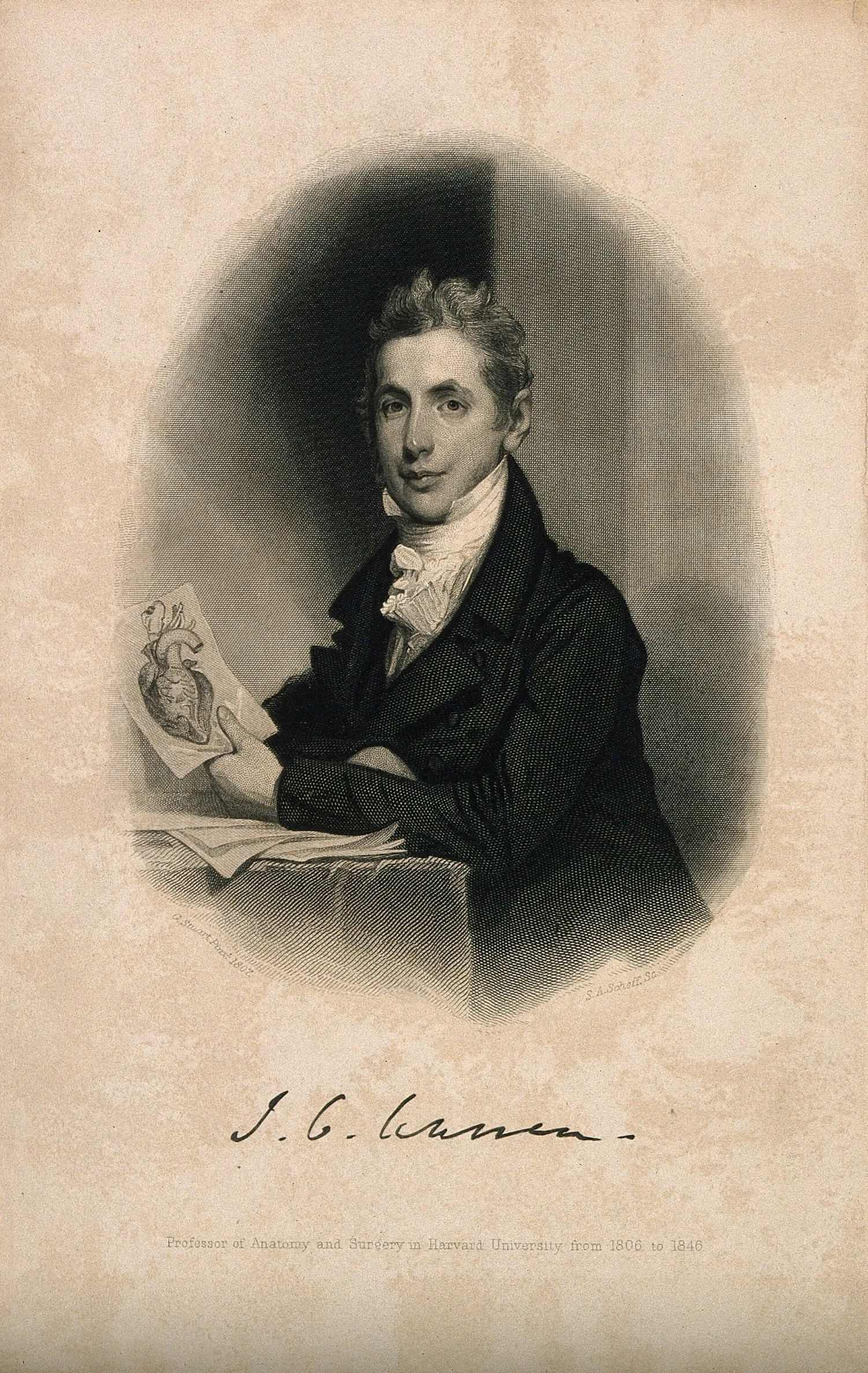
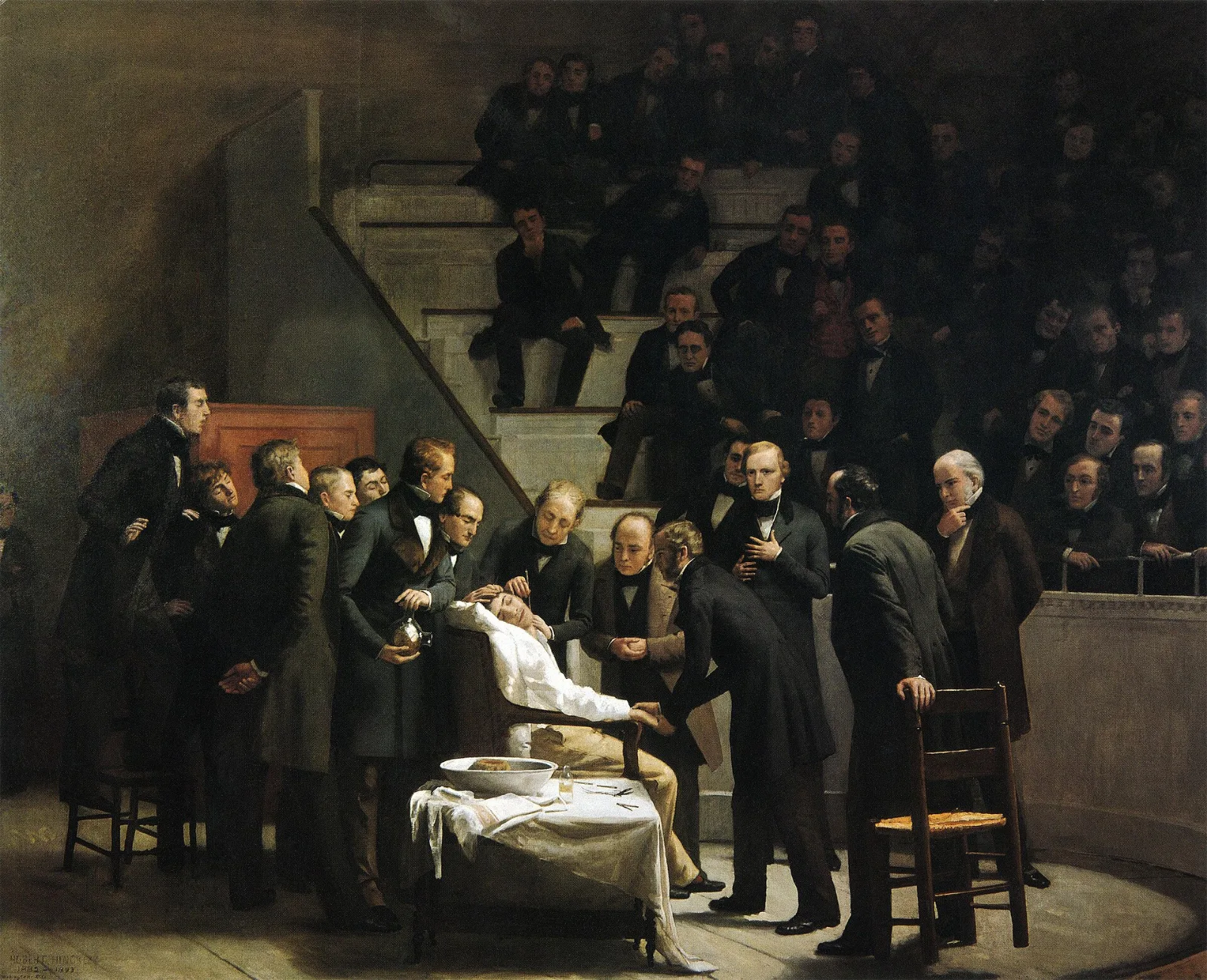
The demonstration was granted grudgingly. John Collins Warren, the hospital's senior surgeon and a man not given to enthusiasm, agreed to remove a vascular tumour from the neck of a young printer named Edward Gilbert Abbott before the assembled students. Morton arrived late, having waited upon an instrument-maker to finish the glass inhaler through which the ether was to be breathed, and the room had begun to murmur that the dentist was a fraud who would not come.
He came. Abbott drew on the apparatus, slipped into stillness, and Warren took up his knife. The incision was made; the knot of distended vessels below the jaw was cut and tied off. The patient did not cry out, did not struggle, gave no sign of the agony the room had come to witness. When Abbott woke and reported that he had felt no pain — only, he said, a sensation as of his neck being scratched — the theatre fell utterly quiet.
Gentlemen, this is no humbug.
— John Collins Warren, as the words have come down to us
The age of painless surgery had begun not with a treatise but with a single, almost grudging concession from a sceptic who had just watched his certainties dissolve.
A want of feeling
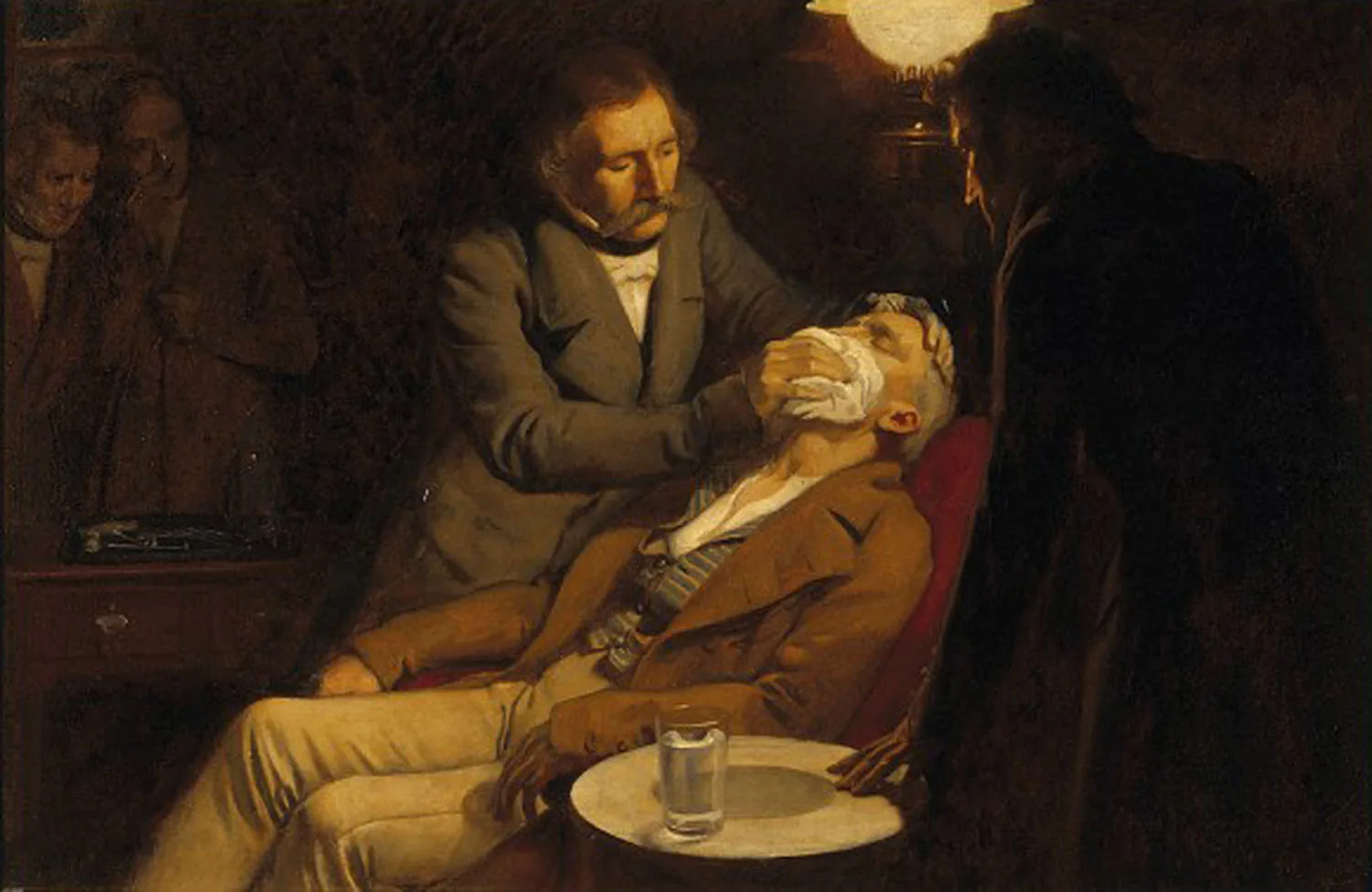
The news travelled faster than the men who carried it. Within weeks Henry Jacob Bigelow had laid the demonstration before the profession in print,4 and within months the vapour had a name. It was Oliver Wendell Holmes who proposed that the new state be called anæsthesia — from the Greek, a want of feeling — and the word proved impossible to refuse.5 Before the year was out the thing had crossed the ocean. On the twenty-first of December, in University College Hospital, Robert Liston amputated a leg under ether and, looking up at his students, remarked that this Yankee dodge beat mesmerism hollow.6 The man who had lived by speed had just watched the reason for speed be taken away.
The haunted men
What followed was less noble. Morton had patented the vapour under a disguising name, Letheon, dressing plain ether in aromatic oils so that no purchaser might recognise what he had bought; and a physician profiting from a secret remedy struck the profession as something close to quackery.7 Then came the scramble for the credit itself. Jackson let it be known that he had told Morton what to do. Wells pressed his prior claim in gas. And in rural Georgia a country doctor named Crawford Long held, in silence, the earliest hand of them all — he had cut a tumour from a man's neck under ether in 1842, four years before Boston, and had published nothing until the argument was already lost.8 None of them died content. Wells, experimenting upon himself with chloroform, fell into addiction and took his own life in a New York jail in the winter of 1848. Morton spent his remaining years in litigation and want, his patent worth nothing, and died of a stroke at forty-eight. Jackson's last years were given over to an asylum. The quarrel could not unmake the gift, but it consumed very nearly every man who reached for it.
Read from the Ward
Read from a modern intensive-care unit, the Ether Dome is less the conquest of pain than the birth of reversible physiological suppression. What Morton actually demonstrated, I think, was not analgesia but something stranger and more far-reaching: that consciousness — and with it the reflexes that guard the airway — could be switched off and, what mattered most, switched back on. Every modern induction, every sedation titrated against a ventilator, descends from that one reversible step.
The danger the room could not yet see is the one our whole specialty is now built around. An unconscious patient cannot guard their own breathing; the same vapour that abolishes the scream abolishes the cough, the swallow, and in the end the drive to breathe at all. Everything that anaesthesiology and critical care later became — the airway secured in trained hands, the tube, the bellows, the monitor that does not blink — exists to do for the patient what the ether has taken away. We did not so much conquer pain as agree to carry, for a few hours, the life of a person we had deliberately disabled.
The price arrived almost with the gift. Within sixteen months of Warren's tumour, a healthy girl of fifteen named Hannah Greener lay down in the north of England to have an ingrown toenail cut out, breathed her anaesthetic, and never woke.9 Hers was the first death laid at anaesthesia's door, and it spelled out the bargain the specialty has lived under ever since: that to be reversibly poisoned is still to be poisoned, and that the hand which switches a person off has given its word to switch them back on. Morton opened that door in the space of a single morning. Learning to stand in the doorway has taken us the better part of two centuries, and we are standing in it still.
- J. C. Warren, “Inhalation of Ethereal Vapor for the Prevention of Pain in Surgical Operations,” Boston Medical and Surgical Journal 35 (1846): 375–79.↩
- Wells's nitrous-oxide demonstration before a Boston audience early in 1845 collapsed when the gas was withdrawn too soon and the patient cried out; the popular placing of it in the hospital's own amphitheatre rests on weak evidence.↩
- On the extraction performed for Eben (Ebenezer Hopkins) Frost on 30 September 1846, and the part it played in securing Morton's invitation to the hospital, see Fenster, Ether Day.↩
- H. J. Bigelow, “Insensibility during Surgical Operations Produced by Inhalation,” Boston Medical and Surgical Journal 35 (1846): 309–17.↩
- O. W. Holmes to W. T. G. Morton, 21 November 1846, proposing the terms anæsthesia and anæsthetic.↩
- R. Liston, first surgical use of ether in England, University College Hospital, 21 December 1846.↩
- The patent for “Letheon” was granted to Morton and Jackson on 12 November 1846; the concealment of ordinary ether beneath an aromatic disguise drew wide censure from the profession.↩
- C. W. Long, “An Account of the First Use of Sulphuric Ether by Inhalation as an Anaesthetic in Surgical Operations,” Southern Medical and Surgical Journal 5 (1849): 705–13.↩
- P. R. Knight and D. R. Bacon, “An Unexplained Death: Hannah Greener and Chloroform,” Anesthesiology 96 (2002): 1250–53.↩
- Chicago
Kim, D. Y. “A Day at the Ether Dome.” Codex Chronica, June 25, 2026. https://codexchronica.com/a-day-at-the-ether-dome/.
- APA
Kim, D. Y. (2026, June 25). A Day at the Ether Dome. Codex Chronica. https://codexchronica.com/a-day-at-the-ether-dome/
- Warren, John Collins. “Inhalation of Ethereal Vapor for the Prevention of Pain in Surgical Operations.” Boston Medical and Surgical Journal 35 (1846): 375–79.
- Bigelow, Henry J. “Insensibility during Surgical Operations Produced by Inhalation.” Boston Medical and Surgical Journal 35 (1846): 309–17.
- Fenster, Julie M. Ether Day: The Strange Tale of America’s Greatest Medical Discovery and the Haunted Men Who Made It. New York: HarperCollins, 2001.
- Knight, Paul R., and Douglas R. Bacon. “An Unexplained Death: Hannah Greener and Chloroform.” Anesthesiology 96 (2002): 1250–53.
- Long, Crawford W. “An Account of the First Use of Sulphuric Ether by Inhalation as an Anaesthetic in Surgical Operations.” Southern Medical and Surgical Journal 5 (1849): 705–13.