
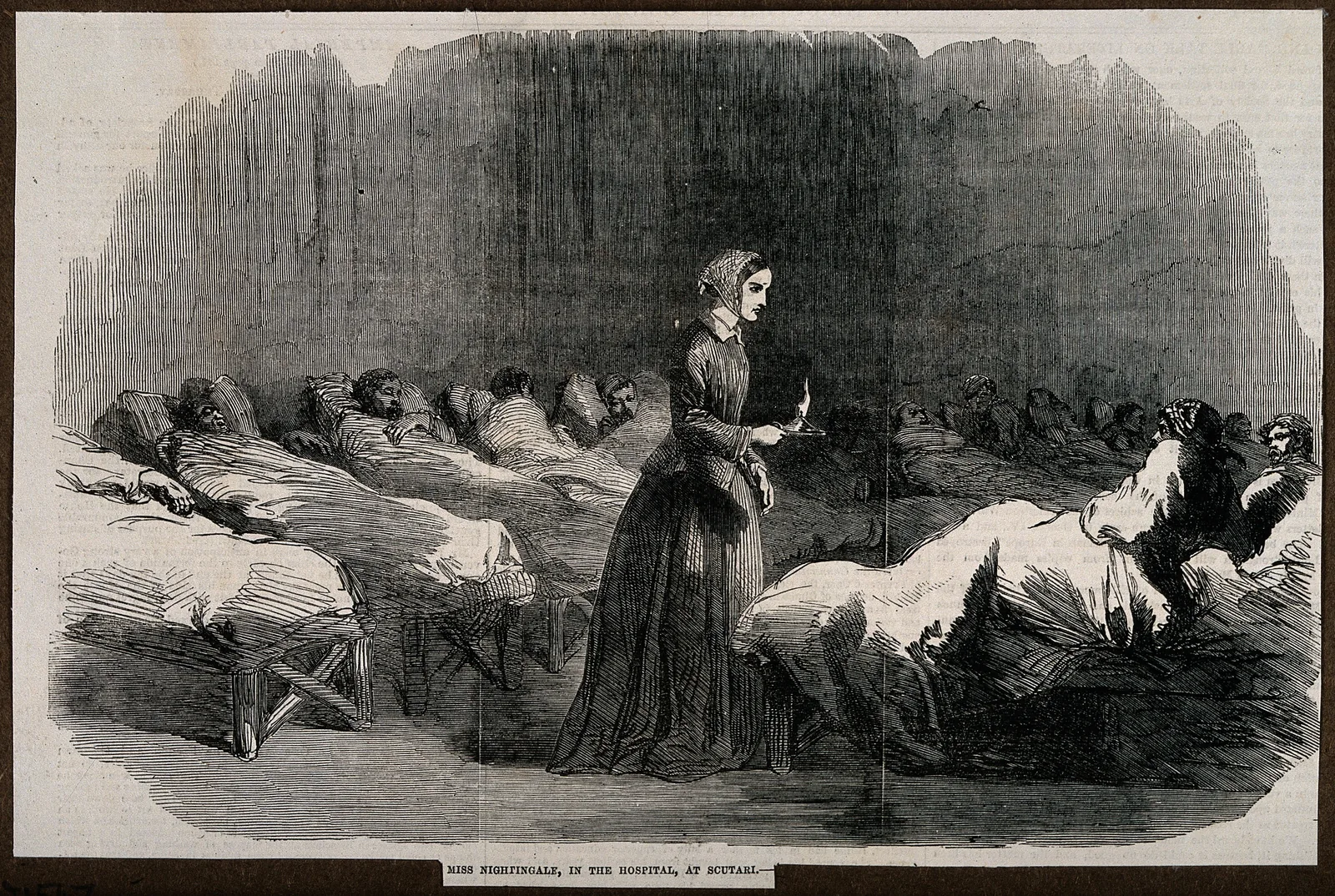
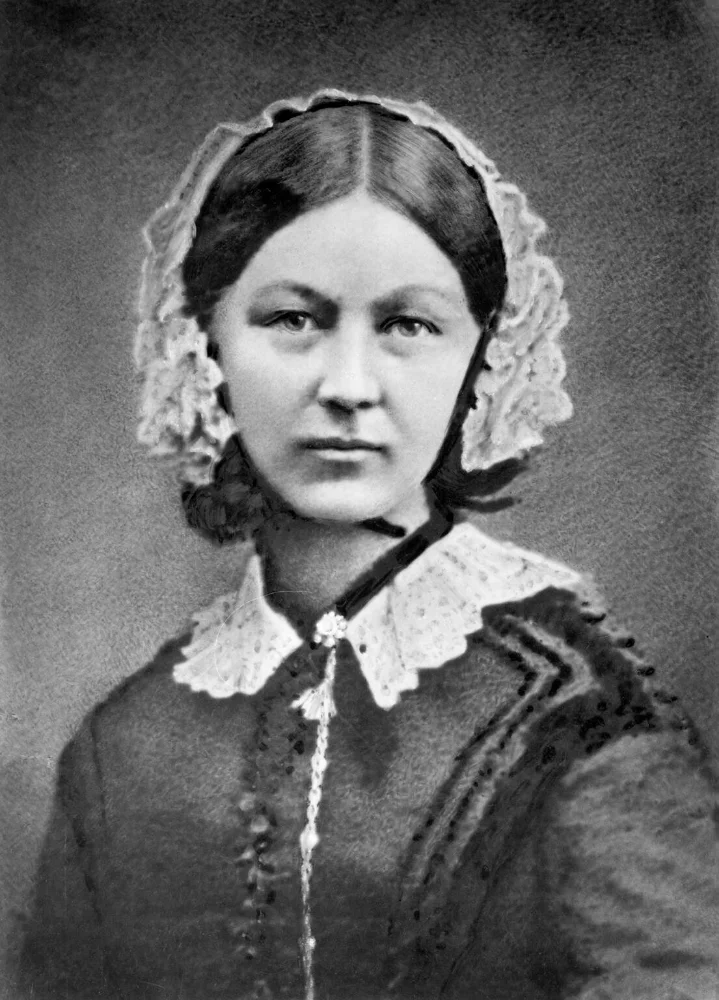
The picture is fixed in the national memory: a slight woman passing along a darkened ward at midnight, a lamp in her hand, the wounded turning their heads to watch her go by. It is true enough, and it is the least important thing about her. Florence Nightingale's winter at Scutari made her a legend on terms almost the reverse of the truth, for the hospital over which she kept her famous vigil was killing more of its men by disease than the enemy ever did by arms, and she did not yet know why. Her greatness lies in what she did once she found out.
The Barrack Hospital
The Crimean War was barely begun when the scandal broke. In the autumn of 1854 the dispatches of The Times carried home the news that British soldiers, having survived the fighting against Russia, were dying in their hundreds of neglect behind the lines, in hospitals without bandages or beds or clean water. The public fury found a focus when Sidney Herbert, the Secretary at War and a friend of the Nightingale family, asked a thirty-four-year-old gentlewoman to take a party of nurses to the East and set the thing right.1
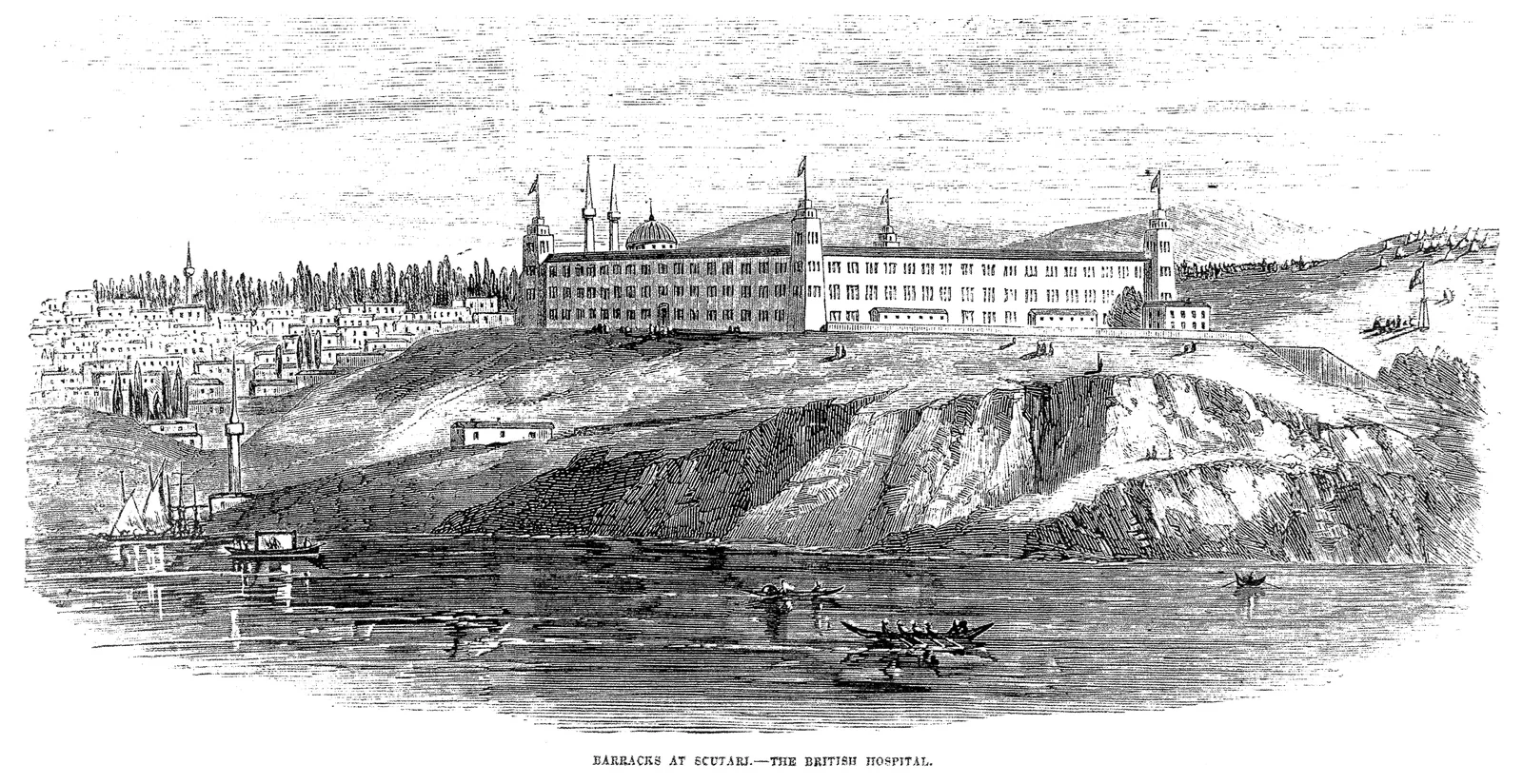
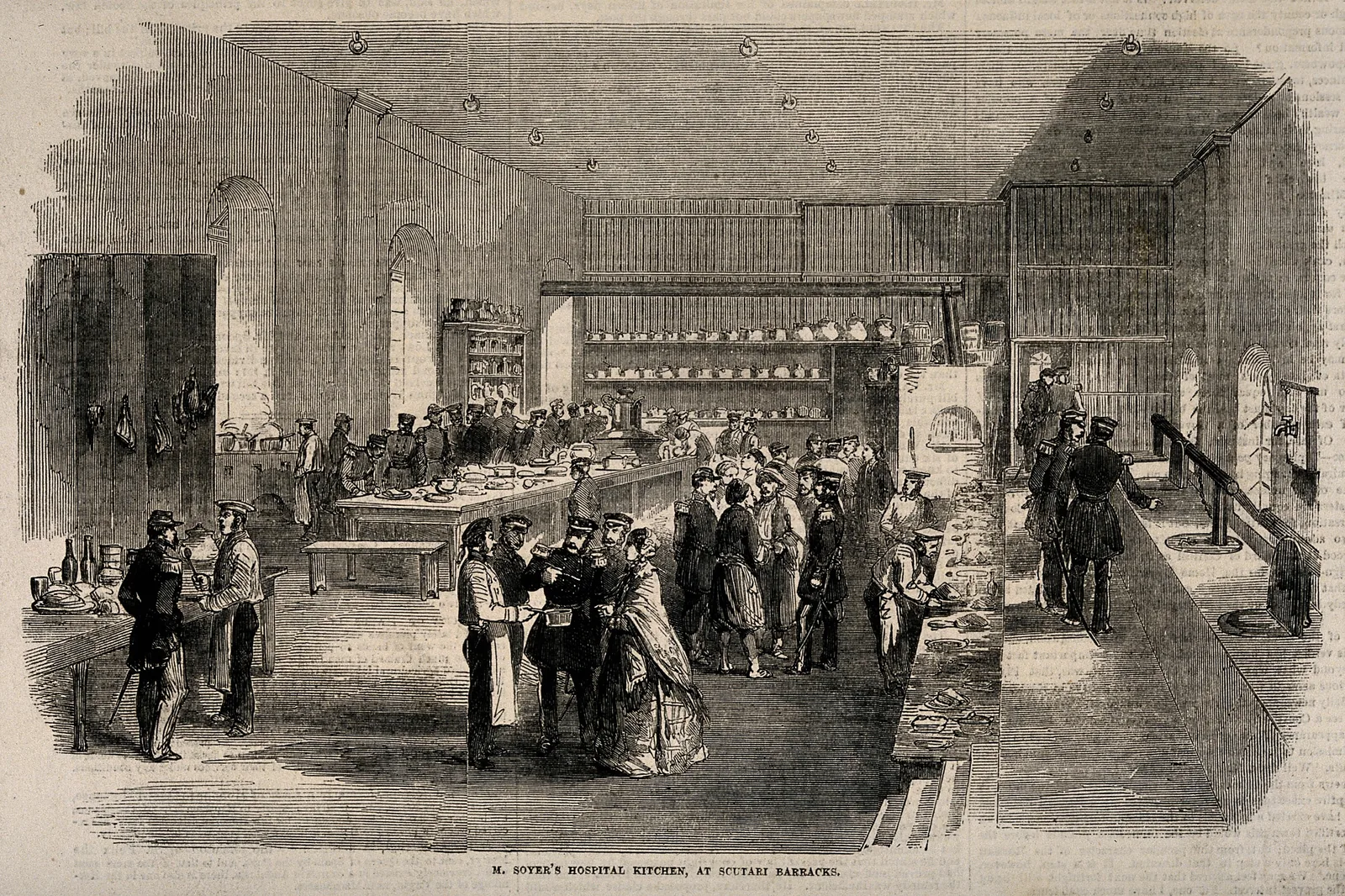
She reached Scutari, on the Asian shore opposite Constantinople, on the fourth of November 1854, with thirty-eight nurses behind her.2 The Barrack Hospital they entered was a vast verminous building holding miles of sick men laid on the floors, many without blankets, most without decent food, the whole place fouled and stinking. Far more of them were dying of fever and flux than of any wound. Nightingale set to work at what she understood, and what she understood was order: she organised supplies and kitchens, set the nurses scrubbing and the laundry running, fed the men, and imposed on the chaos the discipline of a person who would not be told a thing could not be done.
The lamp
The image that would outlast her was made within months. In February 1855 a correspondent of The Times described her as a ministering angel: when the medical officers had retired for the night and silence had settled upon the miles of prostrate sick, he wrote, she might be seen alone, a little lamp in her hand, making her solitary rounds.3 An engraving in the Illustrated London News gave the nation its picture, and before three years were out Longfellow set the thing in verse, the lady with a lamp who would stand in the great history of the land.4 The artists, embroidering, handed her a graceful Grecian lamp; the one she had actually carried down those wards was a homely Turkish folding lantern of pleated paper and a candle.5
The lamp was not nothing. It stood for presence, for the assurance that someone competent was awake at the worst hours, and the soldiers loved her for it past the point of reason. She had given them order where there had been none, and dignity where there had been none, and they were right to be grateful. Yet a lamp is a poor instrument against a sewer, and the thing that was killing them lay where no amount of nursing could reach it.
The hospital that killed
For the Barrack Hospital was not merely bad. It was, by the returns later compiled, one of the worst hospitals of the entire war; the historian Hugh Small has argued it was deadlier even than the squalid tents at the front from which its patients had been carried, a reading other historians dispute.6 It had been built over a warren of choked sewers, and it drew its water through a system so fouled that the sanitary inspectors, when they finally came, found a dead horse rotting in one of the channels.7 The men were dying overwhelmingly of typhus and cholera, of typhoid and dysentery, the diseases of crowding and excrement, and only secondarily of the injuries that had brought them in. In that first winter some four thousand soldiers died at Scutari, roughly ten of them of disease for every one of a wound.8
This is the fact the legend is built to hide. The most famous nurse in history kept her vigil, through that winter, over a building that was poisoning the men she tended, and the harder she worked at supplies and order the more the deaths went on, because the cause was in the drains and she was fighting it in the kitchens.
The commission
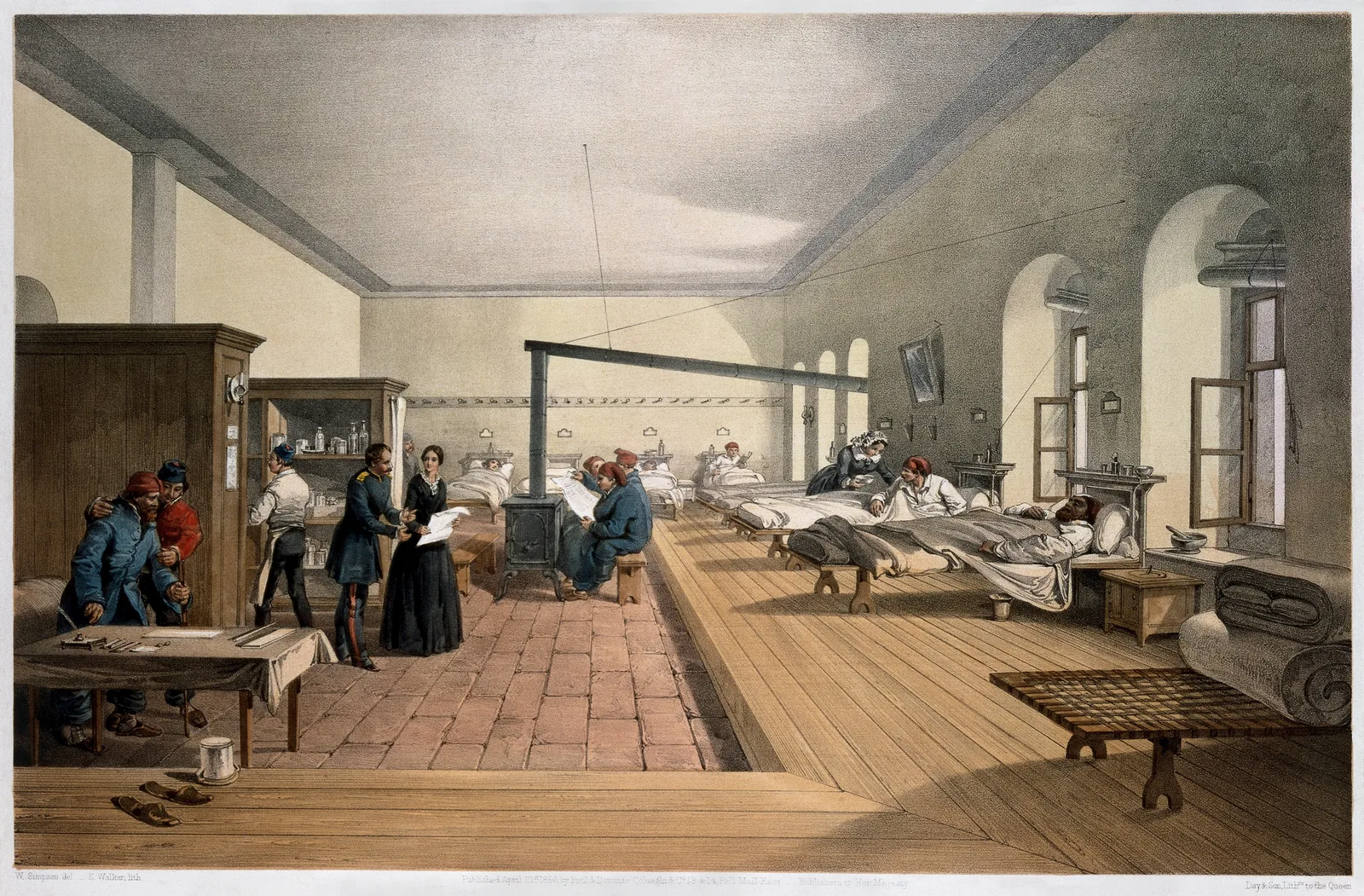
In March 1855, with the scandal at its height, the government sent out a Sanitary Commission, and its men did the work that mattered. They flushed the choked sewers and cleared the water supply, broke openings for air, limewashed the walls, and carted away the accumulated filth. In the months that followed the death rate at Scutari fell, and fell steeply.9 The lives were saved not by the lamp but by the drains.
Here is the part the legend leaves out. Nightingale did not, at the time, credit the change to the sewers. She had believed her men were dying for want of food and supplies and decent administration, the very wants she had laboured against, and she gave the credit there, where her own effort lay. The single most important fact about the deadliest hospital of the war was the one its most celebrated servant had not yet understood. There is no shame in it that I can see. The germ theory was still a generation from acceptance, the link between filth and fever still a quarrel among physicians, and she believed what almost everyone of sense believed. What sets her apart is not that she saw it at once. It is that she made herself see it at all.
The ledger
She saw it afterwards, and it nearly destroyed her. Back in England, feted as a heroine and already breaking in health, she could not let the dead alone. She sat down with the figures, and she found in William Farr, the General Register Office statistician whose mortality returns John Snow had drawn on in tracing the cholera, an ally and a goad.10 The arithmetic was merciless. Across the war some six soldiers had died of disease for every one killed in action; of about twenty-one thousand British deaths the great majority had been from disease and preventable, and her own Scutari had been among the deadliest of them.11 The historian Hugh Small has argued that this discovery, that her hospital had been a death-trap she had not understood and had even, by drawing the sick into it, helped to fill, is the wound that broke her health and never healed.12
What she did with the grief is the reason her name is worth keeping. She did not retreat into the comfortable legend the public had built for her. From a sickbed she would scarcely leave for the rest of her long life, she forced a Royal Commission upon the army, rebuilt its sanitation, reformed the design of hospitals so that they might stop poisoning the people in them, and learned to prove her case in diagrams a minister could not wriggle out of.13 The lamp had made her famous. The ledger made her matter.
Read from the Ward
I still make a round at the end of a night shift, though I carry no lamp, only the cold light of the monitors and a torch I almost never use. It is the oldest gesture in our work and the most consoling: to walk the dark ward, to stop at each bed, to let the watching faces soften because someone is awake and in charge. The correspondent caught it exactly, the poor fellow's face softening at the sight of her, and I know the feeling from the inside, the small pull to believe that the round itself, the presence at the bedside, is the thing that heals. Nightingale's hospital is the standing rebuke to that belief.
The men in her wards were not, for the most part, dying of anything a bedside vigil could touch. They were dying of the building. The Barrack Hospital killed through its sewers and its water and its stagnant air, and the lamp moving among the beds, however welcome, did nothing to any of those. This is the least romantic fact of my trade and the one I most need to keep in front of me: that a hospital is a dangerous place, and can kill the patient it took in for something else. We have a bloodless word for it now, nosocomial, but it names Nightingale's exact horror. The central line that seeds the blood, the ventilator that breeds a pneumonia, the resistant organism ferried bed to bed on unwashed hands: these are the Barrack Hospital in miniature, and they are not rare.
What I take from her is not the lamp but the reckoning that came after it. The hardest thing she ever did was not nursing the dying through that winter. It was sitting down, a year on, with the figures that told her she had presided over one of the deadliest hospitals of the war and had blamed the wrong cause while she did it. I find that close to unbearable, because I know the instinct it cost her to overcome. When your own results are bad, the mind reaches first for the explanations that leave you innocent: the patients were sicker, the staffing was thin, the winter was hard. She reached for those too, and then she stopped, and looked instead at the number with her own name behind it. Every later thing that made her great came out of that one refusal to look away.
So when we count our own dead now, in the audits and the mortality meetings and the surveillance figures no one reads aloud, I try to remember what the counting cost her and what it bought. We keep the lamp because it flatters us; it says the kind presence at the bedside is the heart of medicine. It is, and it is not enough. The soldiers of Scutari were saved in the end not by the angel with the light but by the engineers who opened the drains, and by the woman who was brave enough, afterwards, to say so. The lamp shows you the patient in front of you. Only the ledger shows you the ones the ward itself is killing, and those are the patients you will never save by being kind.
- On The Times despatches exposing the neglect of the British sick, and Sidney Herbert's invitation to Nightingale to lead a nursing party to the East, see Mark Bostridge, Florence Nightingale: The Woman and Her Legend (London: Viking, 2008).↩
- Nightingale reached the Barrack Hospital at Scutari (Üsküdar) on 4 November 1854 with thirty-eight nurses; Bostridge, Florence Nightingale; "Florence Nightingale," National Army Museum.↩
- The Times, 8 February 1855 ("She is a 'ministering angel' … with a little lamp in her hand, making her solitary rounds"). The despatch fixed the image in the public mind.↩
- Henry Wadsworth Longfellow, "Santa Filomena," The Atlantic Monthly (November 1857): "A Lady with a Lamp shall stand / In the great history of the land." The Illustrated London News engraving appeared 24 February 1855.↩
- On the iconographic lamp (the artists' Grecian or genie's lamp) versus the Turkish folding lantern (a fanoos of pleated paper and candle) Nightingale actually used, an example of which survives in the Florence Nightingale Museum, London: Bostridge, Florence Nightingale; Florence Nightingale Museum collections.↩
- That Scutari's mortality was among the highest of the war's hospitals — higher than the field hospitals nearer the front — is the central finding of Hugh Small, Florence Nightingale: Avenging Angel (London: Constable, 1998), and Small, "Nightingale's overlooked Scutari statistics," Significance 17, no. 6 (2020): 28-33.↩
- On the Barrack Hospital standing over blocked sewers, the fouled water supply, and the carcass found in a water channel, found and remedied by the Sanitary Commission: Bostridge, Florence Nightingale; Christopher J. Gill and Gillian C. Gill, "Nightingale in Scutari: Her Legacy Reexamined," Clinical Infectious Diseases 40 (2005): 1799-1805.↩
- Approximately 4,077 soldiers died at Scutari in the first winter, with deaths from typhus, typhoid, cholera and dysentery running roughly tenfold those from wounds: Gill and Gill, "Nightingale in Scutari"; Bostridge, Florence Nightingale.↩
- The Sanitary Commission arrived in March 1855 and cleared the sewers, flushed the water tanks, improved ventilation and limewashed the wards; the death rate fell sharply thereafter. The often-quoted precise rates (a fall from above 40 per cent to a few per cent) are simplified and have been disputed; the steep decline following the sanitary works is not. See Small, Avenging Angel; Small, "Overlooked Scutari statistics" (2020).↩
- On Nightingale's post-war statistical collaboration with William Farr (the compiler of the General Register Office whose returns John Snow had used), see I. Bernard Cohen, "Florence Nightingale," Scientific American 250, no. 3 (1984): 128-37; Bostridge, Florence Nightingale.↩
- Roughly six British soldiers died of disease for every one killed in action across the war (about 16,000 disease deaths against some 2,800 killed in action, of total British deaths near 21,000); the great majority were preventable. Nightingale and Farr's analysis: Notes on Matters Affecting the Health, Efficiency, and Hospital Administration of the British Army (London: Harrison and Sons, 1858); Royal Commission on the Sanitary State of the Army in the East, Report (London: HMSO, 1858).↩
- Hugh Small, Florence Nightingale: Avenging Angel (1998), argues that Nightingale's later realisation — that Scutari's own insanitary state had been the chief killer, and that bringing the sick into it had added to the toll — precipitated the collapse that left her an invalid. The thesis is influential and contested; the comparative mortality data underlying it are in Small (2020).↩
- On the Royal Commission on the Health of the Army (1857), Nightingale's largely bedridden later decades, her work on army and hospital sanitation and hospital design, and her use of statistical diagrams to drive reform, see Bostridge, Florence Nightingale; Cohen, "Florence Nightingale."↩
- Chicago
Kim, D. Y. “The Lady with the Lamp.” Codex Chronica, June 28, 2026. https://codexchronica.com/the-lady-with-the-lamp/.
- APA
Kim, D. Y. (2026, June 28). The Lady with the Lamp. Codex Chronica. https://codexchronica.com/the-lady-with-the-lamp/
- Bostridge, Mark. Florence Nightingale: The Woman and Her Legend. London: Viking, 2008.
- Cohen, I. Bernard. "Florence Nightingale." Scientific American 250, no. 3 (1984): 128-37.
- Gill, Christopher J., and Gillian C. Gill. "Nightingale in Scutari: Her Legacy Reexamined." Clinical Infectious Diseases 40, no. 12 (2005): 1799-1805.
- Nightingale, Florence. Notes on Matters Affecting the Health, Efficiency, and Hospital Administration of the British Army. London: Harrison and Sons, 1858.
- Small, Hugh. Florence Nightingale: Avenging Angel. London: Constable, 1998.
- Small, Hugh. "Nightingale's Overlooked Scutari Statistics." Significance 17, no. 6 (2020): 28-33.