
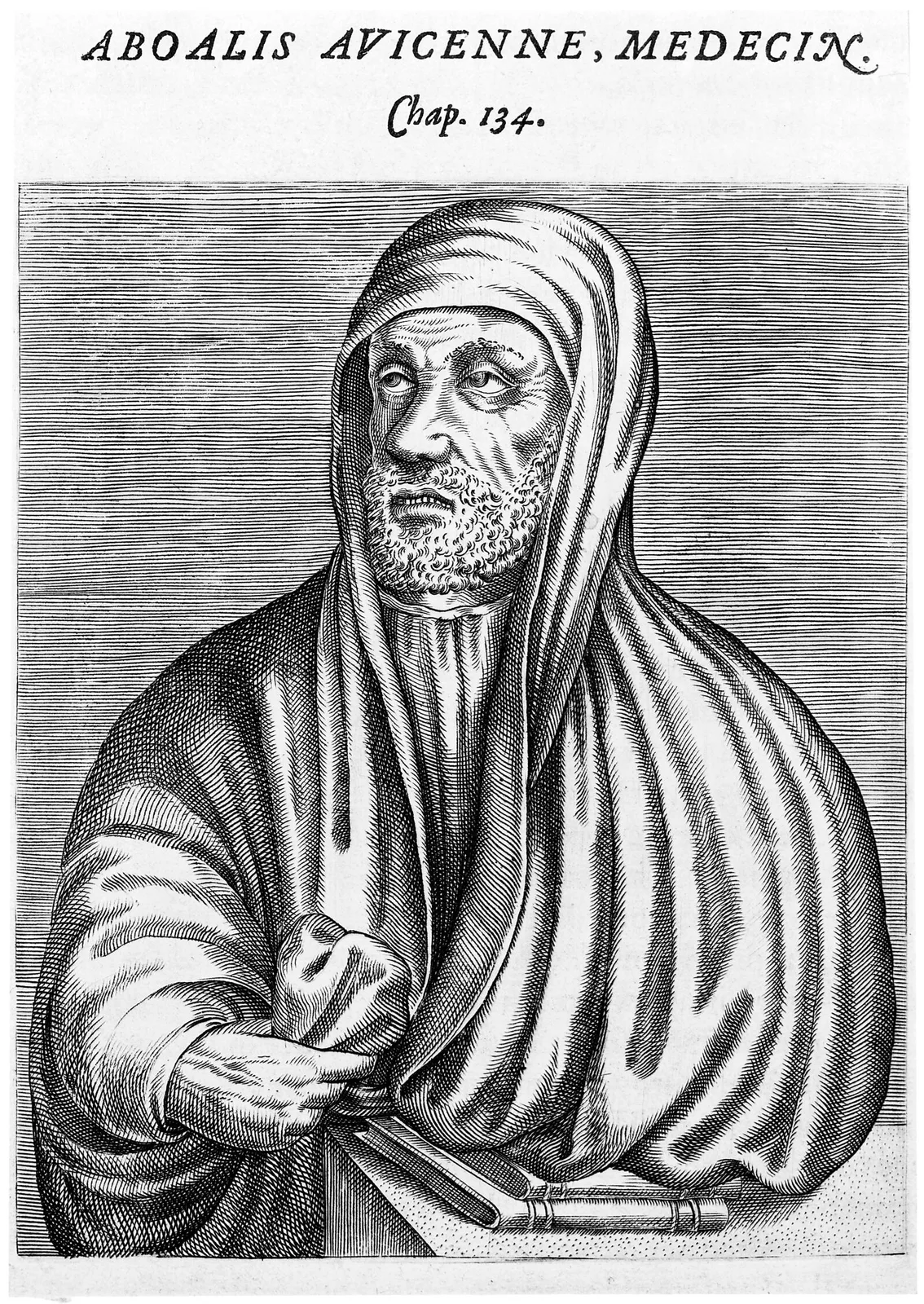
Around the year 1025 a Persian philosopher, vizier and physician gathered the scattered medicine of the Greeks and the Arabs into a single ordered work: five books that ran from the first principles of the art down to the compounding of every drug. He called it a law, al-Qānūn, and for six hundred years Europe took him at his word and set it upon the lecterns of its medical schools. The common account makes him a keeper, the man who held the Greeks in trust until the West could want them back. What he did was larger than keeping, and more double-edged. He gave medicine an order so complete that it could be examined and learned by heart, and in the same motion he made its errors as durable as its truths.
A law, not a shelf
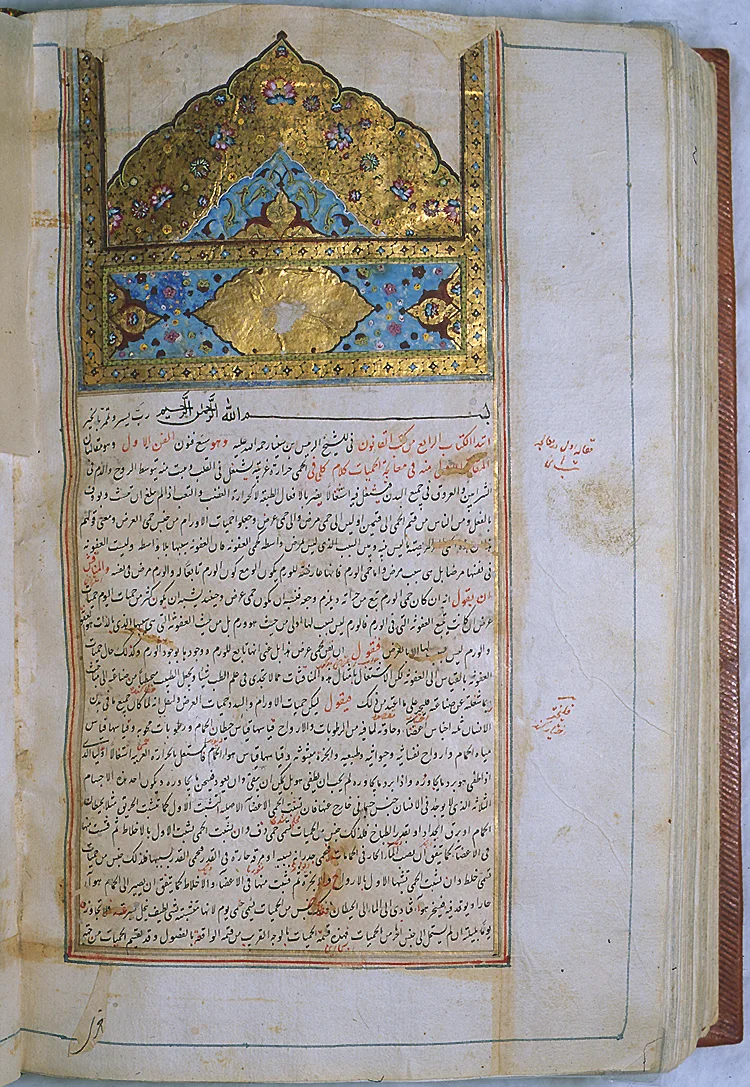
The book Ibn Sīnā finished around 1025 was called al-Qānūn fī al-ṭibb, the law, or canon, of medicine, and the title was not modest.1 A law is a thing meant to be applied without exception, recited back under examination, held in the memory entire; and that is very nearly what the Canon became. In five books it moved from the general principles of the art (the elements, the humours, the faculties) through a materia medica of some hundreds of simple drugs, then head to foot through the diseases proper to each organ, then the fevers and the disorders that belong to no single part, and closed with the compounding of remedies.2 Nothing about the body was left outside its frame.
The common picture of the man who built it is a keeper: the preserver who held Greek medicine safe through the centuries the Latin West could not read it, and handed it back intact. The picture is not false so much as too small. Ibn Sīnā did not merely copy Galen and Hippocrates into Arabic. He took a vast, contradictory, centuries-deep inheritance and forced it into order, using the logic he had from Aristotle to make of medicine a single system in which every claim had its place and followed from the last.3 The achievement was an architecture. He built a house a physician could live inside without ever needing to leave it, and for six hundred years physicians did.
The rules he did not keep
He was seventeen, the story goes, when he cured the Sāmānid ruler of Bukhārā of an illness the elder physicians had abandoned, and took as his reward the run of the royal library. Born near that city about 980, dead at Hamadān in 1037, he was a philosopher and courtier as much as a physician.4 Whatever the anecdote is worth, the doctor it describes was no copyist. The Canon carries a careful early account of meningitis, sorted from the other causes of fever and a stiff neck; it argues that phthisis, the consumption that wastes the lung, passes from one person to another, that sickness may be carried in water and in soil, and that the state of a man's mind bears on the state of his body.5 The most repeated story of his touch has him with a finger on the pulse of a lovesick youth, reciting the streets and the households of the city until the beat stumbled at a certain name, and so naming the beloved the patient would not confess.6 Some of that is legend. The habit behind it, an attention to the body's smallest report, is on every page.
Nowhere is it plainer than in the passage where he sets down how a drug is to be proved.7 He gives a set of conditions, seven in the usual reckoning. The medicine must be pure, uncorrupted by heat or age or the substance it was stored beside. It must be tried on a single, uncomplicated illness, not a tangle of several. Its strength must be matched to the strength of the disease, the dose raised slowly from the least, so that its true power is known. The time between the giving and the effect must be watched, lest a recovery that would have come anyway be laid to the drug. The effect must repeat, in many cases and not in one, or it is no effect at all but an accident. And the proving must be done upon the human body, for a medicine may act on a lion or a horse otherwise than on a man.8 Reproducibility, dose, the parting of coincidence from cause, the human subject: it is the skeleton of the clinical trial, sketched nine hundred years before the trial had a name.
Here is the discomfort. The man who wrote that a remedy must be proved on the human body and on no other creature transmitted, in the same volume and without proof, an anatomy that had been read off exactly those other creatures. The marvellous net Galen had found at the base of the ox's brain, the invisible pores he had set in the wall of the heart, the animal bones lent to the human frame: the Canon carried them all, fixed now in an order so lucid that they were harder to doubt than Galen had ever made them.9 The instrument that might have caught the error and the error itself lay a few hundred pages apart, and the system was the stronger of the two. He proved his drugs on men and drew his bodies from apes, and never felt the seam.
The correction already in the book
The strangest thing is that the correction was already being written, inside the Canon's own house. In Cairo, about 1242, a physician named Ibn al-Nafīs sat down to a commentary on the anatomy of the Canon, and when he came to the heart he refused two masters at once: Galen for the mistake, and Ibn Sīnā for keeping it.10 The wall between the ventricles, he wrote, is solid; there are no pores in it, seen or unseen, and the blood does not seep across. It takes the long road instead, out of the right chamber into the lung and back to the left, and there is no other way for it to pass. He had described the lesser circulation of the blood three centuries before any European would, and he had done it in the margins of the very book that carried the old mistake.11 Europe never read him. The commentary lay unnoticed until a physician turned it up in a Berlin library in 1924.
He was not the only observer the system passed over. A century before the Canon, the physician al-Rāzī, Rhazes to the Latins, had kept casebooks of a sharpness the Canon never matched, had written the first account to tell smallpox from measles by watching each run its course, and had set down a whole book of Doubts about Galen.12 He doubted as a loyal Galenist who simply could not make the master's words agree with what his own eyes reported at the bedside, which is the harder and the better kind of doubt. Both men reached Latin; both were read in the schools. But it was Ibn Sīnā's Canon, and not al-Rāzī's restless watching, that the faculties set at their centre, because a finished system can be taught and examined and a keen eye cannot. Medicine chose the book that could be put on a syllabus.
By the same door it entered
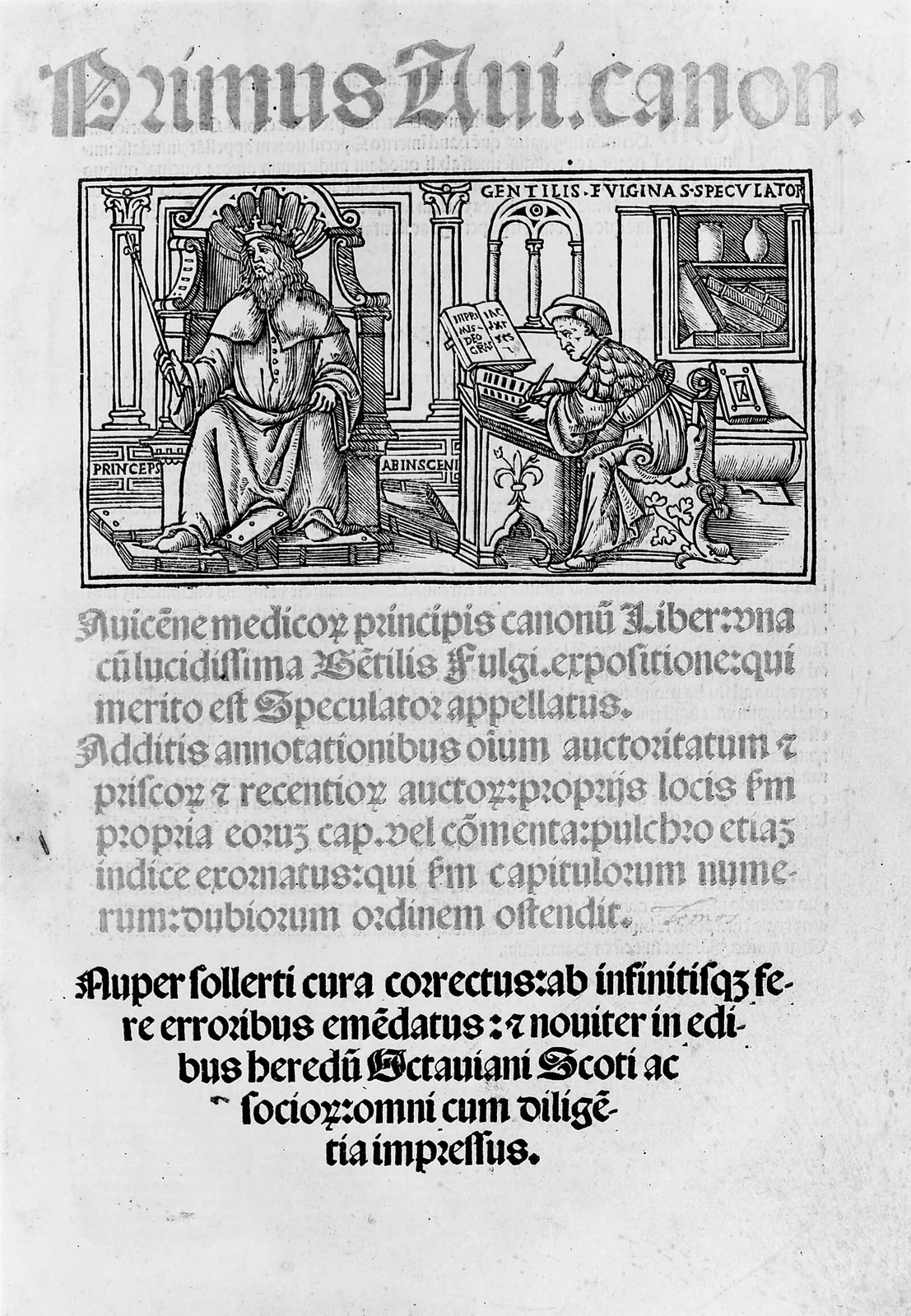
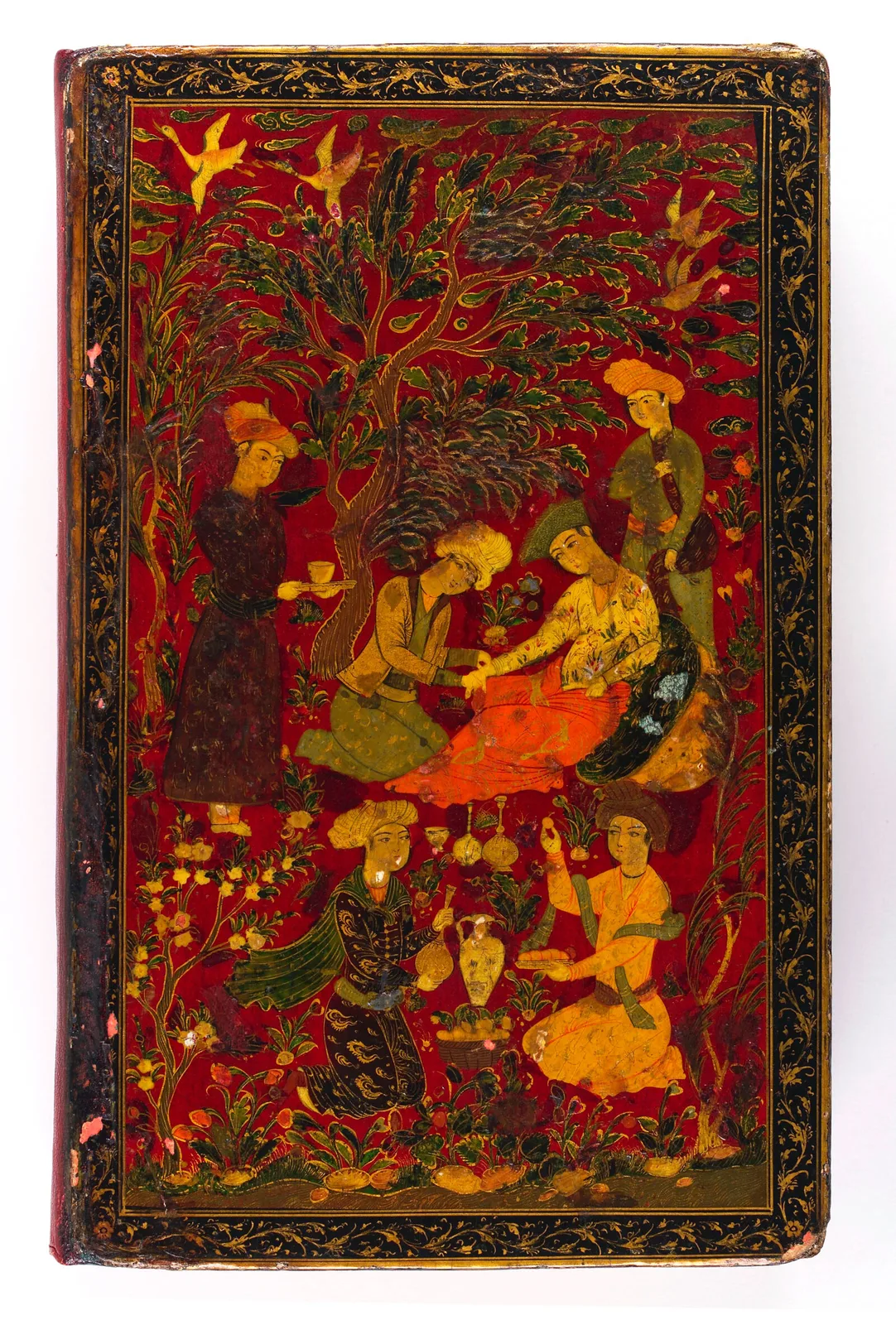
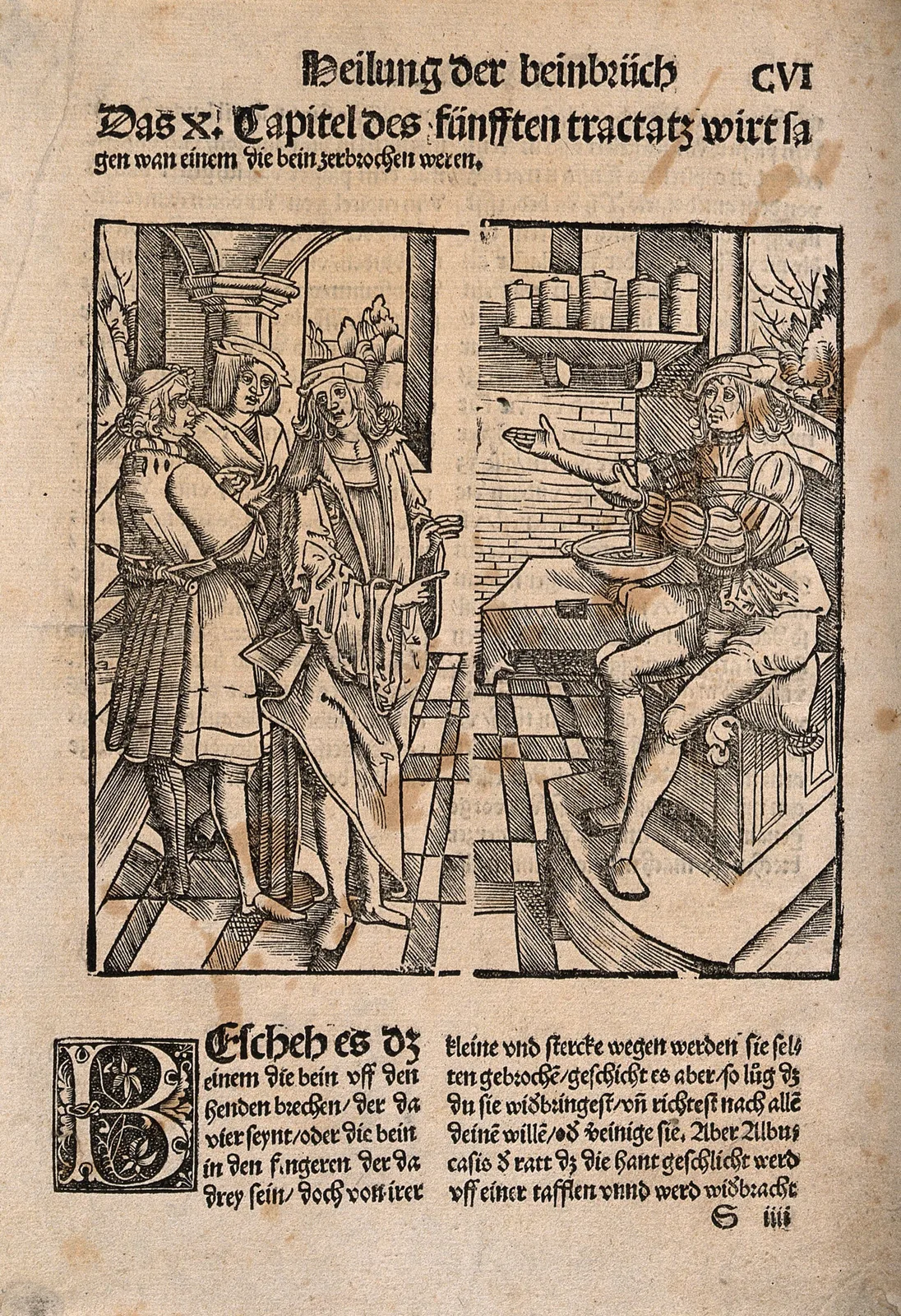
The Canon came into Latin through Toledo, where Gerard of Cremona turned it out of Arabic in the later twelfth century, and it climbed to a place no medical book has held before or since. By the early fourteenth century it was standard at Bologna and Montpellier, and in time at Padua. When printing came it was among the first medicine off the presses, issued at Milan in 1473 and then over and over, some fifteen Latin editions before the century closed and more than sixty in the next.13 A student could pass his whole training with the Canon open in front of him and never once be asked to set it against a body.
What unseated it undid it the way it had first prevailed: by men going back to look. The humanists of the Renaissance began by resenting the Arabic middleman, wanting their Galen pure and Greek and clean of Ibn Sīnā's ordering; and some of them, having gone back to the source, went on back to the corpse. Vesalius in 1543 found the heart's wall whole and the marvellous net nowhere in a man; Harvey in 1628 closed the septum for good and set the blood turning in its circle.14 Long before either, in the summer of 1527, Paracelsus is said to have pitched a copy of the Canon onto the students' bonfire at Basel on the eve of St John, boasting that the buckles of his shoes knew more than Avicenna and Galen together.15 The gesture was premature. The book he burned went on being read in the medical schools of Montpellier and Louvain until about 1650, more than a century after the flames and six hundred years after its author laid down his pen.16 It held by system, and it fell only when the system was made at last to face the body it described.
Read from the Ward
At three in the morning, settling a dose I do not trust myself to hold in memory, I reach for what every physician on the unit reaches for: not my recollection but the guideline, the order set, the application on the phone that keeps the current law of what to give and how much.17 I live inside a canon too. It is not one book by one polymath but the pooled and endlessly revised verdict of the trials, and it is far better than anything Ibn Sīnā had, because it is built from the very discipline his seven rules first sketched: the dose found by degrees, the effect that must repeat, coincidence told apart from cure, the proof made on human bodies and no others. Following it, I am the heir of that passage in Book Two, and not of the anatomy a few leaves on.
The seven rules are also the warning, and I feel it most on the nights the guideline fits too well. Knowledge ordered finely enough to be examined can be followed without being seen. That is the seduction of a canon: it lets a careful person be right most of the time without looking, and so lets the same person be wrong in the one case that does not read like the others, and never know it. The protocol is the marvellous net of my generation. Mostly it describes the patient in front of me. Now and then it is an ox's anatomy set inside a human skull, drawn faithfully because the authority drew it, and it is hardest to question exactly where it is most complete.
I think often of Ibn al-Nafīs, and of the correction that sat in the margin of the standard book for seven hundred years while everyone went on teaching the pores. It is the quietest sort of warning. Somewhere in the canon I trust tonight there is almost certainly a closed septum of its own: a claim already corrected by someone whose paper I have not read, waiting in a journal the syllabus has not caught. I cannot know which claim it is. What I can do is the thing the Canon did best and kept worst, which is to lay a finger on the actual pulse and let this patient, not the law, have the last word on this patient. Then, most mornings, I open the guideline again, because it is right far more often than I am. I only try to keep beside my trust in it the one doubt it can never supply: that somewhere on the page, drawn perfectly, is the heart of an ox in the body of a man.
- Ibn Sīnā (Avicenna), al-Qānūn fī al-ṭibb (The Canon of Medicine), completed c. 1025; a five-book systematic encyclopaedia of medicine whose Arabic title, qānūn ("law," "canon"), signals its aim of an ordered, teachable code of the art. See Vivian Nutton, Ancient Medicine, 2nd ed. (London: Routledge, 2013), chaps. 18–20; Peter E. Pormann and Emilie Savage-Smith, Medieval Islamic Medicine (Edinburgh: Edinburgh University Press, 2007); "Avicenna," Encyclopædia Britannica.↩
- On the five-book structure — (I) general principles; (II) the simple drugs, a materia medica of several hundred items; (III) diseases of the individual organs, ordered head to foot; (IV) fevers and disorders not confined to one part, with surgery and injuries; (V) the compound drugs, or formulary — see Pormann and Savage-Smith, Medieval Islamic Medicine, chap. 2; Nancy G. Siraisi, Avicenna in Renaissance Italy: The Canon and Medical Teaching in Italian Universities after 1500 (Princeton: Princeton University Press, 1987), chap. 1.↩
- On the Canon as an original systematisation rather than a compilation — its imposition of Aristotelian logic and philosophical order upon the inherited Galenic-Hippocratic material — see Siraisi, Avicenna in Renaissance Italy, chaps. 1–2; Pormann and Savage-Smith, Medieval Islamic Medicine, chap. 2; Nutton, Ancient Medicine, chap. 20.↩
- On Ibn Sīnā's life (b. near Bukhārā c. 980, d. Hamadān 1037), his precocity, his cure of the Sāmānid amir Nūḥ ibn Manṣūr and the reward of access to the royal library, and his career as philosopher and vizier as well as physician, see "Avicenna," Encyclopædia Britannica; "Avicenna (980–1037)," MacTutor History of Mathematics Archive, University of St Andrews; Pormann and Savage-Smith, Medieval Islamic Medicine.↩
- On the Canon's clinical content — an early careful description of meningitis, the argument for the contagiousness of phthisis (pulmonary consumption), the transmission of disease through water and soil, and the influence of psychological on physical states — see "Reflections on Avicenna's Impact on Medicine: His Reach Beyond the Middle East," Frontiers in Cardiovascular Medicine / PMC7427450; Pormann and Savage-Smith, Medieval Islamic Medicine, chap. 4.↩
- The tale of Avicenna diagnosing lovesickness by feeling the pulse quicken at the naming of a person and place is a much-repeated anecdote of the biographical tradition rather than a securely documented case; it is reported here as legend illustrating a method, not as fact. See Pormann and Savage-Smith, Medieval Islamic Medicine, on the pulse in Arabic diagnostics.↩
- Ibn Sīnā, Canon, Book II (on the simple drugs), section on "the recognition of the powers of medicines by experiment." For text, translation and analysis see "Ibn Sina's Canon of Medicine: 11th-Century Rules for Assessing the Effects of Drugs," The James Lind Library; and discussions of Avicenna and the origins of the clinical trial.↩
- The rules, in the standard reckoning of seven, require: a pure and uncorrupted drug; a single, uncomplicated disease; a dose matched to the strength of the disease and raised gradually from the least; attention to the time of the effect (to distinguish it from spontaneous recovery); an effect that recurs across many cases rather than once (reproducibility); and testing upon the human body, since a drug may act otherwise on an animal. See "Ibn Sina's Canon of Medicine: 11th-Century Rules," The James Lind Library; "Legacy of Avicenna and Evidence-Based Medicine."↩
- On the Canon's transmission of Galenic physiology and anatomy — including the rete mirabile (a vascular plexus real in ungulates but absent in humans), the supposed invisible pores in the interventricular septum, and animal-derived osteology — carried forward within Avicenna's more systematic frame, see W. C. Aird, "Discovery of the Cardiovascular System: From Galen to William Harvey," Journal of Thrombosis and Haemostasis 9, suppl. 1 (2011): 118–129; Nutton, Ancient Medicine, chap. 20. (Codex Chronica, On the Usefulness of the Parts, Plate III, on the Galenic originals.)↩
- Ibn al-Nafīs, Sharḥ Tashrīḥ al-Qānūn (Commentary on the Anatomy of the Canon), Cairo, c. 1242, in which he denied any pores in the cardiac septum: "there is no passage between these two cavities; for the substance of the heart is solid in this region … the pores of the heart there are closed, and its substance is thick." See John B. West, "Ibn al-Nafis, the Pulmonary Circulation, and the Islamic Golden Age," Journal of Applied Physiology 105, no. 6 (2008): 1877–1880.↩
- On Ibn al-Nafīs's description of the pulmonary (lesser) circulation some three to four centuries before Servetus (1553), Colombo (1559) and Harvey (1628), and on the near-total loss of his text to later medicine until its rediscovery by Muhyi al-Dīn al-Tatawi in a Berlin manuscript in 1924, see West, "Ibn al-Nafis"; and standard histories of the circulation. (Codex Chronica, De Motu Cordis, Plate IX.)↩
- On Abū Bakr al-Rāzī (Rhazes, c. 865–925), his clinical casebooks, his treatise distinguishing smallpox from measles, and his Kitāb al-Shukūk ʿalā Jālīnūs (Doubts about Galen) — written from within, not against, the Galenic tradition — see Peter Adamson, "Abū Bakr al-Rāzī," Stanford Encyclopedia of Philosophy (2021); Pormann and Savage-Smith, Medieval Islamic Medicine, chap. 1.↩
- On Gerard of Cremona's Latin translation of the Canon at Toledo in the later twelfth century, its establishment as a standard university text at Bologna and Montpellier (and, later, Padua) through the fourteenth century, its first printing at Milan in 1473, and its roughly fifteen incunable editions before 1500 with more than sixty further Latin editions in the sixteenth century, see Siraisi, Avicenna in Renaissance Italy, chaps. 1, 5; "The Editions and the Translations of Avicenna's Canon of Medicine" (survey of the Latin printings).↩
- On the humanist campaign against the "Arab" intermediaries in favour of a purer Greek Galen, and the eventual overthrow of Galenic-Avicennan anatomy and physiology by direct observation, see Siraisi, Avicenna in Renaissance Italy, chaps. 3–4; Andreas Vesalius, De Humani Corporis Fabrica (Basel: Oporinus, 1543); William Harvey, De Motu Cordis (Frankfurt: Fitzer, 1628). (Codex Chronica, De Humani Corporis Fabrica, Plate VII; De Motu Cordis, Plate IX.)↩
- The account of Paracelsus casting the Canon into the students' midsummer bonfire before the University of Basel on St John's Eve, 23 June 1527, while town physician and lecturer, and his boast that his shoe-buckles were more learned than Avicenna and Galen, is widely reported and is presented here as the tradition has it. See "Paracelsus," Encyclopædia Britannica; Walter Pagel, Paracelsus: An Introduction to Philosophical Medicine in the Era of the Renaissance (Basel: Karger, 1958).↩
- On the Canon's persistence in European medical teaching — still read at Montpellier and Louvain (Leuven) as late as about 1650 — see Siraisi, Avicenna in Renaissance Italy, chap. 5; "The Editions and the Translations of Avicenna's Canon of Medicine."↩
- On Avicenna's seven rules as an early ancestor of the controlled clinical trial and of evidence-based drug evaluation, see "Ibn Sina's Canon of Medicine: 11th-Century Rules for Assessing the Effects of Drugs," The James Lind Library; "Legacy of Avicenna and Evidence-Based Medicine."↩
- Chicago
Kim, D. Y. “The Canon of Medicine.” Codex Chronica, July 3, 2026. https://codexchronica.com/the-canon-of-medicine/.
- APA
Kim, D. Y. (2026, July 3). The Canon of Medicine. Codex Chronica. https://codexchronica.com/the-canon-of-medicine/
- Adamson, Peter. "Abū Bakr al-Rāzī." Stanford Encyclopedia of Philosophy. Stanford University, 2021.
- Aird, W. C. "Discovery of the Cardiovascular System: From Galen to William Harvey." Journal of Thrombosis and Haemostasis 9, suppl. 1 (2011): 118–129.
- "Avicenna." Encyclopædia Britannica.
- "Avicenna (980–1037)." MacTutor History of Mathematics Archive. University of St Andrews.
- "The Editions and the Translations of Avicenna's Canon of Medicine." Survey of the Latin printings and translations.
- Ibn Sīnā (Avicenna). A Treatise on the Canon of Medicine of Avicenna, Incorporating a Translation of the First Book. Translated by O. Cameron Gruner. London: Luzac, 1930.
- "Ibn Sina's Canon of Medicine: 11th-Century Rules for Assessing the Effects of Drugs." The James Lind Library.
- Nutton, Vivian. Ancient Medicine. 2nd ed. London: Routledge, 2013.
- "Paracelsus." Encyclopædia Britannica.
- Pagel, Walter. Paracelsus: An Introduction to Philosophical Medicine in the Era of the Renaissance. Basel: Karger, 1958.
- Pormann, Peter E., and Emilie Savage-Smith. Medieval Islamic Medicine. Edinburgh: Edinburgh University Press, 2007.
- Siraisi, Nancy G. Avicenna in Renaissance Italy: The Canon and Medical Teaching in Italian Universities after 1500. Princeton: Princeton University Press, 1987.
- West, John B. "Ibn al-Nafis, the Pulmonary Circulation, and the Islamic Golden Age." Journal of Applied Physiology 105, no. 6 (2008): 1877–1880.